J.M. le Clézio - Desert
Здесь есть возможность читать онлайн «J.M. le Clézio - Desert» весь текст электронной книги совершенно бесплатно (целиком полную версию без сокращений). В некоторых случаях можно слушать аудио, скачать через торрент в формате fb2 и присутствует краткое содержание. Город: Jaffrey, Год выпуска: 2009, ISBN: 2009, Издательство: Verba Mundi Books, Жанр: Современная проза, на английском языке. Описание произведения, (предисловие) а так же отзывы посетителей доступны на портале библиотеки ЛибКат.
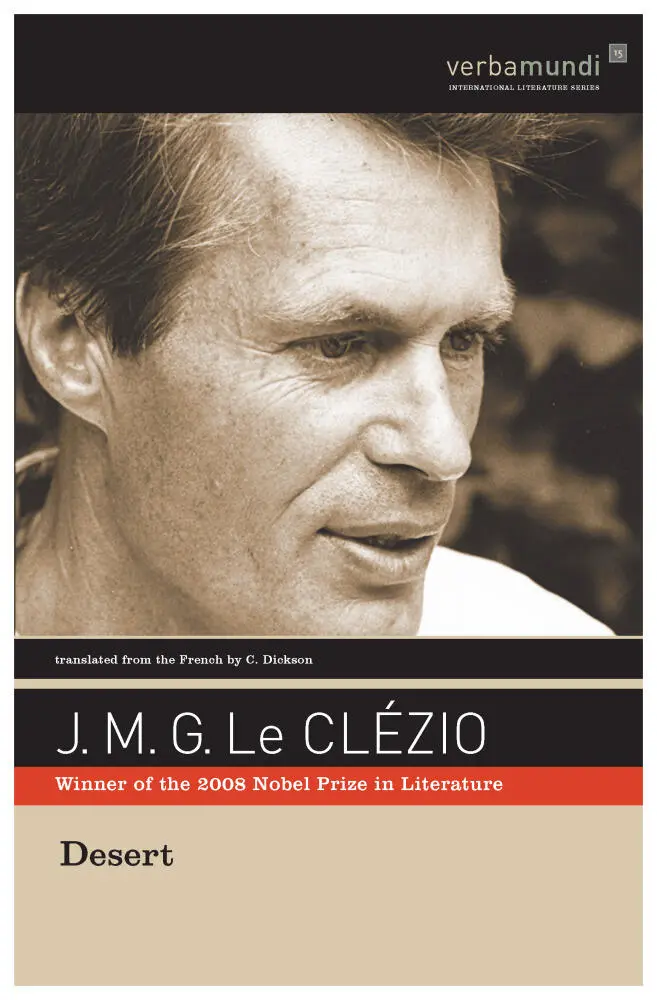
- Название:Desert
- Автор:
- Издательство:Verba Mundi Books
- Жанр:
- Год:2009
- Город:Jaffrey
- ISBN:978-1-56792-386-5
- Рейтинг книги:5 / 5. Голосов: 1
-
Избранное:Добавить в избранное
- Отзывы:
-
Ваша оценка:
Desert: краткое содержание, описание и аннотация
Предлагаем к чтению аннотацию, описание, краткое содержание или предисловие (зависит от того, что написал сам автор книги «Desert»). Если вы не нашли необходимую информацию о книге — напишите в комментариях, мы постараемся отыскать её.
Available for the first time in English translation, Desert is a novel composed of two alternating narratives, set in counterpoint. The first takes place in the desert between 1909 and 1912 and evokes the migration of a young adolescent boy, Nour, and his people, the Blue Men, notorious warriors of the desert. Driven from their lands by French colonial soldiers, Nour's tribe has come to the valley of the Saguiet El Hamra to seek the aid of the great spiritual leader known as Water of the Eyes. The religious chief sends them out from the holy city of Smara into the desert to travel still further. Spurred on by thirst, hunger, and suffering, Nour's tribe and others flee northward in the hopes of finding a land that can harbor them at last.
The second narrative relates the contemporary story of Lalla, a descendant of the Blue Men. Though she is an orphan living in a shantytown known as the Project near a coastal city in Morocco, the blood of her proud, obstinate tribe runs in her veins. All too soon, Lalla must flee to escape a forced marriage with an older, wealthy man. She travels to France, undergoing many trials there, from working as a hotel maid to becoming a highly-paid fashion model, and yet she never betrays the blood of her ancestors.
Desert — читать онлайн бесплатно полную книгу (весь текст) целиком
Ниже представлен текст книги, разбитый по страницам. Система сохранения места последней прочитанной страницы, позволяет с удобством читать онлайн бесплатно книгу «Desert», без необходимости каждый раз заново искать на чём Вы остановились. Поставьте закладку, и сможете в любой момент перейти на страницу, на которой закончили чтение.
Интервал:
Закладка:
Lalla likes to follow the Hartani. She walks behind him along the path he is opening up. It’s not really a path because there aren’t any traces, and yet when the Hartani moves forward you can tell that this is exactly where the passageway is, and nowhere else. Maybe these are paths for goats and foxes, not for people. But the Hartani, he’s just like one of them, he knows things that people don’t, he sees them with his whole body, not only with his eyes.
It’s the same with smells. Sometimes the Hartani walks a very long way out onto the rocky plain toward the east. The sun burns down on Lalla’s shoulders and face, and she has a hard time keeping up with the shepherd. At times like that, he pays no attention to her. He’s looking for something, almost without stopping, bent slightly toward the ground, leaping from rock to rock. Then all of a sudden he stops and puts his face against the earth, lying flat on his stomach as if he were drinking. Lalla draws quietly near when the Hartani lifts himself up a little. His metallic eyes are brimming with joy, as if he had found the most precious thing in the world. Between the stones, in the powdery dirt, there is a green and gray tuft, a very small shrub with scrawny leaves, like so many others out here, but when Lalla brings her own face closer, she smells the scent, very weak at first, then deeper and deeper, the scent of the most beautiful flowers, the smell of mint and of chiba weed, and that of lemons too, the smell of the sea and the wind, of prairies in summer. There is all of that and a lot more, in that dirty, fragile, minuscule plant growing in the shelter of two stones in the middle of the great arid plateau; and the Hartani is the only one who knows it.
He’s the one who shows Lalla all of the lovely smells, because he knows their hiding places. Smells are like stones and animals, they each have their hiding place. But you have to know how to look for them, like dogs, picking up the tiniest scents on the wind, then pouncing without hesitation on the hiding place.
The Hartani showed Lalla how to do it. Before, she didn’t know how. Before, she could pass right by a shrub, or a root, or a honeycomb, without picking up a thing. The air is so full of smells! They’re constantly moving, like breaths, they rise, they fall, encounter one another, mingle, separate. A strange odor of fear hovers over the trail of a hare; a little farther along, the Hartani motions to Lalla to come closer. At first there is nothing on the red earth, but little by little, the young girl detects something acrid, intent; the smell of urine and sweat, then suddenly she recognizes it: it’s the smell of a wild dog, starving, hair bristling, running over the plateau in pursuit of the hare.
Lalla loves spending her days with the Hartani. He shows all of those things to her alone. He’s wary of the others, because they don’t have time to wait, to seek out smells, to see desert birds fly. He’s not afraid of people. It’s rather they who are afraid of him. They say he’s mejnoun, possessed by demons, that he’s a magician, that he has the evil eye. The Hartani, he’s the one who has no father or mother, because he came out of nowhere; he’s the one a desert warrior left near the well one day, without saying a word. He’s the one who has no name. Sometimes Lalla would really like to know who he is; she’d like to ask him, “Where are you from?”
But the Hartani doesn’t understand the language of human beings; he doesn’t answer questions. Aamma’s eldest son says that the Hartani doesn’t know how to speak because he’s deaf. Anyway that’s what the schoolmaster told him one day, it’s called deaf-mute. But Lalla knows very well that isn’t true, because the Hartani hears better than anyone. He knows how to hear sounds so subtle, so faint, that you can’t even hear them by putting your ear to the ground. He can hear a hare jump on the far side of the plateau of stones, or else a man who is coming along the path at the other end of the valley. He can find the place where the cricket sings or the partridge nests in the tall grasses. But the Hartani doesn’t want to hear the language of human beings because he comes from a land where there are no humans, only the sand dunes and the sky.
Sometimes Lalla speaks to the shepherd, for example she says, “Biluuu-la!” slowly, looking deep into his eyes, and a strange glimmer lights up his dark metallic eyes. He places his hand on Lalla’s lips and follows their movement when she says things like that. But he never utters a word himself.
Then after a while, he’s had enough, and he looks away; he goes to sit a little farther off, on another rock. But that’s not very important, because now Lalla knows that words don’t really count. It’s only what you mean to say, deep down inside, like a secret, like a prayer; that’s the only thing that counts. And the Hartani doesn’t speak in any other way; he knows how to give and receive that kind of message. So many things are conveyed through silence. Lalla didn’t know that either before meeting the Hartani. Other people expect only words, or acts, proof, but the Hartani, he looks at Lalla with his handsome metallic eyes, without saying anything, and it is through the light in his eyes that you hear what he’s saying, what he’s asking.
When he’s worried, or on the contrary, when he’s very happy, he stops, he puts his hands on Lalla’s temples, meaning he holds them out on either side of the young girl’s head, without touching her and he stays like that for a long time, his face filled with light. And Lalla can feel the warmth of his palms on her cheeks and temples as if there were a fire warming her. It’s a strange feeling that fills her with happiness too, that creeps deep down inside of her, that releases and calms her. That’s especially why she likes the Hartani, because he has that power in the palms of his hands. Maybe he really is a magician.
She looks at the shepherd’s hands trying to understand. They are long hands with slender fingers, with pearl-colored nails, with thin skin that is brown, almost black on top, and pink, tinged with yellow underneath, like the leaves of those trees that have two colors.
Lalla likes the Hartani’s hands very much. They’re not like the hands of the other men in the Project, and she thinks there aren’t any others like them in all the land. They are nimble and light, full of strength too, and Lalla thinks that they are the hands of a nobleman, the son of a sheik maybe, or maybe even a warrior from the Orient, from Baghdad.
The Hartani knows how to do everything with his hands, not just pick up a stone or break a piece of wood, but make slip-knots with palm fibers, traps for catching birds, or else whistle, make music, imitate the call of the partridge, the hawk, the fox, and imitate the sound of the wind, the storm, the sea. Most of all his hands know how to talk. That’s what Lalla likes best. Sometimes, tucking his feet under his large homespun robe, the Hartani sits down in the sun on a big flat rock to talk. His clothes are very light-colored, almost white, and you can only see his dark face and hands, and that is how he begins to talk.
It isn’t really stories that he tells Lalla. Rather, it’s images that he makes appear in the air, with only his gestures, his lips, with the light in his eyes. Furtive images that appear in flashes, flickering on and off, but never has Lalla heard anything more beautiful, more true. Even the stories that Naman the fisherman tells, even when Aamma talks about al-Azraq, the Blue Man of the desert, and the fountain of clear water that sprang up from under a stone, it’s not that beautiful. The things that the Hartani says with his hands are preposterous, just like he is, but it’s like a dream, because every image that he makes appear comes at a time when you’re least expecting it, and yet it is just what you were expecting. He talks in that way for a long time, making birds with spread feathers appear, rocks clenched like fists, houses, dogs, storms, airplanes, giant flowers, mountains, wind blowing over sleeping faces. None of that means anything, but when Lalla looks at his face, the play of his black hands, she sees these images appear, so lovely and new, bursting with light and life, as if they actually sprang from the palms of his hands, as if they were coming from his lips, along the beam of his eyes.
Читать дальшеИнтервал:
Закладка:
Похожие книги на «Desert»
Представляем Вашему вниманию похожие книги на «Desert» списком для выбора. Мы отобрали схожую по названию и смыслу литературу в надежде предоставить читателям больше вариантов отыскать новые, интересные, ещё непрочитанные произведения.







Обсуждение, отзывы о книге «Desert» и просто собственные мнения читателей. Оставьте ваши комментарии, напишите, что Вы думаете о произведении, его смысле или главных героях. Укажите что конкретно понравилось, а что нет, и почему Вы так считаете.