J.M. le Clézio - Desert
Здесь есть возможность читать онлайн «J.M. le Clézio - Desert» весь текст электронной книги совершенно бесплатно (целиком полную версию без сокращений). В некоторых случаях можно слушать аудио, скачать через торрент в формате fb2 и присутствует краткое содержание. Город: Jaffrey, Год выпуска: 2009, ISBN: 2009, Издательство: Verba Mundi Books, Жанр: Современная проза, на английском языке. Описание произведения, (предисловие) а так же отзывы посетителей доступны на портале библиотеки ЛибКат.
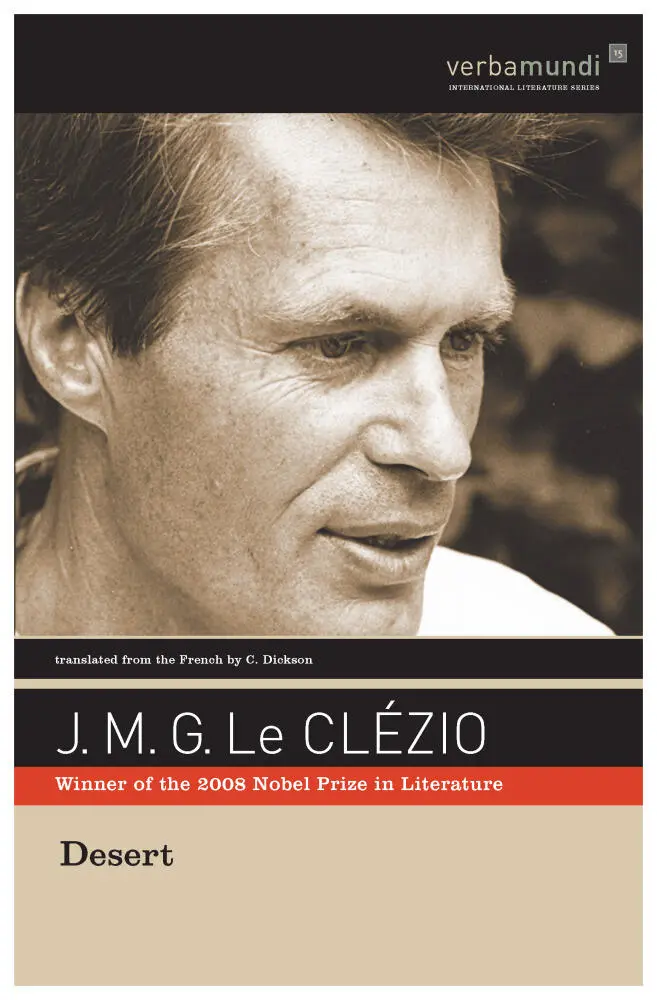
- Название:Desert
- Автор:
- Издательство:Verba Mundi Books
- Жанр:
- Год:2009
- Город:Jaffrey
- ISBN:978-1-56792-386-5
- Рейтинг книги:5 / 5. Голосов: 1
-
Избранное:Добавить в избранное
- Отзывы:
-
Ваша оценка:
Desert: краткое содержание, описание и аннотация
Предлагаем к чтению аннотацию, описание, краткое содержание или предисловие (зависит от того, что написал сам автор книги «Desert»). Если вы не нашли необходимую информацию о книге — напишите в комментариях, мы постараемся отыскать её.
Available for the first time in English translation, Desert is a novel composed of two alternating narratives, set in counterpoint. The first takes place in the desert between 1909 and 1912 and evokes the migration of a young adolescent boy, Nour, and his people, the Blue Men, notorious warriors of the desert. Driven from their lands by French colonial soldiers, Nour's tribe has come to the valley of the Saguiet El Hamra to seek the aid of the great spiritual leader known as Water of the Eyes. The religious chief sends them out from the holy city of Smara into the desert to travel still further. Spurred on by thirst, hunger, and suffering, Nour's tribe and others flee northward in the hopes of finding a land that can harbor them at last.
The second narrative relates the contemporary story of Lalla, a descendant of the Blue Men. Though she is an orphan living in a shantytown known as the Project near a coastal city in Morocco, the blood of her proud, obstinate tribe runs in her veins. All too soon, Lalla must flee to escape a forced marriage with an older, wealthy man. She travels to France, undergoing many trials there, from working as a hotel maid to becoming a highly-paid fashion model, and yet she never betrays the blood of her ancestors.
Desert — читать онлайн бесплатно полную книгу (весь текст) целиком
Ниже представлен текст книги, разбитый по страницам. Система сохранения места последней прочитанной страницы, позволяет с удобством читать онлайн бесплатно книгу «Desert», без необходимости каждый раз заново искать на чём Вы остановились. Поставьте закладку, и сможете в любой момент перейти на страницу, на которой закончили чтение.
Интервал:
Закладка:
Naman builds his fire any old place, wherever he finds large dead branches washed up on the beach, and he stuffs all the holes with dried twigs that he goes to fetch in the flatlands on the other side of the dunes. He also uses dried kelp and dead thistles. That’s when the sun is still high in the sky. Sweat runs down the old man’s forehead and cheeks. The sand burns like fire.
Then he lights the fire with his tinderbox, being very careful to place the flame on the side where there is no wind. Naman is very good at building fires, and Lalla watches his every move closely, to learn. He knows how to find just the right place, neither too exposed, nor too sheltered, in the hollows of the dunes.
The fire starts up and then goes out two or three times, but Naman doesn’t really seem to notice. Every time the flame dies, he roots around in the twigs with his hand, without being afraid of getting burned. That’s the way fire is; it likes people who aren’t afraid of it. So then the flame leaps up again, not very strong at first; you can barely see the tip of it glowing between the branches, then suddenly it blazes up around the whole base of the bonfire, throwing out a bright light and crackling abundantly.
When the fire is going strong, Naman the fisherman sets the tripod up over it and places the pot of pitch on it. Then he sits down in the sand and watches the fire, every once in a while throwing in another twig that the flames devour instantly. Then the children also come to sit down. Having smelled the smoke, they’ve come from afar, running along the beach. They shout, call to one another, burst out laughing, because fire is magic, it makes people want to run and shout and laugh. Right now the flames are very high and bright, they are waving around and crackling, they’re dancing, and you can see all sorts of things in their folds. What Lalla loves most of all is the base of the fire, the very hot brands enveloped in flames, and that incandescent color which has no name and resembles the color of the sun.
She also watches the sparks floating up the column of gray smoke, gleaming bright and then going out, disappearing into the blue sky. At night, the sparks are even more beautiful, like clusters of falling stars.
The sand flies have come out as well, drawn by the odor of burning kelp and hot pitch, irritated by the plumes of smoke. Naman doesn’t pay any attention to them. He’s looking only
at the fire. Every now and again he stands up, dips a stick into the pot of pitch to see if it’s hot enough; then he stirs the thick liquid, blinking his eyes against the whirling smoke. His boat is a few meters away, on the beach, keel pointing skyward, ready for caulking. The sun is descending quickly now, nearing the arid hills on the other side of the dunes. Darkness is spreading. The children are sitting on the beach, huddled close to one another, and their laughter has died down a little. Lalla looks at Naman; she tries to get a glimpse of that clear, water-colored light that shines in his eyes. Naman recognizes her, gives her a friendly little wave, then says immediately, as if it were the most natural thing in the world:
“Did I ever tell you about Balaabilou?”
Lalla shakes her head. She’s happy because it’s the perfect time for a story, just like that, sitting out on the beach, watching the fire that is making the pitch popple in the pot, the very blue sea, feeling the warm wind hustling the smoke along, with the flies and the wasps humming, and not far off, the sound of the waves washing all the way up to the old boat overturned on the sand.
“Ah, so I never told you the story of Balaabilou?”
Old Naman stands up to look at the pitch that is boiling very hard. He turns the stick slowly in the pot and seems to think everything is just right. Then he hands an old pot with a burnt handle to Lalla.
“Okay, you’re going to fill this up with pitch and bring it to me over there when I’m near the boat.”
He doesn’t wait for an answer and goes over to set himself up on the beach beside his boat. He prepares all kinds of paintbrushes made out of bits of rags tied to wooden sticks.
“Come on!”
Lalla fills up the pot. The boiling pitch spatters and stings Lalla’s skin, and the smoke burns her eyes. But she runs, holding the pot full of pitch in her outstretched hands. The children follow her, laughing, and sit down around the boat.
“Balaabilou, Balaabilou…”
Slowly Old Naman chants the name of the nightingale as if he were trying to remember all the details of the story. He dips the sticks into the hot pitch and starts painting the hull of the boat between the seams of the boards, where there are oakum plugs.
“It was a very long time ago,” says Naman. “It happened in a day that neither I, nor my father, nor even my grandfather knew, and yet we remember the story very well. In those days people weren’t the same as they are now, and we knew nothing of the Romans or anything that had to do with other countries. That’s why there were still djinns back then, because no one had chased them away. So back in those days, in a large city in the Orient, there lived a powerful emir whose only child was a daughter named Leila, Night. The emir loved his daughter more than anything in the world, and she was the most beautiful, the most gentle, the most obedient young girl in the kingdom; she was destined to live the happiest of lives in the world…”
Evening is settling slowly in the sky, deepening the blue of the sea and making the froth of the waves seem even whiter. At regular intervals, Old Naman dunks his rag brushes into the pot of pitch and, with a twirling motion, runs them along the grooves filled with oakum. The boiling liquid sinks into the chinks and dribbles onto the sand of the beach. Lalla and all the children watch Naman’s hands.
“Then something terrible happened in the kingdom,” Naman goes on. “There was a great drought, God’s curse over the whole kingdom, and there was no more water in the rivers or in the reservoirs, and everyone was dying of thirst, first the trees and the plants, then the herds of animals, the sheep, the horses, the camels, the birds, and finally the humans, who died of thirst in the fields by the side of the road; it was a dreadful sight to see, and that is why we still remember it…”
The louse flies come out; they alight on the children’s lips, buzz about their ears. They are inebriated by the sharp smell of the pitch and the thick plumes of smoke swirling up between the dunes. There are wasps too, but no one tries to bat them away because when Old Naman tells a story, it’s as if they too become a little magic, sort of like djinns.
“The emir of the kingdom was very sad, and he summoned the wise men to ask their advice, but no one knew what to do to stop the drought. It was then that a stranger appeared, an Egyptian traveler who was well-versed in magic. The emir summoned him as well, and asked him to break the curse upon the kingdom. The Egyptian gazed at an ink spot, and he became suddenly frightened, began to tremble and refused to speak. ‘Speak!’ said the emir. ‘Speak and I will make you the richest man in the kingdom.’ But the stranger refused to speak. ‘My lord,’ he said, ‘allow me to go on my way, don’t ask me to reveal this secret.’”
When Naman stops talking to dip his brushes in the pot, Lalla and the children are almost afraid to breathe. They listen to the fire crackling and the sound of the pitch boiling in the pot.
“Then the emir grew angry and said to the Egyptian, ‘Speak or you are doomed.’ And the executioners seized him and were already unsheathing their sabers to cut off his head. So the stranger cried out, ‘Stop! I will tell you the secret of the curse, but know that you are damned!’”
Читать дальшеИнтервал:
Закладка:
Похожие книги на «Desert»
Представляем Вашему вниманию похожие книги на «Desert» списком для выбора. Мы отобрали схожую по названию и смыслу литературу в надежде предоставить читателям больше вариантов отыскать новые, интересные, ещё непрочитанные произведения.











Обсуждение, отзывы о книге «Desert» и просто собственные мнения читателей. Оставьте ваши комментарии, напишите, что Вы думаете о произведении, его смысле или главных героях. Укажите что конкретно понравилось, а что нет, и почему Вы так считаете.