J.M. le Clézio - Desert
Здесь есть возможность читать онлайн «J.M. le Clézio - Desert» весь текст электронной книги совершенно бесплатно (целиком полную версию без сокращений). В некоторых случаях можно слушать аудио, скачать через торрент в формате fb2 и присутствует краткое содержание. Город: Jaffrey, Год выпуска: 2009, ISBN: 2009, Издательство: Verba Mundi Books, Жанр: Современная проза, на английском языке. Описание произведения, (предисловие) а так же отзывы посетителей доступны на портале библиотеки ЛибКат.
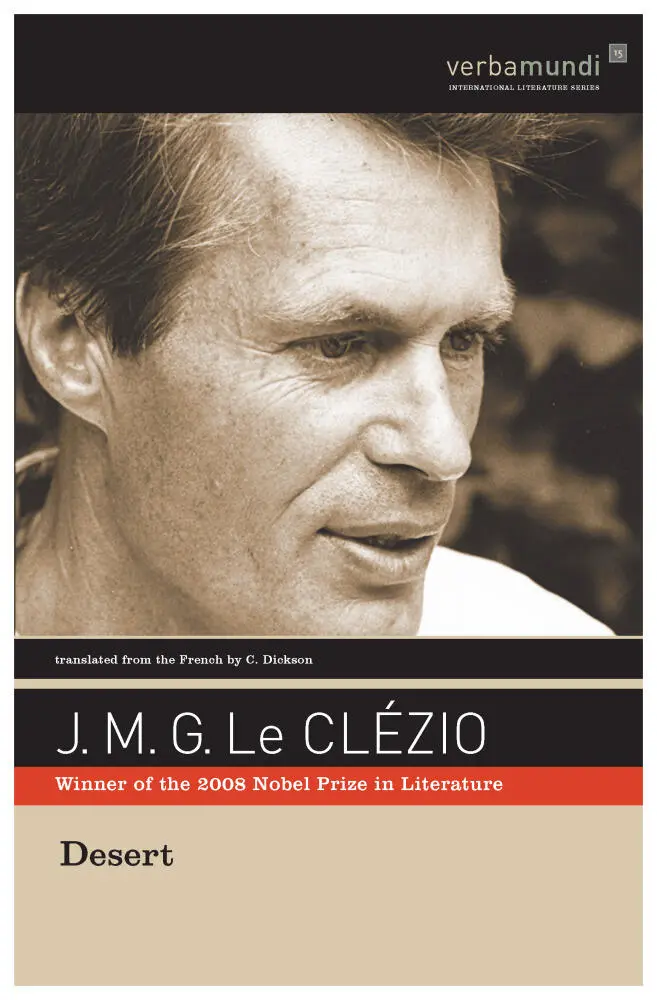
- Название:Desert
- Автор:
- Издательство:Verba Mundi Books
- Жанр:
- Год:2009
- Город:Jaffrey
- ISBN:978-1-56792-386-5
- Рейтинг книги:5 / 5. Голосов: 1
-
Избранное:Добавить в избранное
- Отзывы:
-
Ваша оценка:
Desert: краткое содержание, описание и аннотация
Предлагаем к чтению аннотацию, описание, краткое содержание или предисловие (зависит от того, что написал сам автор книги «Desert»). Если вы не нашли необходимую информацию о книге — напишите в комментариях, мы постараемся отыскать её.
Available for the first time in English translation, Desert is a novel composed of two alternating narratives, set in counterpoint. The first takes place in the desert between 1909 and 1912 and evokes the migration of a young adolescent boy, Nour, and his people, the Blue Men, notorious warriors of the desert. Driven from their lands by French colonial soldiers, Nour's tribe has come to the valley of the Saguiet El Hamra to seek the aid of the great spiritual leader known as Water of the Eyes. The religious chief sends them out from the holy city of Smara into the desert to travel still further. Spurred on by thirst, hunger, and suffering, Nour's tribe and others flee northward in the hopes of finding a land that can harbor them at last.
The second narrative relates the contemporary story of Lalla, a descendant of the Blue Men. Though she is an orphan living in a shantytown known as the Project near a coastal city in Morocco, the blood of her proud, obstinate tribe runs in her veins. All too soon, Lalla must flee to escape a forced marriage with an older, wealthy man. She travels to France, undergoing many trials there, from working as a hotel maid to becoming a highly-paid fashion model, and yet she never betrays the blood of her ancestors.
Desert — читать онлайн бесплатно полную книгу (весь текст) целиком
Ниже представлен текст книги, разбитый по страницам. Система сохранения места последней прочитанной страницы, позволяет с удобством читать онлайн бесплатно книгу «Desert», без необходимости каждый раз заново искать на чём Вы остановились. Поставьте закладку, и сможете в любой момент перейти на страницу, на которой закончили чтение.
Интервал:
Закладка:
She waits a long time for him, sitting in the fine sand of the dune, in the shade of the tall fig tree. She hums a little, holding her arms over her head so she won’t swallow too much sand. She sings the name that she is so fond of, that is long and beautiful, that simply says, “Méditerra-né-é-e…”
She waits, watching the sea that’s beginning to get rough — a grayish-blue, like steel — and a sort of pale mist that masks the line of the horizon. Sometimes she thinks she sees a dark spot dancing amid the reflections between the crests of the waves, and she straightens up a little, because she thinks it’s Naman’s boat coming. But the dark spot disappears. It’s a mirage on the sea, or maybe the back of a dolphin.
Naman was the one who had told her about dolphins. He told her of groups of dark backs leaping joyfully through the waves in front of the boat stems, as if to greet the fishermen, then suddenly they’d be off, disappearing out toward the horizon. Naman likes to tell Lalla stories about dolphins. When he talks, the light of the sea makes his eyes even brighter, and it’s as if Lalla can see the black creatures in the color of his eyes. But as hard as she searches the sea, she never sees any dolphins. They probably don’t like to come too near the coast.
Naman tells the story of a dolphin that led a fisherman’s boat back to the coast one day when he was lost at sea in a storm. Clouds had settled over the sea, covering it like a shroud, and the raging wind had broken the boat’s mast. So the storm had carried the fisherman’s boat far out to sea, so far that he didn’t know where the coast was anymore. The boat drifted for two days through the rough seas that threatened to capsize it at any moment. The fisherman thought he was doomed and was saying his prayers when a large dolphin appeared amidst the waves. It jumped around the boat, playing in the waves as dolphins usually do. But this dolphin was all alone. Then suddenly it started guiding the boat. It was hard to believe, but that’s what the dolphin did: it swam behind the boat and pushed it. Sometimes, the dolphin swam off, disappeared in the waves, and the fisherman thought he’d been abandoned. Then the dolphin came back and started pushing the boat with its head, thrashing the sea with its powerful tail. They continued along in that fashion for one whole day, and at nightfall, during a break in the clouds, the fisherman finally caught sight of the lights on the coast. He shouted and wept with joy because he knew he’d been saved. When the boat neared the harbor, the dolphin turned and swam back toward the open sea, and the fisherman watched it go, the dolphin’s big, black back gleaming in the twilight.
Lalla quite likes that story. She often searches the surface of the sea to find the big black dolphin, but Naman told her that all that happened very long ago, and the dolphin must be very old now.
Lalla is waiting like she does every morning, sitting in the shade of the tall fig tree. She gazes at the gray and blue sea where the pointed crests of the waves bob. The waves break on the beach following a sort of slanted course; first they come rolling in on the eastern side over by the rocky headland, and then from the west, near the river. Last of all they break in the middle. The wind pounces, snatches up piles of foam and flings them out toward the dunes; the foam melts into the sand and dust.
When the sun is very high in the cloudless sky, Lalla goes back to the Project; she doesn’t hurry because she knows she’ll have work waiting for her when she arrives. First she’ll have to go fetch the water at the fountain, carrying an old rusty tin balanced on her head, then wash the clothes in the river, but that — well, that’s rather nice because you can chat with the others and listen to them telling all sorts of incredible stories, especially that girl whose name is Ikikr (which means “chickpea” in Berber) because of the wart on her cheek. But there are two things that Lalla doesn’t like at all: going to gather twigs for the fire and grinding wheat to make flour.
So she goes back very slowly, dragging her feet a little along the path. She doesn’t sing any more then because it’s the time of day when you run into people on the dunes, boys who are going to check the bird traps or men on their way to work. Sometimes the boys make fun of Lalla because she doesn’t know how to walk barefoot very well and because she doesn’t know any curse words. But Lalla can hear them coming from a long way off, and she hides behind a thorn bush near a dune and waits till they’ve passed.
There’s also that scary woman. She’s not old, but she’s very dirty, with tangled black and red hair, clothing torn from the thorns. When she appears on the path in the dunes you have to be very careful because she’s mean and doesn’t like children. People call her Aïsha Kondisha, but that’s not her real name. No one knows her real name. They say that she kidnaps children to hurt them. When Lalla hears Aïsha Kondisha coming along the path, she hides behind a bush and holds her breath. Aïsha Kondisha goes by muttering incomprehensible phrases. She stops a moment, lifts her head because she senses that someone is there. But she’s almost blind and can’t see Lalla. So she strikes out again, hobbling and shouting out insults in her hideous voice.
On certain mornings there is something in the sky that Lalla really loves: it’s a big white cloud, long and stringy, that crosses the sky right in the bluest spot. At the end of the white trail, you can see a little silver cross moving slowly through the sky with its head pointing upward. She loves to watch the cross moving across the huge blue sky, without a sound, leaving behind the long white cloud made of little cottony puffs that blend in with each other and spread out like a road, then the wind brushes over the cloud and washes the sky clean.
Lalla thinks she would love to be up there, in the tiny silver cross, above the sea, above the islands like that, heading out to the most distant of lands. She remains for a long time looking up at the sky after the airplane disappears.
The Project comes into view after a bend in the path when you’re far from the sea and you’ve walked for half an hour in the direction of the river. Lalla doesn’t know why it’s called the Project, because in the beginning there were only about ten plank and tarpaper cabins on the other side of the river and the vacant lots that separate it from the real town. Maybe they called it that to make people forget they were living with dogs and rats in the dust.
This is where Lalla came to live when her mother died, so long ago that she doesn’t remember very well when she came. It was very hot because it was in the summer, and the wind blew clouds of dust up over the plank shacks. She’d walked with her eyes shut behind the form of her aunt until they reached the windowless cabin where her aunt’s sons lived. Then she’d felt like running away, taking off along the road that leads to the high mountains and never coming back.
Every time Lalla comes back from the dunes and sees the roofs of tarpaper and sheet metal, her heart sinks and she remembers the day she came to the Project for the first time. But that was so long ago now, it’s as if everything that had come before didn’t really happen to her, as if it were a story that she’d heard someone tell.
It’s like her birth, in the mountains to the south, where the desert begins. Sometimes in winter, when there’s nothing to do outside and the wind blows hard over the plain of dust and salt, whistling between the poorly fitted planks in Aamma’s house, Lalla sits down on the floor and listens to the story of her birth.
It’s a very long and very strange story, and Aamma doesn’t always tell it the same way. In her slightly singsong voice, her head nodding as if she were going to fall asleep, Aamma says: “When the day you were to be born came, it was just before summer, before the dry season. Hawa could feel you were coming, and since everyone was still asleep, she left the tent silently. She just bound up her belly with a piece of cloth and walked out as best she could until she reached a spot with a tree and a spring, because she knew that when the sun came up she would need shade and water. It’s the custom down there, everyone must always be born near a spring. So she walked there and then she lay down near the tree and waited for the night to end. No one knew that your mother was outside. She could walk without making a sound, without making the dogs bark. Even though I was sleeping right next to her, I hadn’t heard her moan or get up to leave the tent…”
Читать дальшеИнтервал:
Закладка:
Похожие книги на «Desert»
Представляем Вашему вниманию похожие книги на «Desert» списком для выбора. Мы отобрали схожую по названию и смыслу литературу в надежде предоставить читателям больше вариантов отыскать новые, интересные, ещё непрочитанные произведения.











Обсуждение, отзывы о книге «Desert» и просто собственные мнения читателей. Оставьте ваши комментарии, напишите, что Вы думаете о произведении, его смысле или главных героях. Укажите что конкретно понравилось, а что нет, и почему Вы так считаете.