J.M. le Clézio - Desert
Здесь есть возможность читать онлайн «J.M. le Clézio - Desert» весь текст электронной книги совершенно бесплатно (целиком полную версию без сокращений). В некоторых случаях можно слушать аудио, скачать через торрент в формате fb2 и присутствует краткое содержание. Город: Jaffrey, Год выпуска: 2009, ISBN: 2009, Издательство: Verba Mundi Books, Жанр: Современная проза, на английском языке. Описание произведения, (предисловие) а так же отзывы посетителей доступны на портале библиотеки ЛибКат.
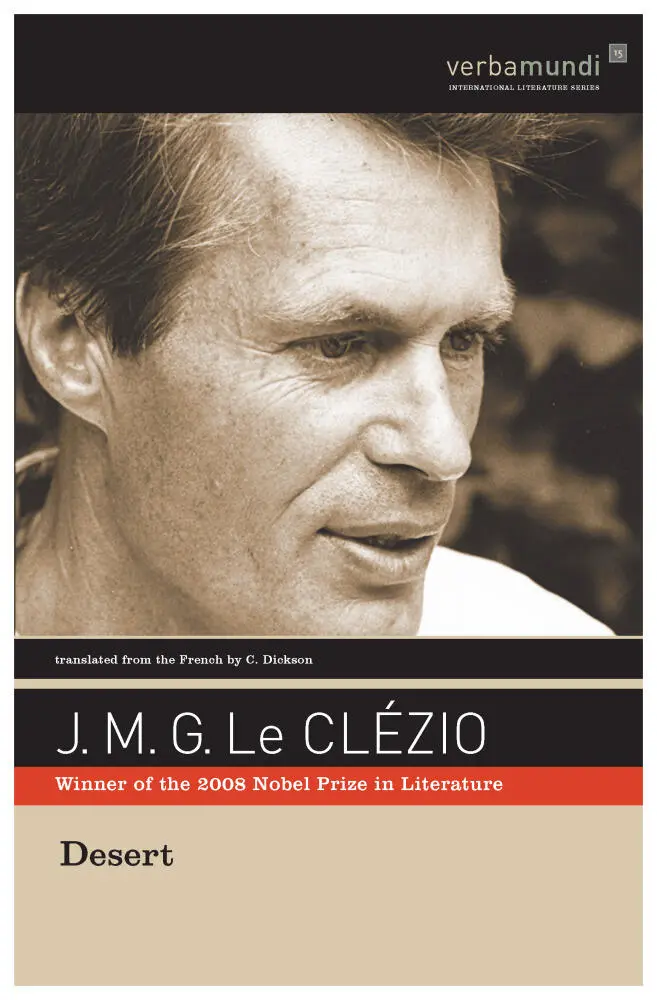
- Название:Desert
- Автор:
- Издательство:Verba Mundi Books
- Жанр:
- Год:2009
- Город:Jaffrey
- ISBN:978-1-56792-386-5
- Рейтинг книги:5 / 5. Голосов: 1
-
Избранное:Добавить в избранное
- Отзывы:
-
Ваша оценка:
Desert: краткое содержание, описание и аннотация
Предлагаем к чтению аннотацию, описание, краткое содержание или предисловие (зависит от того, что написал сам автор книги «Desert»). Если вы не нашли необходимую информацию о книге — напишите в комментариях, мы постараемся отыскать её.
Available for the first time in English translation, Desert is a novel composed of two alternating narratives, set in counterpoint. The first takes place in the desert between 1909 and 1912 and evokes the migration of a young adolescent boy, Nour, and his people, the Blue Men, notorious warriors of the desert. Driven from their lands by French colonial soldiers, Nour's tribe has come to the valley of the Saguiet El Hamra to seek the aid of the great spiritual leader known as Water of the Eyes. The religious chief sends them out from the holy city of Smara into the desert to travel still further. Spurred on by thirst, hunger, and suffering, Nour's tribe and others flee northward in the hopes of finding a land that can harbor them at last.
The second narrative relates the contemporary story of Lalla, a descendant of the Blue Men. Though she is an orphan living in a shantytown known as the Project near a coastal city in Morocco, the blood of her proud, obstinate tribe runs in her veins. All too soon, Lalla must flee to escape a forced marriage with an older, wealthy man. She travels to France, undergoing many trials there, from working as a hotel maid to becoming a highly-paid fashion model, and yet she never betrays the blood of her ancestors.
Desert — читать онлайн бесплатно полную книгу (весь текст) целиком
Ниже представлен текст книги, разбитый по страницам. Система сохранения места последней прочитанной страницы, позволяет с удобством читать онлайн бесплатно книгу «Desert», без необходимости каждый раз заново искать на чём Вы остановились. Поставьте закладку, и сможете в любой момент перейти на страницу, на которой закончили чтение.
Интервал:
Закладка:
Lalla plays with the flies for a long time. These are louse flies that live in the kelp on the beach. But there are also black flies in the Project houses, on the oilcloths, on the cardboard walls, on the windows. The buildings in Les Glacières have big blue flies that fly over the garbage bins making a noise like bomber planes.
Suddenly Lalla stands up. She runs as fast as she can toward the dunes. She climbs up the slope of sand that slips down and shifts under her bare feet. The thistles prick her toes, but she ignores them. She wants to get to the top of the dunes to see the sea, as quickly as possible.
As soon as you’re at the top of the dunes, the wind hits you hard in the face, and Lalla nearly falls over backward. The cold wind from the sea contracts her nostrils and burns her eyes, the sea is immense, blue-gray, dotted with foam, it rumbles quietly as the short waves fall on the flat expanse of sand where the vast, deep blue, almost black sky is mirrored.
Lalla is leaning forward into the wind. Her dress (in truth it is a boy’s calico shirt that her aunt cut the sleeves off of) is clinging to her stomach and thighs, as if she’d just come out of the water. The sound of the wind and the sea is screaming in her ears, first the left, then the right, mixed with the faint sound made by little twists of her hair snapping against her temples. Sometimes the wind picks up a handful of sand and throws it at Lalla’s face. She has to shut her eyes to keep from being blinded. But the wind ends up making her eyes water anyway, and there are grains of sand in her mouth that grit between her teeth.
So when she is good and giddy from the wind and the sea, Lalla goes back down the rampart of dunes. She squats for a minute at the foot of the dune, just long enough to catch her breath. The wind doesn’t reach the other side of the dunes. It goes over them, heads inland, till it reaches the blue hills hung with mist. The wind doesn’t wait. It does what it wants, and Lalla is happy when it’s there, even if it does burn her eyes and ears, even if it does throw handfuls of sand in her face. She thinks of it often, and of the sea too, when she’s in the dark house in the Project, and the air is so heavy and smells so strong; she thinks of the wind that is huge, transparent, that leaps endlessly over the sea, that crosses the desert in an instant, goes all the way to the cedar forests and then dances over there at the foot of the mountains, amidst the birds and flowers. The wind doesn’t wait. It crosses the mountains, sweeping away dust, sand, ashes, it knocks over boxes, sometimes it comes all the way to the town of planks and tarpaper and plays at ripping off a few roofs and walls. But it doesn’t matter. Lalla thinks it’s beautiful, as transparent as water, quick as lightning, and so powerful it could destroy all the cities in the world if it wanted to, even those that have tall white houses with high glass windows.
Lalla knows how to say its name, she learned it all by herself when she was little, and she used to listen to it coming through the planking of the house at night. It’s called whoooooohhh, just like that, with a whistle.
A little farther on, in amongst the shrubs, Lalla meets back up with it. It draws the yellow grasses aside like a hand passing over them.
A hawk hovers almost motionless above the grassy plain, its copper-colored wings spread in the wind. Lalla looks at it, she admires it, because it knows how to fly in the wind. The hawk barely moves the ends of its quill feathers, slightly fans out its tail, and glides effortlessly along with its cross-shaped shadow rippling over the yellow grass. From time to time it pules, saying only, kaiiiik! kaiiiik! and Lalla answers it.
Then it suddenly dives toward the earth, wings drawn in, skims interminably over the grass, like a fish slipping over seaweed swaying on the ocean floor. That’s how it disappears into the distance between the tousled blades of grass. Even though Lalla calls out many times with the plaintive cry, kaiiiik! kaiiiik! the bird doesn’t come back.
But it remains in her eyes for a long time, a shadow in the shape of an arrow skimming over the yellow grass like a stingray, soundlessly, in its tide of fear.
Lalla stands still now, her head thrown back, eyes opened on the white sky, watching the circles swimming there — cutting into one another, like when you throw stones into a water tank. There are no insects or birds or anything of the kind, and yet thousands of specks can be seen moving in the sky, as if there were ant peoples, weevil peoples, and fly peoples up there. They aren’t flying in the white air; they’re walking around in all directions, animated with a feverish haste, as if they didn’t know how to get away. Maybe they are the faces of all the people who live in the cities, cities so big you can never get out, where there are so many cars, so many people, and where you never see the same face twice. Old Naman talks about all that and at the same time he also says strange words, Algeciras, Madrid (he says: Madris), Marseille, Lyon, Paris, Geneva.
Lalla doesn’t always see those faces. It’s only on certain days, when the wind blows and drives the clouds over toward the mountains, and when the air is very white and quivering with sunlight; that’s when you can see them, the people-insects, the ones that move, walk, and run and dance way up there, barely visible, like very young gnats.
Then the sea calls to her again. Lalla runs through the scrub till she reaches the gray dunes. The dunes are like cows lying down, heads low, spines curved. Lalla likes to climb up on their backs, making a path just for herself with her hands and feet and then roll head over heels down the other side to the sandy beach. The ocean unfurls on the hard sand making a loud ripping sound, the water recedes, and the foam melts in the sun. There is so much light and so much noise here that Lalla has to shut her eyes and mouth. The sea salt burns her eyelids and lips, and the gusting wind makes her breath catch in her throat. Yet Lalla loves being by the sea. She enters the water, the waves knock against her legs and her stomach, making the blue shirt cling to her skin. She feels her feet sinking into the sand like two wooden poles. But she doesn’t go any farther out, because every now and again the sea will catch children up — just like that, without paying attention — and then bring them back a couple of days later, leaving them on the hard beach, their bellies and faces swollen with water, their noses, lips, fingertips, and genitals eaten by crabs.
Lalla walks on the sand along the ruff of foam. Her dress — drenched all the way up to her chest — dries in the wind. The wind braids her jet black hair, but only on one side, and her face is the color of copper in the sunlight.
Scattered about on the sand are beached jellyfish with their tendrils spread out around them like tresses. Lalla watches the holes that form in the sand each time a wave recedes. She also runs after the tiny gray crabs, like spiders, with their pincers raised, and it gives her a good laugh. But she doesn’t try to catch them like the other children do; she lets them run off into the sea, disappear in the sparkling foam.
Lalla walks a little farther down the shore, singing that same song that says only one word, “Méditerra-né-é-e…”
Then she goes over to sit down at the foot of the dunes facing the beach, her arms around her knees and her face hidden in the folds of the blue shirt to avoid breathing in the sand that the wind throws at her.
She always goes to sit in the same place, right where a rotten wooden pole sticks out of the water in the hollows of the waves, and a large fig tree grows in the stones amid the dunes. She waits for Naman the fisherman there.
Naman the fisherman isn’t like everyone else. He’s a fairly tall, thin man, with wide shoulders, a bony face, and brick-colored skin. He always walks around barefoot, wearing blue cotton pants and a white shirt that’s too big for him that flares in the wind. But even like that, Lalla thinks he is very handsome and very elegant, and her heart always beats a little faster when she knows he’s going to come. He has a face with distinct features, leathered from the sea breeze; the skin on his forehead and cheeks is very dark and drawn tight from the sun out at sea. He has thick hair, the same color as his skin. But most of all, his eyes are an extraordinary color — a blue-green mixed with gray, very pale and transparent in that dark face, as if they had captured the light and transparency of the sea. It’s in order to see his eyes that Lalla loves to wait for the fisherman on the beach near the tall fig tree and also to see his smile when he catches sight of her.
Читать дальшеИнтервал:
Закладка:
Похожие книги на «Desert»
Представляем Вашему вниманию похожие книги на «Desert» списком для выбора. Мы отобрали схожую по названию и смыслу литературу в надежде предоставить читателям больше вариантов отыскать новые, интересные, ещё непрочитанные произведения.








Обсуждение, отзывы о книге «Desert» и просто собственные мнения читателей. Оставьте ваши комментарии, напишите, что Вы думаете о произведении, его смысле или главных героях. Укажите что конкретно понравилось, а что нет, и почему Вы так считаете.