J.M. le Clézio - Desert
Здесь есть возможность читать онлайн «J.M. le Clézio - Desert» весь текст электронной книги совершенно бесплатно (целиком полную версию без сокращений). В некоторых случаях можно слушать аудио, скачать через торрент в формате fb2 и присутствует краткое содержание. Город: Jaffrey, Год выпуска: 2009, ISBN: 2009, Издательство: Verba Mundi Books, Жанр: Современная проза, на английском языке. Описание произведения, (предисловие) а так же отзывы посетителей доступны на портале библиотеки ЛибКат.
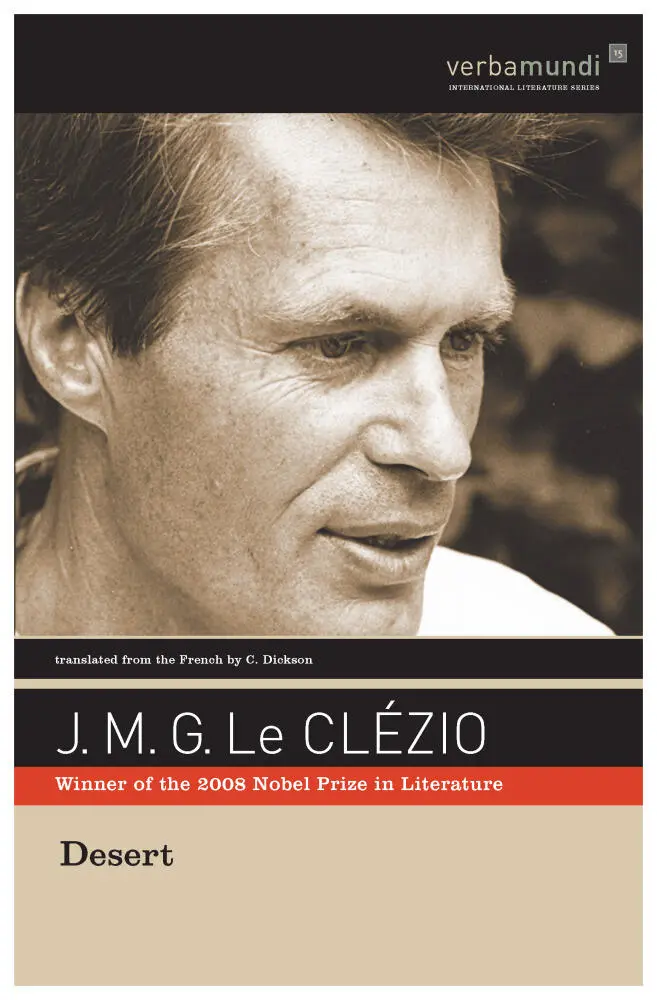
- Название:Desert
- Автор:
- Издательство:Verba Mundi Books
- Жанр:
- Год:2009
- Город:Jaffrey
- ISBN:978-1-56792-386-5
- Рейтинг книги:5 / 5. Голосов: 1
-
Избранное:Добавить в избранное
- Отзывы:
-
Ваша оценка:
Desert: краткое содержание, описание и аннотация
Предлагаем к чтению аннотацию, описание, краткое содержание или предисловие (зависит от того, что написал сам автор книги «Desert»). Если вы не нашли необходимую информацию о книге — напишите в комментариях, мы постараемся отыскать её.
Available for the first time in English translation, Desert is a novel composed of two alternating narratives, set in counterpoint. The first takes place in the desert between 1909 and 1912 and evokes the migration of a young adolescent boy, Nour, and his people, the Blue Men, notorious warriors of the desert. Driven from their lands by French colonial soldiers, Nour's tribe has come to the valley of the Saguiet El Hamra to seek the aid of the great spiritual leader known as Water of the Eyes. The religious chief sends them out from the holy city of Smara into the desert to travel still further. Spurred on by thirst, hunger, and suffering, Nour's tribe and others flee northward in the hopes of finding a land that can harbor them at last.
The second narrative relates the contemporary story of Lalla, a descendant of the Blue Men. Though she is an orphan living in a shantytown known as the Project near a coastal city in Morocco, the blood of her proud, obstinate tribe runs in her veins. All too soon, Lalla must flee to escape a forced marriage with an older, wealthy man. She travels to France, undergoing many trials there, from working as a hotel maid to becoming a highly-paid fashion model, and yet she never betrays the blood of her ancestors.
Desert — читать онлайн бесплатно полную книгу (весь текст) целиком
Ниже представлен текст книги, разбитый по страницам. Система сохранения места последней прочитанной страницы, позволяет с удобством читать онлайн бесплатно книгу «Desert», без необходимости каждый раз заново искать на чём Вы остановились. Поставьте закладку, и сможете в любой момент перейти на страницу, на которой закончили чтение.
Интервал:
Закладка:
The din of the crowd rose, and the names being called out were echoing off the walls of the houses, were being indelibly inscribed in memory, in the cold bare earth and in the star-filled sky.
“May the great blessing of the Lord, Messenger of God, be bestowed upon us, O God, and that of the Messenger Ilias, the blessing of al-Khadir, who drank at the very source of life, O God, and the blessing of Ouways Qarni, O God, and that of the Great Abd al-Qâdir al-Jilani, the saint of Baghdad, the Messenger of God on earth, O God…”
The names burst forth in the silence of the night, over the music that murmured and swayed as imperceptibly as a soft breath. “All of the people of the earth, and the people of the sea, O God, the people of the North, the people of the South, O God, the people of the East, the people of the West, O God, the people of the sky, the people of the earth, O God…”
The words of remembrance were more and more beautiful, words that came from the farthest corners of the desert and had at last found their way back into the hearts of each man, each woman, like an old dream starting over again.
“Bestow upon us, O God, the great blessing of the lords Abou Yaza, Yalannour, Abou Madian, Maarouf, al-Jounaïd, al-Hallaj, al-Chibli, the great holy lords of the city of Baghdad…”
The light of the moon appeared slowly above the rocky hills to the east of the Saguiet, and Nour watched it, swaying his body, keeping his eyes rooted deep in the black sky. In the center of the square, Sheik Ma al-Aïnine was still bowed forward, very white, almost ghostlike. Only his thin fingers were moving, flicking his ebony beads.
“Bestow upon us, O God, the blessing of the lords, al-Halwi, he who danced for the children, Ibn Haouari, Tsaouri, Younous ibn Obaïd, Basri, Abou Yazrd, Mohammed al-Saghir al-Souhaïli whose teachings revealed the words of the great God, Abdesselaam, Ghazâli, Abou Chouhaïb, Abou Mahdi, Malik, Abou Mohammed Abdelazziz al-Thobba, the saint of the city of Marrakech, O God!”
The names were the exaltation of remembrance itself, as if they were the eyes of the constellations, and from their far-away gaze, great strength descended, there, upon the freezing square where the people were gathered.
“God, O God, bestow upon us the blessing of all the lords, the companions, the followers, the army of your victory, Abou Ibrahim Tounsi, Sidi bel Abbas Sebti, Sidi Ahmed al-Haritsi, Sidi Jakir, Abou Zakri Yahia al-Nawâni, Sidi Mohammed ben Issa, Sidi Ahmed al-Rifaï, Mohammed bel Sliman al-Jazoûli, the great lord, God’s messenger on this earth, the saint of the city of Marrakech, O God!”
The names came and went from mouth to mouth, the names of stars, the names of grains of sand in the desert wind, the names of the endless days and nights, beyond death.
“God, O God, bestow upon us the blessing of all the lords of the earth, those who have known the secret, those who have known life and forgiveness, the true lords of the earth, the sea, and the sky, Sidi Abderrhaman, he who was known as Sahabi, the prophet’s companion, Sidi Abdelqâdir, Sidi Embarek, Sidi Belkheir who drew milk from a he-goat, Lalla Mansoura, Lalla Fatima, Sidi Ahmed al-Haroussi, who repaired a broken jug, Sidi Mohammed, he who was known as al-Azraq, the Blue Man, who showed the great Sheik Ma al-Aïnine the path, Sidi Mohammed al-Sheikh al-Kaamel, the perfect one, and all the lords of the earth, the sea, and the sky…”
Silence fell once again, filled with ecstasy and glimmers of light. From time to time the pipe music would start up again, slip along, then cease. The men and women stood up and walked toward the gates of the city. Left alone, Ma al-Aïnine did not move, bowing over the earth, staring at the same invisible spot on the ground lit with white moonlight.
When the dance began, Nour stood up and joined the crowd. The men were stamping the hard ground under their bare feet, without moving forward or backward, closed into a tight crescent that reached across the square. God’s name was exhaled forcefully, as if all the men were suffering and wrenching their insides at the same time. The earthen drum punctuated each cry — “Houwa! Him!” — and the women cried out and made their voices quaver.
It was music that seeped into the cold earth, that rose into the deepest reaches of the dark sky, that mingled with the halo of the moon. There was no more time then, no more suffering. The men and women were striking the ground with the tips of their toes and with their heels, repeating the invincible cry:
“Houwa! Him!… Hayy!… Living!”
Their heads turned to the right, to the left, right, left, and the music inside their bodies came up through their throats and leapt out to the farthest reaches of the horizon. The hoarse, jerky breaths carried them along on the night as if in flight, lifting them up over the immense desert, toward the light patches of dawn on the other side of the mountains, to the land of the Souss, to Tiznit, toward the plain of Fez.
“Houwa! Him!… God!” shouted the deep voices of the men, drunk with the dull sound of the earthen drums and the strains of reed flutes, as the squatting women rocked their torsos and slapped their heavy silver and bronze necklaces with the palms of their hands. Their voices trembled at times like those of the flutes, on the very threshold of human perception, then suddenly stopped. Then the men took up their thudding again and the harsh sound of their heavy breathing echoed in the square: “Houwa! Him!… Hayy!… Living!… Houwa! Hayy! Houwa! Hayy!” Eyes half closed, head thrown backward. It was a sound that went beyond natural forces, a sound that split open reality and was soothing at the same time, the coming and going of a giant saw devouring the trunk of a tree. Each painful and deep exhalation widened the wound in the sky, the wound that tied the men to open space, that mingled their blood and their lymph. Each singer called out the name of God, faster and faster, head craned upward like that of a bellowing ox, the arteries of the neck like ropes under the strain. The light from the braziers and the white glow of the moon struck their swaying bodies as if lightning were flashing repeatedly through the clouds of dust. Breaths were panting faster and faster, letting out almost mute cries, lips unmoving, mouths half opened, and in the square, in the barren desert night, nothing could be heard now save the forgelike sound of labored breathing in the men’s throats:
“Hh! Hh! Hh! Hh!”
Now there were no more words. It was like that, linked directly to the center of the sky and the earth, united by the heavy wind of the men’s breath, as if, when accelerated, the rhythm of their breath abolished the days and nights, the months, the seasons, even abolished the hopelessness of space, and brought the end of all journeys, the end of all time, closer. The suffering was intense, and the drunkenness from their breathing made their limbs tingle, their throats open wider. In the center of the half-circle of men, the women danced with only their bare feet, not moving their bodies, their arms — held slightly out from their bodies — shaking almost imperceptibly. The dull beat of their heels penetrated the earth, making an unbroken rumble like that of an army passing. Near the musicians, the warriors from the south, faces veiled with black, were leaping up and down in the air raising their knees up very high, like great birds attempting to take flight. Then, little by little, as night went on, they stopped moving. One after the other the men and the women squatted down on the ground, arms outstretched before them, palms turned skyward; only their hoarse whispers echoed in the silence, endlessly repeating the same syllables:
“Hh! Hh! Houwa! Hayy!… Hh! Hh!”
The wrenching sound of breathing was so great, so powerful that it was as if they had all already traveled very far from Smara, through the sky, on the wind, mingling with the moonlight and the fine desert dust. There was no such thing as silence, or solitude. The sound of breathing had filled the entire night, covered all of space.
Читать дальшеИнтервал:
Закладка:
Похожие книги на «Desert»
Представляем Вашему вниманию похожие книги на «Desert» списком для выбора. Мы отобрали схожую по названию и смыслу литературу в надежде предоставить читателям больше вариантов отыскать новые, интересные, ещё непрочитанные произведения.











Обсуждение, отзывы о книге «Desert» и просто собственные мнения читателей. Оставьте ваши комментарии, напишите, что Вы думаете о произведении, его смысле или главных героях. Укажите что конкретно понравилось, а что нет, и почему Вы так считаете.