J.M. le Clézio - Desert
Здесь есть возможность читать онлайн «J.M. le Clézio - Desert» весь текст электронной книги совершенно бесплатно (целиком полную версию без сокращений). В некоторых случаях можно слушать аудио, скачать через торрент в формате fb2 и присутствует краткое содержание. Город: Jaffrey, Год выпуска: 2009, ISBN: 2009, Издательство: Verba Mundi Books, Жанр: Современная проза, на английском языке. Описание произведения, (предисловие) а так же отзывы посетителей доступны на портале библиотеки ЛибКат.
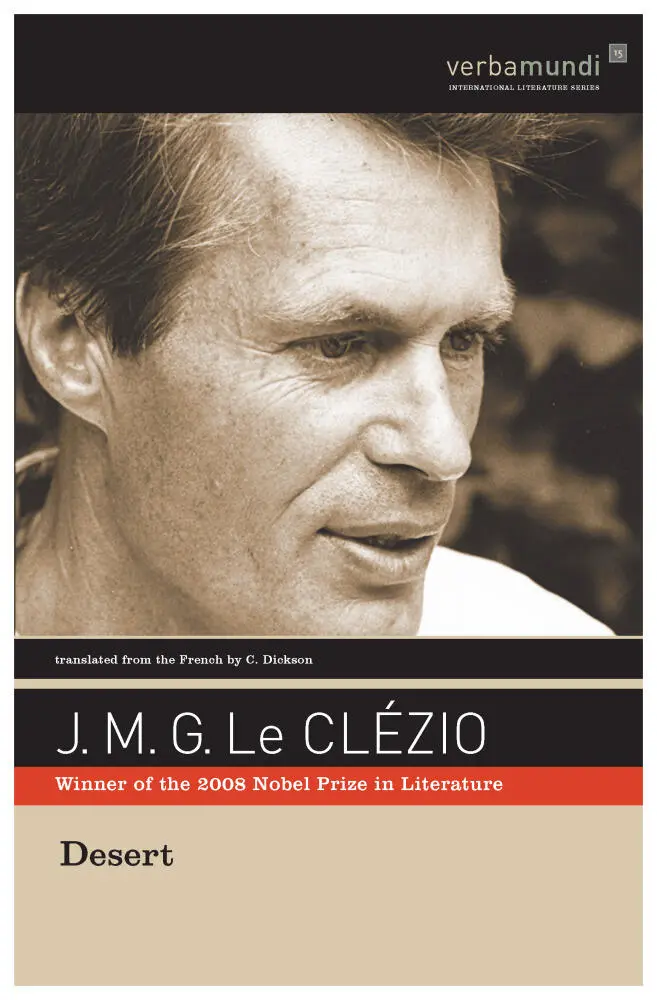
- Название:Desert
- Автор:
- Издательство:Verba Mundi Books
- Жанр:
- Год:2009
- Город:Jaffrey
- ISBN:978-1-56792-386-5
- Рейтинг книги:5 / 5. Голосов: 1
-
Избранное:Добавить в избранное
- Отзывы:
-
Ваша оценка:
Desert: краткое содержание, описание и аннотация
Предлагаем к чтению аннотацию, описание, краткое содержание или предисловие (зависит от того, что написал сам автор книги «Desert»). Если вы не нашли необходимую информацию о книге — напишите в комментариях, мы постараемся отыскать её.
Available for the first time in English translation, Desert is a novel composed of two alternating narratives, set in counterpoint. The first takes place in the desert between 1909 and 1912 and evokes the migration of a young adolescent boy, Nour, and his people, the Blue Men, notorious warriors of the desert. Driven from their lands by French colonial soldiers, Nour's tribe has come to the valley of the Saguiet El Hamra to seek the aid of the great spiritual leader known as Water of the Eyes. The religious chief sends them out from the holy city of Smara into the desert to travel still further. Spurred on by thirst, hunger, and suffering, Nour's tribe and others flee northward in the hopes of finding a land that can harbor them at last.
The second narrative relates the contemporary story of Lalla, a descendant of the Blue Men. Though she is an orphan living in a shantytown known as the Project near a coastal city in Morocco, the blood of her proud, obstinate tribe runs in her veins. All too soon, Lalla must flee to escape a forced marriage with an older, wealthy man. She travels to France, undergoing many trials there, from working as a hotel maid to becoming a highly-paid fashion model, and yet she never betrays the blood of her ancestors.
Desert — читать онлайн бесплатно полную книгу (весь текст) целиком
Ниже представлен текст книги, разбитый по страницам. Система сохранения места последней прочитанной страницы, позволяет с удобством читать онлайн бесплатно книгу «Desert», без необходимости каждый раз заново искать на чём Вы остановились. Поставьте закладку, и сможете в любой момент перейти на страницу, на которой закончили чтение.
Интервал:
Закладка:
Then she walked and ran all the way to the fisherman’s house. She thought there would be people with him, helping him, caring for him, but Naman is all alone, lying on his straw mat, his head resting on his arm. He is shivering so hard that his teeth are chattering, and he can’t even raise himself up on his elbows when Lalla comes into the house. He smiles a little, and his eyes shine brighter when he recognizes Lalla. His eyes are still the color of the sea, but his thin face has turned a white, slightly gray color that is frightening.
She sits down next to him and talks to him, almost in hushed tones. Usually he’s the one who tells stories, and she listens, but today all that has changed. Lalla just talks to him about any old thing, to soothe her anxiety and impart a little human warmth to the old man. She talks to him about things that he used to tell her of in the past, things about his trips to the cities in Spain and France. She talks about it all as if she’d been the one who had seen those cities, who had taken those long journeys. She talks to him about the streets of Algeciras, narrow winding streets near the port, where you can smell the sea wind and the odor of fish, and the train station with blue tiled platforms, and the big railroad trestles straddling ravines and rivers. She talks to him about the streets of Cádiz, gardens with multicolored flowers, tall palm trees lined up in front of white palaces, and about all of those streets with crowds, with black automobiles, buses, coming and going amid mirrored reflections, past buildings as tall as marble cliffs. She talks about the streets of all the cities, as if she had walked through them, Sevilla, Córdoba, Granada, Almadén, Toledo, Aranjuez, and about the city that is so big, you could get lost for days on end — Madris, where people come from all corners of the earth.
Old Naman listens to Lalla without saying anything, without moving, but his clear eyes shine brightly, and Lalla knows he loves hearing those stories. When she stops talking, she can hear the old man’s body trembling and his breath wheezing: so she quickly resumes to avoid hearing those terrible sounds.
Now she’s talking about the big city of Marseille in France, about the port with immense wharves where boats from all the countries in the world are docked, freighters as big as citadels with incredibly high forecastles and masts thicker than trees, very white ocean liners with thousands of windows that have strange names, mysterious flags, names of cities, Odessa, Riga, Bergen, Limassol. In the streets of Marseille, the crowd hurries along, endlessly going in and out of giant stores, jostling in front of the cafés, restaurants, movie theaters, and the black automobiles drive down the avenues leading who knows where, and trains fly over the roofs on suspended bridges, and airplanes take off and circle slowly in the gray sky above the buildings and the vacant lots. At noon, the church bells ring, and the sound reverberates through the streets, over the esplanades, deep down in the underground tunnels. At night, the city is lit up, lighthouses sweep the sea with their long pencils, automobile headlights glitter. The narrow streets are silent, and thieves armed with jackknives hide in doorways waiting for late-night stragglers. Sometimes there are terrible battles in vacant lots, or on the wharves in the shadows of the sleeping freighters.
Lalla talks for such a long time and her voice is so soft that Old Naman falls asleep. When he is asleep, his body stops trembling, and his breathing becomes more regular. Then Lalla can leave the fisherman’s house at last, her eyes stinging from the light outside.
Many people are suffering from the wind of ill fortune, poor people, infants. When she passes by their houses, Lalla can hear their laments, the moaning voices of women, children crying, and she knows that there too, perhaps, someone will die. She is sad; she wishes she were far away, across the sea, in those cities she invented for Old Naman.
But the man with the gray-green suit has come back. He probably doesn’t know that the wind of ill fortune is blowing on the plank and tarpaper Project; in any case he wouldn’t really care, because the wind of ill fortune doesn’t affect people like him. He’s a stranger to ill fortune, to all of this.
He’s come back to Aamma’s house, and he passes Lalla in front of the door. When she sees him, it startles her and she lets out a little shriek, because she knew he would come back and felt apprehensive about it. The man in the gray-green suit gives her a funny look. He has a hard steady gaze, like people who are used to giving orders, and the skin on his face is white and dry with the blue shadow of a beard on his cheeks and chin. He’s carrying other bags containing gifts. Lalla steps aside when he passes her and looks at the packages. He mistakes her glance and takes a step toward her, holding out the gifts. But Lalla leaps back as fast as she can; she runs away without turning back until she can feel the sand of the path that leads up to the plateau of stones under her feet.
She doesn’t know where the path ends. Eyes blurred with tears, a knot in her throat, Lalla is walking as fast as she can. Up here the sun is always hotter, as if you were closer to the sky. But the heavy wind is not blowing on the brick- and chalk-colored hills. The stones are hard, broken and sharp-edged, jagged; the black shrubs are covered with thorns upon which, here and there, tufts of sheep’s wool have snagged; even the blades of grass are sharp as knives. Lalla walks for a long time through the hills. Some are high and steep, with cliffs like sheer walls; others are low, hardly more than a pile of stones, and you’d think they’d been made by children.
Every time Lalla enters this land, she feels as if she no longer belongs to the same world, as if time and space had expanded, as if the ardent light of the sky had penetrated her lungs and dilated them, and her whole body had taken on the proportions of a giant who would live for a very long time, very slowly.
Taking her time now, Lalla follows the bed of a dry torrent up toward the vast plateau of stones, where the one she calls al-Ser dwells.
She doesn’t really know why she’s heading in that direction; it’s sort of as if there were two Lallas, one who didn’t know, blinded with anxiety and anger, fleeing the wind of ill fortune, and the other who did know and was making her legs walk in the direction of al-Ser’s dwelling place. So she’s climbing up to the plateau of stones, her mind blank, not understanding. Her bare feet find the ancient traces that the wind and the sun weren’t able to erase.
She is slowly climbing up toward the plateau of stones. The sun is burning her face and shoulders, burning her hands and legs. But she can barely feel it. It’s the light that is liberating, that erases memories, that makes you as pure as a white stone. The light cleanses the wind of ill fortune, burns away sickness, evil spells.
Lalla is moving forward, eyes almost closed against the reverberating light, and sweat is making her dress stick to her abdomen, to her chest, to her back. Never, perhaps, has there been so much light on earth, and never has Lalla so thirsted after it, as if she had come from a dark valley in which death and shadows prevailed. The air up here is still, it is hovering, it flickers and pulsates, and you think you can hear the sound of light waves, the strange music that resembles the song of bees.
When she reaches the vast, deserted plateau, the wind blows against her again, making her stagger. It is a cold, hard, unrelenting wind that pushes against her and makes her shiver in her damp, sweaty clothing. The light is blinding; it explodes in the wind, glinting in starbursts off the peaks of the rocks. Up here, there is no grass, no trees, no water, only light and wind for centuries on end. There are no paths, no human traces. Lalla is moving forward aimlessly, in the middle of the plateau, where only scorpions and scolopendras live. It is a place where no one comes, not even the desert shepherds, and when one of their animals strays up here, they jump up and down, whistling and throwing stones to make it come running back.
Читать дальшеИнтервал:
Закладка:
Похожие книги на «Desert»
Представляем Вашему вниманию похожие книги на «Desert» списком для выбора. Мы отобрали схожую по названию и смыслу литературу в надежде предоставить читателям больше вариантов отыскать новые, интересные, ещё непрочитанные произведения.











Обсуждение, отзывы о книге «Desert» и просто собственные мнения читателей. Оставьте ваши комментарии, напишите, что Вы думаете о произведении, его смысле или главных героях. Укажите что конкретно понравилось, а что нет, и почему Вы так считаете.