J.M. le Clézio - Desert
Здесь есть возможность читать онлайн «J.M. le Clézio - Desert» весь текст электронной книги совершенно бесплатно (целиком полную версию без сокращений). В некоторых случаях можно слушать аудио, скачать через торрент в формате fb2 и присутствует краткое содержание. Город: Jaffrey, Год выпуска: 2009, ISBN: 2009, Издательство: Verba Mundi Books, Жанр: Современная проза, на английском языке. Описание произведения, (предисловие) а так же отзывы посетителей доступны на портале библиотеки ЛибКат.
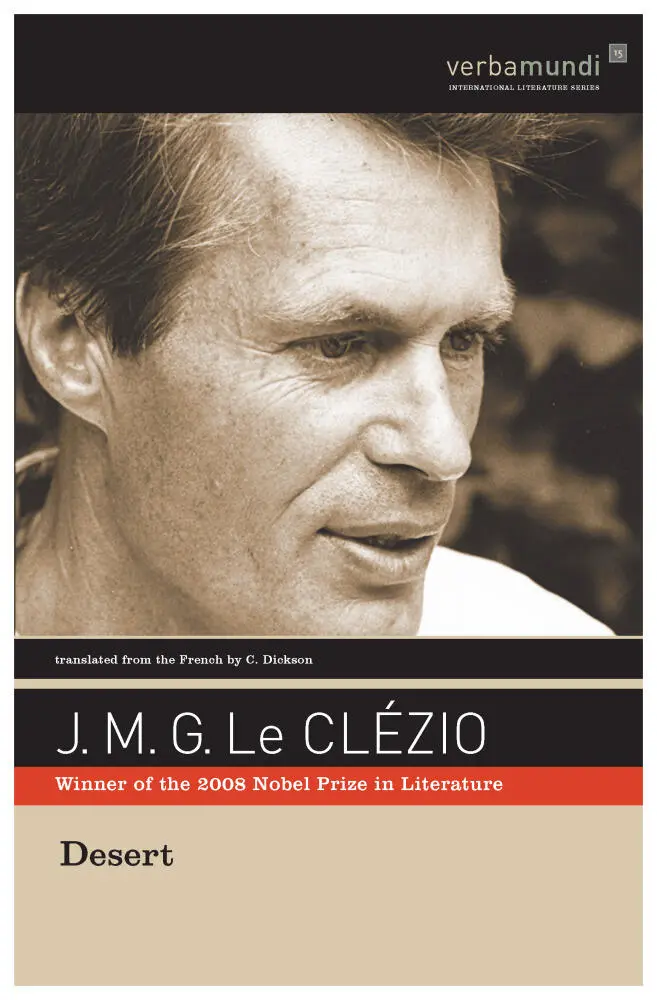
- Название:Desert
- Автор:
- Издательство:Verba Mundi Books
- Жанр:
- Год:2009
- Город:Jaffrey
- ISBN:978-1-56792-386-5
- Рейтинг книги:5 / 5. Голосов: 1
-
Избранное:Добавить в избранное
- Отзывы:
-
Ваша оценка:
Desert: краткое содержание, описание и аннотация
Предлагаем к чтению аннотацию, описание, краткое содержание или предисловие (зависит от того, что написал сам автор книги «Desert»). Если вы не нашли необходимую информацию о книге — напишите в комментариях, мы постараемся отыскать её.
Available for the first time in English translation, Desert is a novel composed of two alternating narratives, set in counterpoint. The first takes place in the desert between 1909 and 1912 and evokes the migration of a young adolescent boy, Nour, and his people, the Blue Men, notorious warriors of the desert. Driven from their lands by French colonial soldiers, Nour's tribe has come to the valley of the Saguiet El Hamra to seek the aid of the great spiritual leader known as Water of the Eyes. The religious chief sends them out from the holy city of Smara into the desert to travel still further. Spurred on by thirst, hunger, and suffering, Nour's tribe and others flee northward in the hopes of finding a land that can harbor them at last.
The second narrative relates the contemporary story of Lalla, a descendant of the Blue Men. Though she is an orphan living in a shantytown known as the Project near a coastal city in Morocco, the blood of her proud, obstinate tribe runs in her veins. All too soon, Lalla must flee to escape a forced marriage with an older, wealthy man. She travels to France, undergoing many trials there, from working as a hotel maid to becoming a highly-paid fashion model, and yet she never betrays the blood of her ancestors.
Desert — читать онлайн бесплатно полную книгу (весь текст) целиком
Ниже представлен текст книги, разбитый по страницам. Система сохранения места последней прочитанной страницы, позволяет с удобством читать онлайн бесплатно книгу «Desert», без необходимости каждый раз заново искать на чём Вы остановились. Поставьте закладку, и сможете в любой момент перейти на страницу, на которой закончили чтение.
Интервал:
Закладка:
Behind them came the children and the shepherds, pursuing the herds of goats and sheep, throwing stones to drive them onward. The swirls of dust enveloped them like a red fog, and Nour watched the strange, disheveled shapes that seemed to be dancing in the dust. The women walked alongside the pack camels, some were carrying babies in their cloaks, slowly making their way barefoot over the scorching earth. Nour could hear the clear tinkling of their gold and copper necklaces, the bangles on their ankles. They walked along humming a sad interminable song that came and went like the sound of the wind.
But at the very end came those who could not go on, the aged, the infants, the wounded, young women whose men were dead and who no longer had anyone to help them find food or water. There were many of them, scattered along the trail in the valley of the Saguiet, and they kept coming for hours after the soldiers of the sheik had passed. They were the ones Nour looked upon with special compassion.
Standing by the side of the trail, he saw them walking slowly past, hardly lifting their legs, heavy with weariness. They had emaciated gray faces, eyes shiny with fever. Their lips were bleeding; their hands and chests were marked with wounds where the clotted blood had mixed with golden particles of dust. The sun beat down on them as it did on the red stones of the path, and they received a real beating. The women had no shoes, and their bare feet were burned from the sand and eaten away with the salt. But the most painful thing about them, the most disquieting thing that made pity rise in Nour’s breast, was their silence. Not one of them spoke or sang. No one cried or moaned. All of them, men, women, children with bleeding feet, plodded noiselessly forward, like a defeated people, not uttering a word. All that could be heard was the sound of their footsteps in the sand and the shallow panting of their breaths. Then they moved slowly away, bundles rocking on their backs, like strange insects after a storm.
Nour remained standing by the side of the trail, his bundle resting at his feet. From time to time, when an old woman or a wounded soldier walked in his direction, he tried to talk to them, drew near them saying, “Hello, hello, you aren’t too terribly tired, are you? Would you like me to help you with your load?”
But they remained silent, they didn’t even look at him, and their faces were as hard as the stones in the valley, closed tight against the pain and the light.
A group of men from the desert came, warriors from Chinguetti. Their ample sky-blue cloaks were in shreds. They had bound up their legs and feet with bloodstained rags. They were carrying nothing, not even a bag of rice, not even a flask of water. They had nothing left but their rifles and their spears and they struggled along, like the old people and children.
One of them was blind, and he was holding on to the group by a flap of cloak, staggering over the rocks in the path, tripping against the roots of shrubs.
When he passed near Nour and heard the voice of the young boy greeting them, he stopped and let go of his companion’s cloak.
“Have we arrived?” he asked.
The others kept on walking without even looking back. The desert warrior’s face was still young, but wasted with fatigue, and a dirty piece of cloth was tied across his burned eyes.
Nour gave him a little of his water to drink, put his load back on his shoulders, and placed the warrior’s hand on his cloak.
“Come, I’ll be your guide now.”
They struck out walking on the path again, toward the end of the valley, pursuing the huge cloud of red dust.
The man did not speak. His hand was gripping Nour’s shoulder so tightly it was painful. In the evening, when they stopped at the Yorf well, the boy was exhausted. They had now reached the foot of the red cliffs, where the mesas of the Haua and the valley leading northward began.
All the caravans had come together there: Larhdaf’s, Saadbou’s and the great sheik’s, with his blue men. In the dusk light, Nour watched the thousands of men sitting on the dried earth around the dark stain of the well. The red dust was settling gradually, and the smoke of the braziers was already rising into the sky.
When Nour had rested, he picked up his bundle but didn’t knot it around his chest. He took the blind warrior’s hand, and they walked over to the well.
Everyone had already drunk, the men and women on the east side of the well, the animals on the west side. The water was murky, mixed with the red mud of the banks. Yet never had it seemed more beautiful to the people. The cloudless sky shone upon its black surface as if upon polished metal.
Nour leaned toward the water and drank deeply without catching his breath. Kneeling at the edge of the well, the blind warrior also drank, avidly, almost without even using his cupped hand. When he had had his fill, he sat down at the edge of the well, his face dark and his beard dripping with water.
Then they walked back, over near the animals. The sheik had given the order for everyone to stay clear of the well, so as not to trouble the water.
Night was falling quickly near the Hamada. Darkness crept into the bottom of the valley, leaving only the sharp peaks of red stone in the flaming sun.
Nour looked for his mother and father for a minute, without seeing them. Maybe they had already left for the first part of the northern trail with Larhdaf’s soldiers. Nour chose a place for the night, near the livestock. He set his bundle down and shared a piece of millet bread and some dates with the blind warrior. The man ate quickly and stretched out afterward on the ground with his hands under his head. Then Nour spoke to him, to ask him who he was. The man began slowly, with his voice slightly hoarse from having remained silent, telling about everything that had happened back there, far away in Chinguetti, near the great salt lake of Chinchan, the soldiers of the Christians who had attacked the caravans, burned the villages, who had taken the children away to camps. When the soldiers of the Christians had come from the west, from the shores of the sea, or else from the south, warriors clad in white, mounted on camels, and black men from Niger, the desert peoples had had to flee northward. During one of the battles, he had been wounded with a rifle and had lost his sight. So his companions had brought him northward, to the holy city of Smara, because they said the great sheik knew how to heal wounds caused by the Christians, that he had the power of restoring sight. While he was talking, tears ran from his closed eyelids, because now he was thinking of everything he had lost.
“Do you know where we are now?” He was always asking that of Nour, as if he were afraid of being abandoned there, in the middle of the desert.
“Do you know where we are? Are we still a long way from the place where we’ll be able to stop for good?”
“No,” Nour would say, “we’ll soon reach the lands the sheik promised, the lands of plenty, where it will be like the kingdom of God.”
But he had no idea, and deep down in his heart, he thought perhaps they would never reach that land, even if they did cross the desert, the mountains, and even the sea, all the way out to the place where the sun first appears on the horizon.
Now the blind warrior was starting to speak again, but he wasn’t talking about the war. He was telling, in an almost hushed voice, about his childhood in Chinguetti, the salt road with his father and brothers. He was telling about his schooling in the Chinguetti mosque and then the departure of the huge caravans, through the expanse of the desert, heading for the Adrar, and even farther east, out by the Hank Mountains, around the Abd al-Malek well, where the miraculous tomb stands. He was talking about all of that softly, almost singing, lying on the ground, with the cool darkness of night covering his face and his burned eyes.
Читать дальшеИнтервал:
Закладка:
Похожие книги на «Desert»
Представляем Вашему вниманию похожие книги на «Desert» списком для выбора. Мы отобрали схожую по названию и смыслу литературу в надежде предоставить читателям больше вариантов отыскать новые, интересные, ещё непрочитанные произведения.









Обсуждение, отзывы о книге «Desert» и просто собственные мнения читателей. Оставьте ваши комментарии, напишите, что Вы думаете о произведении, его смысле или главных героях. Укажите что конкретно понравилось, а что нет, и почему Вы так считаете.