J.M. le Clézio - Desert
Здесь есть возможность читать онлайн «J.M. le Clézio - Desert» весь текст электронной книги совершенно бесплатно (целиком полную версию без сокращений). В некоторых случаях можно слушать аудио, скачать через торрент в формате fb2 и присутствует краткое содержание. Город: Jaffrey, Год выпуска: 2009, ISBN: 2009, Издательство: Verba Mundi Books, Жанр: Современная проза, на английском языке. Описание произведения, (предисловие) а так же отзывы посетителей доступны на портале библиотеки ЛибКат.
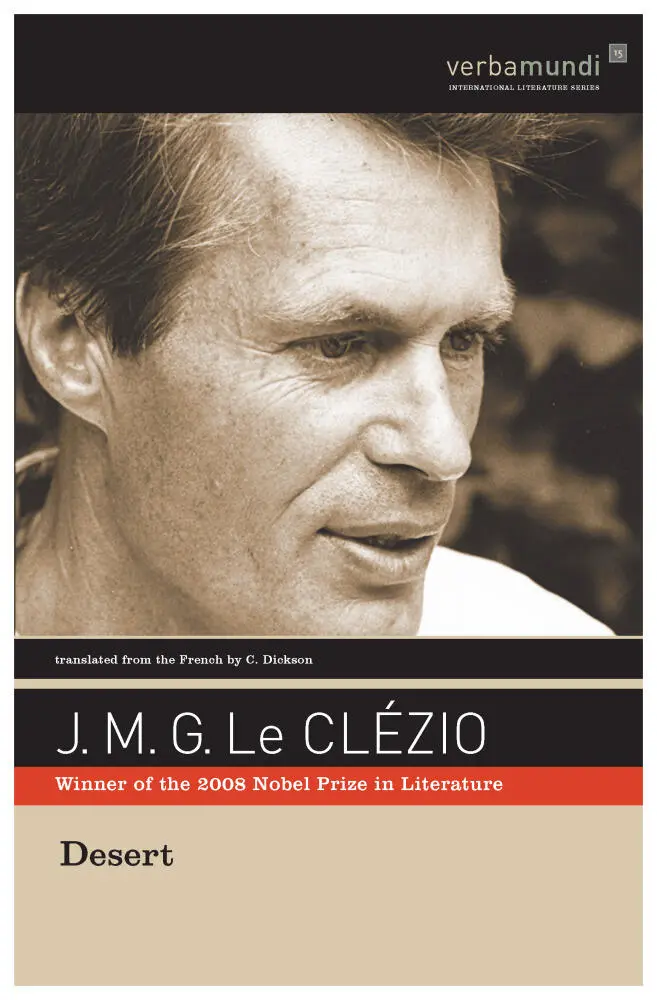
- Название:Desert
- Автор:
- Издательство:Verba Mundi Books
- Жанр:
- Год:2009
- Город:Jaffrey
- ISBN:978-1-56792-386-5
- Рейтинг книги:5 / 5. Голосов: 1
-
Избранное:Добавить в избранное
- Отзывы:
-
Ваша оценка:
Desert: краткое содержание, описание и аннотация
Предлагаем к чтению аннотацию, описание, краткое содержание или предисловие (зависит от того, что написал сам автор книги «Desert»). Если вы не нашли необходимую информацию о книге — напишите в комментариях, мы постараемся отыскать её.
Available for the first time in English translation, Desert is a novel composed of two alternating narratives, set in counterpoint. The first takes place in the desert between 1909 and 1912 and evokes the migration of a young adolescent boy, Nour, and his people, the Blue Men, notorious warriors of the desert. Driven from their lands by French colonial soldiers, Nour's tribe has come to the valley of the Saguiet El Hamra to seek the aid of the great spiritual leader known as Water of the Eyes. The religious chief sends them out from the holy city of Smara into the desert to travel still further. Spurred on by thirst, hunger, and suffering, Nour's tribe and others flee northward in the hopes of finding a land that can harbor them at last.
The second narrative relates the contemporary story of Lalla, a descendant of the Blue Men. Though she is an orphan living in a shantytown known as the Project near a coastal city in Morocco, the blood of her proud, obstinate tribe runs in her veins. All too soon, Lalla must flee to escape a forced marriage with an older, wealthy man. She travels to France, undergoing many trials there, from working as a hotel maid to becoming a highly-paid fashion model, and yet she never betrays the blood of her ancestors.
Desert — читать онлайн бесплатно полную книгу (весь текст) целиком
Ниже представлен текст книги, разбитый по страницам. Система сохранения места последней прочитанной страницы, позволяет с удобством читать онлайн бесплатно книгу «Desert», без необходимости каждый раз заново искать на чём Вы остановились. Поставьте закладку, и сможете в любой момент перейти на страницу, на которой закончили чтение.
Интервал:
Закладка:
On the other side of the mountains, the caravan arrived at the Taïdalt palm grove, where the Noun River and the trail to Goulimine begin. Nour thought they would be able to rest and drink to their heart’s content, but the palm grove was small, shrunken from drought and the desert wind. The tall gray dunes had eaten into the oasis, and the water was mud-colored. There was hardly anyone in the palm grove, save a few old men, wasted with hunger. So Ma al-Aïnine’s troop traveled on the next day, following the dried river toward Goulimine.
Before reaching the city, the troops of Ma al-Aïnine’s sons rode out ahead. Two days later, they came back with bad news: the soldiers of the Christians had landed at Sidi Ifni, and they too were heading northward. Larhdaf wanted to go to Goulimine all the same, to fight against the Spanish and the French, but the sheik motioned toward the men camping on the plain and merely asked him, “Are those your soldiers?” Then Larhdaf bowed his head, and the sheik gave the order to depart, skirting Goulimine, toward the Aït Boukha palm grove, then across the mountains to reach the Bou Izakarn trail to the east.
Despite their exhaustion, the men and women made their way for weeks through the red mountains, along dry torrents. The blue men, the women, the shepherds with their herds, the pack camels, the horsemen, all had to weave their way through the blocks of stone, to find a passageway over the rockslides. That is how they reached the holy city of Sidi Ahmed ou Moussa, the patron saint of acrobats and jugglers. The caravan spread out over the arid valley to pitch camp. Only the sheik and his sons and members of the Goudfia stayed within the confines of the tomb while the noblemen came to show their allegiance.
That evening there was a collective prayer beneath the starry sky, and the men and women came together at the tomb of the saint. The silence around the fires was broken only by the crackling of dry branches, and Nour could see the slight frame of the sheik squatting on the ground, reciting the formula of the dzikr in a low voice. But that evening, it was a prayer without shouts or music, because death was too close, and fatigue had made their throats tight. There was nothing but the very gentle voice, light as a wisp of smoke, chanting in the silence. Nour looked around and saw the thousands of men sitting on the ground, draped in their woolen cloaks, lit by fires scattering out into the distance. They sat motionless in silence. It was the most intense, most painful prayer he had ever heard. No one moved except, from time to time, a woman breastfeeding her child to put it to sleep, or an old man coughing. In the steep-walled valley, there wasn’t a breath of air, and the fires were burning very straight and bright. The night was ice-cold and beautiful, filled with stars. Then the glow of the moon appeared at the horizon, over the black cliffs, and the absolutely round silver disk rose hour by hour to its zenith.
The sheik prayed all night long as the fires went out, one after the other. The people, overcome with exhaustion, lay down to sleep right where they were. Nour only left the gathering two or three times, to go urinate behind the bushes in the valley bottom. He couldn’t sleep, as if his body were burning with fever. Next to him, his father, mother, and sisters had dozed off, wrapped up in their cloaks, and the blind warrior was sleeping too, his head lying on the cold earth.
Nour continued to watch the old man sitting next to the white tomb, chanting softly in the silent night, as if he were rocking a child.
At daybreak, the caravan went on, accompanied by some of the Aït ou Moussa and mountain men from Ilirh, from Tafermit, the Ida Gougmar, the Ifrane, the Tirhmi, all those who wanted to follow Ma al-Aïnine in his war for the kingdom of God.
There were still many more days of crossing the deserted mountains, along dried torrents. Each day the burning sun, the thirst, the blinding, overly white sky, the all-too-red rocks, the dust that suffocated the animals and people started over again. Nour couldn’t remember anymore what the world was like when he wasn’t on the move. He couldn’t remember the wells, where the women go to fetch water in their jugs and chatter like birds. He could no longer remember the song of the shepherds who allow their herds to wander, or the games children play in the sand of the dunes. It was if he had been walking forever, endlessly seeing identical hills, ravines, red rocks. At times he would have liked so much to sit down on a stone, just any stone by the side of the trail, and watch the long caravan going off, the dark shapes of the men and the camels in the shimmering air, as if it were a mirage fading away. But the hand of the blind warrior did not leave his shoulder, it pushed him onward, forced him to keep walking.
When they came in sight of a village, they stopped. The name of the village was passed from one person to the next, buzzing on everyone’s lips, “Tirhmi, Anezi, Assaka, Asserssif…” Now they were walking along a real river, in which a thin trickle of water ran. Argans and white acacias grew along its banks. Then they walked over an immense sandy plain, as white as salt, where the sunlight was blinding.
One evening as the caravan was settling in for the night, a band of warriors arrived from the north, in the company of a man on horseback wearing a long white cloak.
It was the great sheik Lahoussine himself, who had come to bring the aid of his warriors and distribute food to the travelers. Then the people realized the journey was drawing to an end, because they were entering the valley of the great Souss River, the place where there would be water and pasture for the livestock, and land for all of the men.
When the news spread amongst the travelers, a feeling of emptiness and death came over Nour once again, as it had before leaving Smara. The people were running back and forth in the dust shouting out, calling to one another, “We’ve arrived! We’ve arrived!” The blind warrior was gripping Nour’s shoulder very tightly, and he too was shouting, “We’ve arrived!”
But it wasn’t until two days later that they arrived in the valley of the great river, before the city of Taroudant. For hours they followed the river upstream, walking in the thin streams of water running through the red stones. In spite of the river water, the banks were barren and dry, and the earth was hard, baked by the sun and the wind.
Nour walked over the smooth stones of the river, dragging the blind warrior behind him. In spite of the blaze of the sun, the water was as cold as ice. A few scraggly shrubs were growing in the middle of the river, on little pebble islands. There were also long white tree trunks that the floodwaters had brought down from the mountains.
Nour had already forgotten the presentiment of death. He was happy because he too believed it was the end of the journey, that this was the land Ma al-Aïnine had promised them before leaving Smara.
The hot air was laden with smells, for it was the beginning of spring. Nour breathed in that smell for the very first time. Insects danced over the streams of water, wasps, light flies. It had been so long since Nour had seen any wildlife that he was happy to see those flies and those wasps. Even when a horsefly suddenly stung him through his clothing, it didn’t anger him, and he merely shooed it away with his hand.
On the other side of the Souss River, hugging the red mountain, was the large city of mud houses, looming up like a celestial vision. Unearthly, as if suspended in the sunlight, the city seemed to be waiting for the men of the desert, waiting to offer them refuge. Never before had Nour seen such a beautiful city. The high windowless walls of red stone and mud glowed in the light of the setting sun. A halo of dust was floating over the city like pollen, encompassing it in its magical cloud.
Читать дальшеИнтервал:
Закладка:
Похожие книги на «Desert»
Представляем Вашему вниманию похожие книги на «Desert» списком для выбора. Мы отобрали схожую по названию и смыслу литературу в надежде предоставить читателям больше вариантов отыскать новые, интересные, ещё непрочитанные произведения.










Обсуждение, отзывы о книге «Desert» и просто собственные мнения читателей. Оставьте ваши комментарии, напишите, что Вы думаете о произведении, его смысле или главных героях. Укажите что конкретно понравилось, а что нет, и почему Вы так считаете.