J.M. le Clézio - Desert
Здесь есть возможность читать онлайн «J.M. le Clézio - Desert» весь текст электронной книги совершенно бесплатно (целиком полную версию без сокращений). В некоторых случаях можно слушать аудио, скачать через торрент в формате fb2 и присутствует краткое содержание. Город: Jaffrey, Год выпуска: 2009, ISBN: 2009, Издательство: Verba Mundi Books, Жанр: Современная проза, на английском языке. Описание произведения, (предисловие) а так же отзывы посетителей доступны на портале библиотеки ЛибКат.
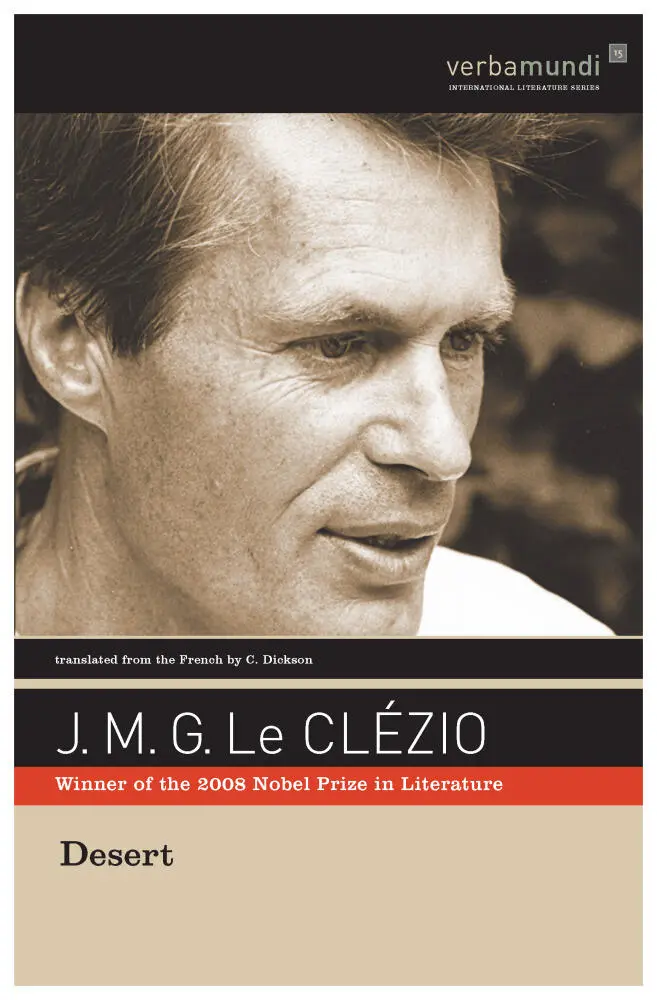
- Название:Desert
- Автор:
- Издательство:Verba Mundi Books
- Жанр:
- Год:2009
- Город:Jaffrey
- ISBN:978-1-56792-386-5
- Рейтинг книги:5 / 5. Голосов: 1
-
Избранное:Добавить в избранное
- Отзывы:
-
Ваша оценка:
Desert: краткое содержание, описание и аннотация
Предлагаем к чтению аннотацию, описание, краткое содержание или предисловие (зависит от того, что написал сам автор книги «Desert»). Если вы не нашли необходимую информацию о книге — напишите в комментариях, мы постараемся отыскать её.
Available for the first time in English translation, Desert is a novel composed of two alternating narratives, set in counterpoint. The first takes place in the desert between 1909 and 1912 and evokes the migration of a young adolescent boy, Nour, and his people, the Blue Men, notorious warriors of the desert. Driven from their lands by French colonial soldiers, Nour's tribe has come to the valley of the Saguiet El Hamra to seek the aid of the great spiritual leader known as Water of the Eyes. The religious chief sends them out from the holy city of Smara into the desert to travel still further. Spurred on by thirst, hunger, and suffering, Nour's tribe and others flee northward in the hopes of finding a land that can harbor them at last.
The second narrative relates the contemporary story of Lalla, a descendant of the Blue Men. Though she is an orphan living in a shantytown known as the Project near a coastal city in Morocco, the blood of her proud, obstinate tribe runs in her veins. All too soon, Lalla must flee to escape a forced marriage with an older, wealthy man. She travels to France, undergoing many trials there, from working as a hotel maid to becoming a highly-paid fashion model, and yet she never betrays the blood of her ancestors.
Desert — читать онлайн бесплатно полную книгу (весь текст) целиком
Ниже представлен текст книги, разбитый по страницам. Система сохранения места последней прочитанной страницы, позволяет с удобством читать онлайн бесплатно книгу «Desert», без необходимости каждый раз заново искать на чём Вы остановились. Поставьте закладку, и сможете в любой момент перейти на страницу, на которой закончили чтение.
Интервал:
Закладка:
The travelers stopped in the valley, below the city, and gazed at it for a long time in both love and fear. Now, for the first time since the beginning of their journey, they felt how truly weary they were, their clothing in shreds, their feet wrapped in bloody rags, their lips and eyelids burned by the desert sun. They were sitting on the shingles of the river, and some had pitched their tents or had built shelters out of branches and leaves. As if he too were feeling the fear of the crowd, Ma al-Aïnine stopped with his sons and warriors on the bank of the river.
Now the large tents of the tribal chieftains were being raised; the pack camels were being unloaded. Night fell on the ramparts of the city; the sky went dark, and the red earth turned black. Only the high frost-covered peaks of the Atlas, Mount Tichka, Mount Tinergouet, still glistened in the sun when the valley was already sunk in darkness. The call for the evening prayer in the city could be heard, a voice that echoed out strangely like a lament. On the shingles of the river, the travelers were prostrating themselves and praying too, without raising their voices, accompanied by the soft gurgling of the stream.
When morning came, Nour was astounded. He had slept through the night without feeling the stones bruising his ribs, or the cold, or the dampness of the river. When he awoke, he saw the mist drifting slowly down the valley, as if the light of day were pushing it along. In the riverbed, amidst the sleeping men, the women were already up, going to fetch water, or gathering a few twigs. The children were looking for shrimp under the flat stones.
But it was when he looked at the city that Nour was filled with wonder. In the pure dawn air, at the foot of the mountains, stood the tall fortress of Taroudant. Its walls of red stone, its terraces, its towers were clear and distinct, seeming to have been sculpted out of the bedrock of the mountain itself. From time to time, the white mist passed between the riverbed and the city, half hiding it, as if the citadel were floating above the valley, a sort of earthen and stone vessel gliding slowly past the islands of the snow-capped mountains.
Nour stared at it without being able to turn away. His eyes were fascinated with the high windowless walls. There was something mysterious and threatening in those walls, as if the city wasn’t inhabited by people, but by supernatural spirits. Slowly, the light appeared in the sky — pink, then amber-colored, just like that, until the intense blue was everywhere. The light sizzled on the mud walls, on the terraces, on the gardens of orange trees and on the tall palms. Lower down, the arid lands traversed by the irrigation canals were an almost dusky color of red.
Standing stock still on the beach in the silence, surrounded by the men of the desert, Nour watched the magical city awakening. Thin wisps of smoke lifted into the air, and — almost ethereal — the familiar sounds of life, voices, the laughter of children, a young woman singing could be heard.
For the men of the desert, sitting motionless in the bed of the river, those wisps of smoke, those sounds seemed immaterial, as if they were dreaming that fortified city on the mountainside, those fields, those palm and orange trees.
The sun had risen high in the sky, was already burning the stones of the riverbed. A strange odor wafted over to the nomad camp, and Nour had a hard time recognizing it. It wasn’t the sharp and cold smell of the days of fleeing and fear, the smell he had been breathing in for such a long time across the desert. It was an odor of musk and oil, pungent, inebriating, the smell of braziers in which cedar coal is being burned, the smell of coriander, of pepper, of onions.
Nour breathed in that odor, without daring to move for fear of losing it, and the blind warrior also recognized that blissful smell. All the men remained motionless, their wide eyes looking on unblinkingly, achingly, at the high red wall of the city. They looked at the city which was so close and yet so distant at the same time, the city that might open its gates, and their hearts beat faster. Around them, the pebble beaches of the river were already shimmering in the heat of day. They watched the magical city without moving. Then, as the sun rose higher in the sky, each of the men, one after the other, covered his head with a flap of his cloak.
LIFE WITH THE SLAVES
LEANING ON THE RAILING, Lalla watches the strip of land that has appeared on the horizon like an island. In spite of her fatigue, all of her energy is turned toward scrutinizing the land; she’s trying to make out the houses, the roads, maybe even the shapes of people. Next to her, the passengers are crowding up against the railing. They’re shouting, gesticulating, talking excitedly; they’re calling to one another in all diVerent languages from one end of the afterdeck to the other. They’ve been waiting for this moment for such a long time! There are many children and teenagers. They’re all wearing the same tag pinned to their clothing, with their name, date of birth, and the name and address of the person who is waiting for them in Marseille. The bottom of the tag has been stamped, signed, and marked with a small red cross circled in black. Lalla doesn’t like the red cross; she has the feeling it’s burning her skin through her smock, that it’s gradually leaving its mark on her chest.
The cold wind is gusting over the deck, and the heavy waves are making the iron sides of the ship vibrate. Lalla feels nauseous because all night long, instead of sleeping, the children were passing around tubes of condensed milk that the Red Cross officials distributed before they embarked. And also, since there weren’t enough deck chairs, Lalla had to sleep on the floor in the nauseating heat of the hold, surrounded with the smell of kerosene, of grease, shaken by the chugging of the engine. Now the first gulls are flying over the stern, they’re screeching and squawking as if they were angry to see the ship arriving. They don’t look like princes of the sea at all; they’re a dirty gray color, with yellow beaks and a cruel gleam to their eyes.
Lalla hadn’t seen the sun rise. She’d fallen asleep, overcome with fatigue on the tarpaulin in the hold, her head resting on a piece of cardboard. When she awoke, everyone was already up on deck, their eyes glued to the strip of land. The only person left in the hold was a very pale young woman holding a tiny baby in her arms. The baby was sick; it had vomited on the floor; it was whimpering softly. When Lalla drew near to ask what was wrong with it, the young woman looked at her without answering, glassy-eyed.
Now land is very near, it is floating on the green sea littered with trash. Rain is beginning to fall on the deck, but no one goes for shelter. The cold water runs over the children’s frizzy hair, forming drops on the ends of their noses. They are dressed like paupers, in thin, short-sleeved shirts, blue cotton pants or gray skirts, sometimes in traditional long homespun robes. Their bare feet are stuck into black leather shoes that are too big. The adult men are wearing old worn suit jackets with pants that are too short, and woolen ski caps. Lalla looks at the children, the women, the men around her; they seem sad and frightened; their faces are yellow, swollen with weariness, their arms and legs nubbly with goose bumps. The smell of the sea mingles with that of fatigue and anxiety, and off in the distance, like a smudge on the green sea, the land also seems sad and weary. The sky is low; the clouds are hiding the tops of the hills; no matter how hard she looks, Lalla can’t see the white city Naman the fisherman used to speak of, not the palaces or the church towers. Now there is nothing but endless stone- and cement-colored wharves, wharves opening out onto other wharves. The ship loaded with passengers is gliding slowly through the black water of the basins. Standing on the wharves, a few men are watching the ship go by indifferently. Though the children shout at the top of their lungs, waving their arms around, no one answers them. The rain continues to fall, a fine cold drizzle. Lalla looks at the water in the basin, the black greasy water, where refuse even the gulls don’t want floats.
Читать дальшеИнтервал:
Закладка:
Похожие книги на «Desert»
Представляем Вашему вниманию похожие книги на «Desert» списком для выбора. Мы отобрали схожую по названию и смыслу литературу в надежде предоставить читателям больше вариантов отыскать новые, интересные, ещё непрочитанные произведения.











Обсуждение, отзывы о книге «Desert» и просто собственные мнения читателей. Оставьте ваши комментарии, напишите, что Вы думаете о произведении, его смысле или главных героях. Укажите что конкретно понравилось, а что нет, и почему Вы так считаете.