J.M. le Clézio - Desert
Здесь есть возможность читать онлайн «J.M. le Clézio - Desert» весь текст электронной книги совершенно бесплатно (целиком полную версию без сокращений). В некоторых случаях можно слушать аудио, скачать через торрент в формате fb2 и присутствует краткое содержание. Город: Jaffrey, Год выпуска: 2009, ISBN: 2009, Издательство: Verba Mundi Books, Жанр: Современная проза, на английском языке. Описание произведения, (предисловие) а так же отзывы посетителей доступны на портале библиотеки ЛибКат.
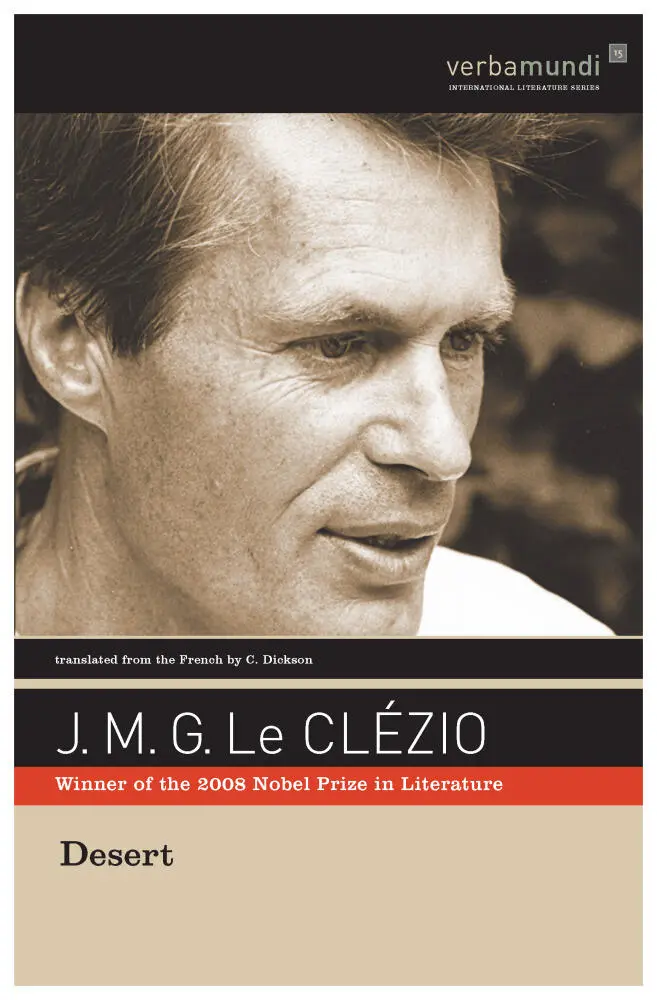
- Название:Desert
- Автор:
- Издательство:Verba Mundi Books
- Жанр:
- Год:2009
- Город:Jaffrey
- ISBN:978-1-56792-386-5
- Рейтинг книги:5 / 5. Голосов: 1
-
Избранное:Добавить в избранное
- Отзывы:
-
Ваша оценка:
Desert: краткое содержание, описание и аннотация
Предлагаем к чтению аннотацию, описание, краткое содержание или предисловие (зависит от того, что написал сам автор книги «Desert»). Если вы не нашли необходимую информацию о книге — напишите в комментариях, мы постараемся отыскать её.
Available for the first time in English translation, Desert is a novel composed of two alternating narratives, set in counterpoint. The first takes place in the desert between 1909 and 1912 and evokes the migration of a young adolescent boy, Nour, and his people, the Blue Men, notorious warriors of the desert. Driven from their lands by French colonial soldiers, Nour's tribe has come to the valley of the Saguiet El Hamra to seek the aid of the great spiritual leader known as Water of the Eyes. The religious chief sends them out from the holy city of Smara into the desert to travel still further. Spurred on by thirst, hunger, and suffering, Nour's tribe and others flee northward in the hopes of finding a land that can harbor them at last.
The second narrative relates the contemporary story of Lalla, a descendant of the Blue Men. Though she is an orphan living in a shantytown known as the Project near a coastal city in Morocco, the blood of her proud, obstinate tribe runs in her veins. All too soon, Lalla must flee to escape a forced marriage with an older, wealthy man. She travels to France, undergoing many trials there, from working as a hotel maid to becoming a highly-paid fashion model, and yet she never betrays the blood of her ancestors.
Desert — читать онлайн бесплатно полную книгу (весь текст) целиком
Ниже представлен текст книги, разбитый по страницам. Система сохранения места последней прочитанной страницы, позволяет с удобством читать онлайн бесплатно книгу «Desert», без необходимости каждый раз заново искать на чём Вы остановились. Поставьте закладку, и сможете в любой момент перейти на страницу, на которой закончили чтение.
Интервал:
Закладка:
Maybe there is no city? Lalla looks at the rain-soaked wharves, the shapes of the docked freighters, the cranes, and still farther out, the long white buildings making a wall at the far end of the harbor. Little by little, the merriment of the children on the International Red Cross ship begins to subside. From time to time, a few shouts ring out, but they don’t last. The officials and female assistants are walking over the deck, shouting out orders that no one understands. They succeed in grouping the children together and begin to call out names, but their voices are lost in the noise of the engine and the clamor of the crowd.
“…Makel…”
“…Séfar…”
“Ko-di-ki…”
“Hamal…”
“…Lagor…”
It doesn’t make any sense and no one answers. Then the loudspeaker starts talking, as if it were barking over the heads of the passengers, and a kind of panic occurs. Some people run up toward the front, others try to climb the stairs to the upper deck, where the officers push them back. Finally, everyone calms down because the ship has just docked and the engines have been cut. On the wharf there is an ugly cement structure with lit windows. The children, the women, the men lean over the railing trying to get a glimpse of a familiar face amongst the people that can be seen walking around over there, no larger than insects, on the other side of the structure.
The process of disembarkment begins, meaning that for several hours, the passengers remain on the deck of the International Red Cross ship, waiting to be given some kind of signal. As time goes by, the children who are crowded together on the deck grow more and more restless. The small children begin to cry, with a continual high-pitched whining, which doesn’t help matters. The women shout, or sometimes the men. Lalla is sitting on a pile of rope, with her suitcase beside her, in the shade of the bulkhead of the officers’ deck, and is waiting, watching the gray gulls in the gray sky.
Finally the time comes to go ashore. The passengers are so tired of waiting that it takes them quite some time to get moving. Lalla follows the drove up to the large gray structure. There, three policemen and some interpreters are asking questions of the people arriving. It is a bit quicker for the children, because the policeman simply reads what is written on their tags and copies it on the forms.
When he’s finished, the man looks at Lalla and asks, “Do you intend to work in France?”
“Yes,” Lalla says.
“What job?”
“I don’t know.”
“Housemaid,” the policeman says, and writes that on his form. Lalla picks up her suitcase and goes over to wait with the others, in the large dirty room with gray walls where the electric light shines brightly. There’s nothing to sit on, and in spite of the cold and the rain outside, the room is stiflingly hot. The youngest children have fallen asleep in their mothers’ arms, or else on the floor, lying on a pile of clothing. Now it’s the older children who are complaining. Lalla is thirsty; her throat is dry; her eyes are burning with fever. She’s too tired to think of anything. She’s waiting, leaning up against the wall, standing first on one leg, then the other. At the other end of the room, in front of the police lines, is the very pale young woman with a blank look, holding her baby in her arms. She’s standing in front of the officer’s desk looking haggard, not saying anything. The policeman talks to her for a long time, shows the papers to the interpreter from the International Red Cross. Something isn’t right. The policeman asks questions that the interpreter repeats to the young woman, but she just looks at them, not seeming to understand. They don’t want to let her through. Lalla looks at the young woman who is so pale, holding her baby. She is holding it so tightly in her arms that it wakes up a little and starts screaming, then calms down when its mother quickly uncovers her breast and offers it for the baby to suck on. The policeman looks embarrassed. He turns away, glances around. His eyes meet those of Lalla, who has just walked up.
“Do you speak her language?”
“I don’t know,” says Lalla.
Lalla says a few words in Chleuh, and the young woman looks at her for a minute and then answers.
“Tell her that her papers aren’t in order, the authorization for the baby is missing.”
Lalla tries to translate the sentence. She thinks the young woman hasn’t understood, then all of a sudden she collapses and begins to weep. The policeman says a few more words, and the interpreter from the International Red Cross lifts the young woman to her feet as well as he can and guides her over to the back of the room, where there are two or three imitation leather armchairs.
Lalla is sad because she realizes that the young woman will have to take the boat back in the opposite direction with her sick baby. But she is too weary herself to think about it much, and she goes back to lean up against the wall next to her suitcase. At the other end of the room, high up on the wall, there is a clock with numbers inscribed on rotating flaps. Each minute, a flap turns with a sharp click. The people in the room aren’t talking anymore. They’re waiting, sitting on the floor, or standing against the wall, eyes fixed, faces tense, as if with each click, the door in the back is going to open and let them go.
Finally, after such a long time that no one is hoping for anything anymore, the men from the International Red Cross walk across the large room. They open the door in the back and start calling out the names of the children again. The muttering of voices resumes, the people crowd up near the exit. Lalla, carrying her cardboard suitcase, cranes out her neck to see over the heads of the others; she is so impatient for her name to be called that her legs begin to tremble. When the man from the Red Cross says her name, he sort of barks it out, and Lalla doesn’t understand. Then he repeats himself, shouting, “Hawa! Hawa ben Hawa!”
Lalla runs, her suitcase banging around at the end of her arm, and makes her way through the crowd. She stops in front of the door while the man checks her tag, then she leaps out, as if someone had shoved her from behind. There is so much light outside, after all those hours spent in the large gray room, that Lalla staggers, overcome with dizziness. She moves forward through the rows of women and men without seeing them, walks aimlessly straight ahead, until she feels someone taking her by the arm, hugging her, kissing her. Aamma pulls her over toward the exit from the wharves, toward the city.
Aamma lives alone in an apartment in the old town, near the port, on the top floor of a dilapidated house. There’s just a living room with a sofa, a dark bedroom with a folding bed, and a kitchen. The windows of the apartment open onto an inner courtyard, but you can see the sky pretty well above the tile roofs. In the morning, up until noon, there’s even a little sunshine that comes in through the two windows of the room with the sofa. Aamma tells Lalla that she was very lucky to have found the apartment, and also to have found work as a cook at the hospital cafeteria. When she arrived in Marseille, several months ago, she was first housed in a furnished apartment in the outskirts, where there were five women to each room, and the police came by every morning, and there were fights in the street. Two men even had a knife fight, and Aamma had to flee, leaving one of her suitcases behind, because she was afraid of being picked up by the police and deported.
Aamma seems quite happy to see Lalla, after all this time. She doesn’t ask her any questions about what happened when Lalla ran away into the desert with the Hartani and was later taken to the hospital in the city, because she was dying of thirst and fever. The Hartani had continued his journey southward alone, toward the caravans, because that was what he was always meant to do. Aamma has aged a lot in a few months’ time. She has a thin weary face, a gray complexion, and her eyes are ringed with dark circles. In the evening, when she gets home from work, she nibbles on cookies and drinks mint tea while she talks about her journey by car across Spain with other men and women who were going to look for work. They drove along the roads for days, passing through villages, over mountains, rivers. And one day, the driver of the car showed them a city with a lot of identical brick houses, with black roofs. He said, this is it, here we are. Aamma got out of the car along with the others, and, since the entire trip had been paid in advance, they took their belongings and started walking through the streets of the town. But when Aamma showed the envelope with the name and address of Naman’s brother, people started laughing and told her she wasn’t in Marseille, but Paris. So then she had to take the train and travel all night again before she got here.
Читать дальшеИнтервал:
Закладка:
Похожие книги на «Desert»
Представляем Вашему вниманию похожие книги на «Desert» списком для выбора. Мы отобрали схожую по названию и смыслу литературу в надежде предоставить читателям больше вариантов отыскать новые, интересные, ещё непрочитанные произведения.












Обсуждение, отзывы о книге «Desert» и просто собственные мнения читателей. Оставьте ваши комментарии, напишите, что Вы думаете о произведении, его смысле или главных героях. Укажите что конкретно понравилось, а что нет, и почему Вы так считаете.