J.M. le Clézio - Desert
Здесь есть возможность читать онлайн «J.M. le Clézio - Desert» весь текст электронной книги совершенно бесплатно (целиком полную версию без сокращений). В некоторых случаях можно слушать аудио, скачать через торрент в формате fb2 и присутствует краткое содержание. Город: Jaffrey, Год выпуска: 2009, ISBN: 2009, Издательство: Verba Mundi Books, Жанр: Современная проза, на английском языке. Описание произведения, (предисловие) а так же отзывы посетителей доступны на портале библиотеки ЛибКат.
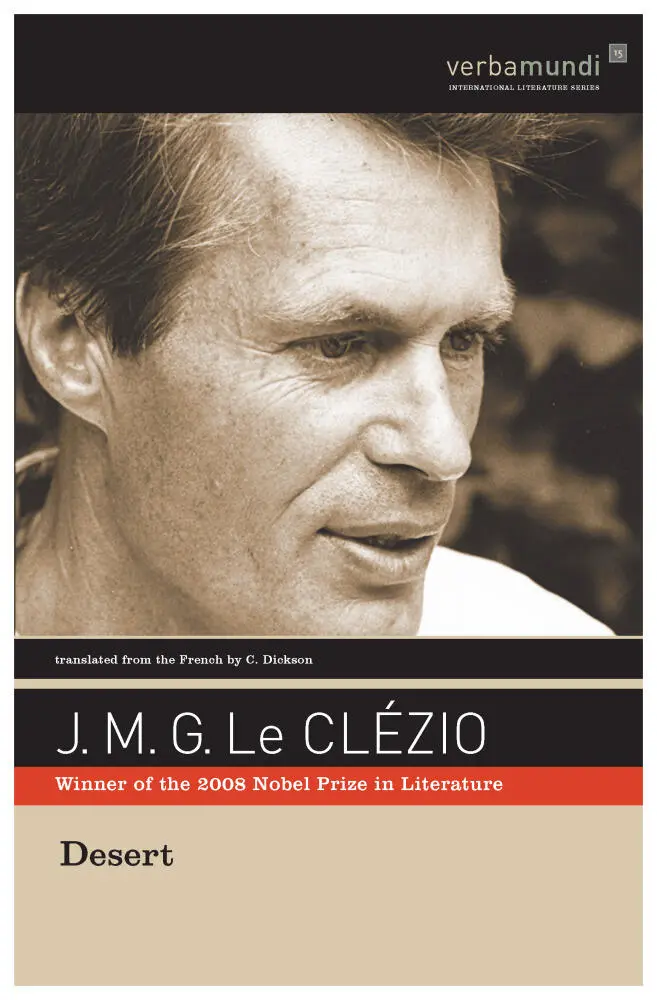
- Название:Desert
- Автор:
- Издательство:Verba Mundi Books
- Жанр:
- Год:2009
- Город:Jaffrey
- ISBN:978-1-56792-386-5
- Рейтинг книги:5 / 5. Голосов: 1
-
Избранное:Добавить в избранное
- Отзывы:
-
Ваша оценка:
Desert: краткое содержание, описание и аннотация
Предлагаем к чтению аннотацию, описание, краткое содержание или предисловие (зависит от того, что написал сам автор книги «Desert»). Если вы не нашли необходимую информацию о книге — напишите в комментариях, мы постараемся отыскать её.
Available for the first time in English translation, Desert is a novel composed of two alternating narratives, set in counterpoint. The first takes place in the desert between 1909 and 1912 and evokes the migration of a young adolescent boy, Nour, and his people, the Blue Men, notorious warriors of the desert. Driven from their lands by French colonial soldiers, Nour's tribe has come to the valley of the Saguiet El Hamra to seek the aid of the great spiritual leader known as Water of the Eyes. The religious chief sends them out from the holy city of Smara into the desert to travel still further. Spurred on by thirst, hunger, and suffering, Nour's tribe and others flee northward in the hopes of finding a land that can harbor them at last.
The second narrative relates the contemporary story of Lalla, a descendant of the Blue Men. Though she is an orphan living in a shantytown known as the Project near a coastal city in Morocco, the blood of her proud, obstinate tribe runs in her veins. All too soon, Lalla must flee to escape a forced marriage with an older, wealthy man. She travels to France, undergoing many trials there, from working as a hotel maid to becoming a highly-paid fashion model, and yet she never betrays the blood of her ancestors.
Desert — читать онлайн бесплатно полную книгу (весь текст) целиком
Ниже представлен текст книги, разбитый по страницам. Система сохранения места последней прочитанной страницы, позволяет с удобством читать онлайн бесплатно книгу «Desert», без необходимости каждый раз заново искать на чём Вы остановились. Поставьте закладку, и сможете в любой момент перейти на страницу, на которой закончили чтение.
Интервал:
Закладка:
Lalla is watching a plane lifting slowly into the pale sky, making a thundering sound. It veers up over the city, passing in front of the sun, blinking it out for a fraction of a second, and then flies off in the direction of the sea, growing smaller and smaller. Lalla stares at it very hard, until it is nothing more than an imperceptible dot. Maybe it’s going to fly out over the desert, over the expanses of sand and stones, out where the Hartani is walking?
So then Lalla goes off as well. Legs wobbling a little, she walks back down toward the city.
There’s something else that Lalla really likes to do: she goes to sit on the steps of the wide flight of stairs in front of the train station and watches the travelers going up and down. There are the ones who are arriving, all out of breath, eyes tired, hair mussed, and who go teetering down the stairs into the light. There are the ones who are leaving, who are in a hurry because they’re afraid of missing their trains; they run up the stairs two at a time, and their suitcases and bags knock against their legs, and their eyes are trained straight ahead on the entrance to the station. They stumble on the last steps, they call out to one another for fear of getting lost.
Lalla really likes hanging around the train station. It’s as if the big city wasn’t quite finished yet, as if there were still that large hole through which people keep coming and going. She often thinks that she would really like to go away, get on a train headed northward, with all of those names of lands that are intriguing and a little frightening, Irun, Bordeaux, Amsterdam, Lyon, Dijon, Paris, Calais. When she has a little money, Lalla goes into the station, buys a Coca-Cola at the refreshment stand and a platform ticket. She goes into the large departure hall, and wanders around on all the platforms in front of the trains that have just come in or that are leaving soon. Sometimes she even gets on one of the cars and sits down for a minute on the green moleskin seat. The people arrive one after the other and settle down in the compartment, they even ask, “Is it taken?” and Lalla gives a little shake of her head. Then when the loudspeaker announces that the train is going to leave, Lalla quickly gets off the car, jumps down onto the platform.
The train station is also one of the places where you can see without being seen, because there is too much agitation and hurriedness to pay much attention to anyone. There are all sorts of people in the station, cruel people, violent people with bright red faces, people who shout at the top of their lungs; there are very sad and very poor people too, old people who are lost, anxiously searching for the platforms their trains are leaving from, women with too many children who hobble along with their loads by the cars that are too high. There are all of the people that poverty has brought to this city, blacks who have come off boats, heading for the cold countries with their colorful short-sleeved shirts and a lone beach bag serving as luggage; dark-skinned North Africans, layered with old jackets, wearing ski caps or hats with ear flaps; the Turks, the Spaniards, the Greeks, all looking worried and weary, wandering around on the platforms in the wind, bumping into one another in the midst of the crowd of indifferent travelers and jeering soldiers.
Lalla watches them, just barely hidden between the telephone booth and the information board. She’s backed into the shadows pretty well, and her copper-colored face is shielded with the collar of her coat. But from time to time, her heart starts beating faster and a flash of light darts from her eyes, like the reflection of the sun off the stones in the desert. She watches all the people who are headed for other cities, for hunger, cold, misfortune, those who will be humiliated, who will live in solitude. They go by, stooping slightly, eyes blank, clothing already worn from nights of sleeping on the ground, like so many defeated soldiers.
They are headed for black cities, for low skies, for smokestacks, for the cold, the sickness that rips your chest apart. They’re headed for their shantytowns in muddy lots, down below the freeways, for rooms like graves dug into the ground, surrounded by high walls and fences. Maybe those men, those women, passing by like ghosts, dragging their bags and their too-heavy children, will never come back, maybe they’ll die in those countries they don’t even know, far from their villages, far from their families? They’re headed into those foreign countries that will take their lives, that will crush and devour them. Lalla is standing very still in her dark corner, and her vision blurs because that’s what she thinks. She would so like to go away from here, walk through the streets of the city until there were no more houses, no more gardens, not even any roads, or shoreline, just a path like before, that would lead out, growing ever narrower till it reached the desert.
Night falls on the city. Lights flicker on in the streets, around the train station, on the iron pylons, and on the long red, white, and green bars over the cafés and the movie theaters. Lalla is walking through the dark streets without making a sound, slipping along hugging the walls. Men’s faces are terrifying when night falls, and they are only partially lit by the streetlamps. Their eyes shine cruelly, the sound of their footsteps echoes in the corridors, under the carriage entrances. Lalla is walking quickly now, as if she were trying to flee. From time to time, a man follows her, tries to come up to her, take her arm, so Lalla hides behind a car, then disappears. Once again, she starts slipping along like a shadow; she wanders around in the streets of the old town until she reaches the Panier neighborhood, where Aamma lives. She takes the unlit stairway, so no one will see which door she’s gone in. She knocks lightly on the door, and when she hears her aunt’s voice, she says her name with relief.
That’s what Lalla’s days are like, here, in the big city of Marseille, along all the streets, with all of the men and all of the women she’ll never be able to know.
THERE ARE A LOT of beggars. In the beginning, when she’d just arrived, Lalla was quite surprised. Now she’s gotten used to it. But she doesn’t forget to see them, like most people in the city, who just make a little detour so as not to step on them, or who even step over them when they’re in a hurry.
Radicz is a beggar. That’s how she met him, walking along the main avenues near the train station. One day, she’d left the Panier early, and it was still dark, because it was winter. There weren’t many people in the narrow streets and stairways of the old town, and the main avenue below the general hospital was still deserted, with only trucks driving along with their headlights on and a few men and a few women on their mopeds all muffled up in their overcoats.
That was where she saw Radicz. He was sitting scrunched up in a doorway, doing his best to keep out of the wind and drizzling rain. He looked as if he were very cold and when Lalla came up beside him, he gave her a funny look, not at all like boys usually do when they see a girl. He looked at her without lowering his eyes, and there wasn’t much you could read in that look, like the eyes of animals. Lalla stopped in front of him; she asked, “What are you doing here? Aren’t you cold?”
The boy shook his head without smiling. Then he held out his hand.
“Give me something.”
Lalla had nothing but a piece of bread and an orange that she’d brought along for her lunch. She gave them to the boy. He snatched the orange from her without saying thank you and began eating it.
That’s how Lalla got to know him. After that, she saw him often, in the streets, near the train station, or else on the wide flight of stairs when the weather was nice. He can remain sitting for hours, staring straight ahead, without paying attention to anyone. But he likes Lalla quite a bit, maybe because of the orange. He told her his name was Radicz; he even wrote the name on the ground with a twig, but he seemed astonished when Lalla told him she didn’t know how to read.
Читать дальшеИнтервал:
Закладка:
Похожие книги на «Desert»
Представляем Вашему вниманию похожие книги на «Desert» списком для выбора. Мы отобрали схожую по названию и смыслу литературу в надежде предоставить читателям больше вариантов отыскать новые, интересные, ещё непрочитанные произведения.











Обсуждение, отзывы о книге «Desert» и просто собственные мнения читателей. Оставьте ваши комментарии, напишите, что Вы думаете о произведении, его смысле или главных героях. Укажите что конкретно понравилось, а что нет, и почему Вы так считаете.