J.M. le Clézio - Desert
Здесь есть возможность читать онлайн «J.M. le Clézio - Desert» весь текст электронной книги совершенно бесплатно (целиком полную версию без сокращений). В некоторых случаях можно слушать аудио, скачать через торрент в формате fb2 и присутствует краткое содержание. Город: Jaffrey, Год выпуска: 2009, ISBN: 2009, Издательство: Verba Mundi Books, Жанр: Современная проза, на английском языке. Описание произведения, (предисловие) а так же отзывы посетителей доступны на портале библиотеки ЛибКат.
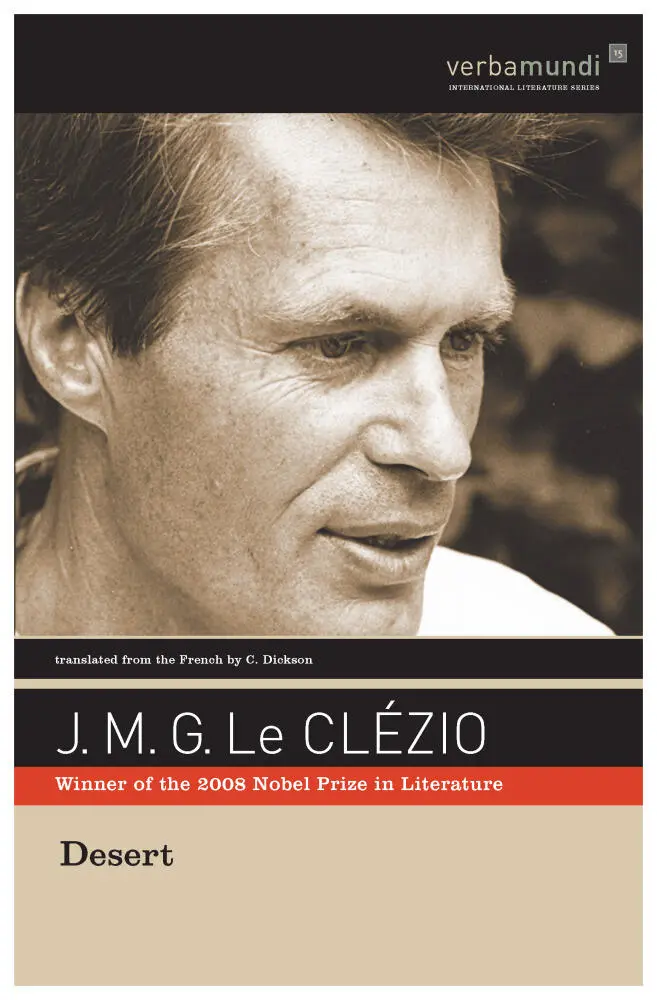
- Название:Desert
- Автор:
- Издательство:Verba Mundi Books
- Жанр:
- Год:2009
- Город:Jaffrey
- ISBN:978-1-56792-386-5
- Рейтинг книги:5 / 5. Голосов: 1
-
Избранное:Добавить в избранное
- Отзывы:
-
Ваша оценка:
Desert: краткое содержание, описание и аннотация
Предлагаем к чтению аннотацию, описание, краткое содержание или предисловие (зависит от того, что написал сам автор книги «Desert»). Если вы не нашли необходимую информацию о книге — напишите в комментариях, мы постараемся отыскать её.
Available for the first time in English translation, Desert is a novel composed of two alternating narratives, set in counterpoint. The first takes place in the desert between 1909 and 1912 and evokes the migration of a young adolescent boy, Nour, and his people, the Blue Men, notorious warriors of the desert. Driven from their lands by French colonial soldiers, Nour's tribe has come to the valley of the Saguiet El Hamra to seek the aid of the great spiritual leader known as Water of the Eyes. The religious chief sends them out from the holy city of Smara into the desert to travel still further. Spurred on by thirst, hunger, and suffering, Nour's tribe and others flee northward in the hopes of finding a land that can harbor them at last.
The second narrative relates the contemporary story of Lalla, a descendant of the Blue Men. Though she is an orphan living in a shantytown known as the Project near a coastal city in Morocco, the blood of her proud, obstinate tribe runs in her veins. All too soon, Lalla must flee to escape a forced marriage with an older, wealthy man. She travels to France, undergoing many trials there, from working as a hotel maid to becoming a highly-paid fashion model, and yet she never betrays the blood of her ancestors.
Desert — читать онлайн бесплатно полную книгу (весь текст) целиком
Ниже представлен текст книги, разбитый по страницам. Система сохранения места последней прочитанной страницы, позволяет с удобством читать онлайн бесплатно книгу «Desert», без необходимости каждый раз заново искать на чём Вы остановились. Поставьте закладку, и сможете в любой момент перейти на страницу, на которой закончили чтение.
Интервал:
Закладка:
He has pretty hair, very black and straight, and a copper complexion. He has green eyes and a little moustache like a shadow over his lips. Most of all, he has a lovely smile sometimes, which makes his very white front teeth sparkle. He wears a small ring in his left ear, and he claims it’s made of gold. But he’s clothed shabbily, in an old pair of stained, torn pants, a bunch of old sweaters that he wears one on top of the other, and a man’s suit jacket, which is too big for him. He wears a pair of black leather shoes with no socks.
Lalla likes to run into him by chance in the street, because he’s never exactly the same. Some days his eyes are sad and veiled, as if he were lost in some dream and nothing could pull him out of it. Other days, he’s happy, and his eyes shine; he tells all sorts of absurd stories that he makes up as he goes along, and he starts laughing for a long time, noiselessly, and Lalla can’t help but laugh along with him.
Lalla would like for him to come to see her at her aunt’s house, but she doesn’t dare, because Radicz is a gypsy, and that would certainly not please Aamma. He doesn’t live in the Panier neighborhood, or even nearby. He lives very far away, somewhere west of the city, near the railroad, over where there are the big vacant lots and large gasoline storage tanks, and smokestacks that burn day and night. He said so himself, but he never talks for long about his house or his family. He simply says that he lives too far away to come to town every day, and when he does come, he sleeps outside instead of going back to his house. He doesn’t mind; he says he knows some good hiding places, where you’re not cold, where you can’t feel the wind and where no one, absolutely no one, could find him.
For example, there are the places under the stairs in the broken-down customs buildings. There’s a hole, just the size of a kid, and you slip inside and plug up the hole with a piece of cardboard. Or else there are tool sheds on the building sites, or tarp-covered trucks. Radicz knows all about those kinds of things.
Most of the time, you can find him somewhere around the train station. When the weather’s fine, and the sun is nice and warm, he sits on the steps of the wide flight of stairs, and Lalla comes over to sit by him. They watch the people going by together. Sometimes Radicz picks someone out, says, “Watch this.” He goes straight over to the traveler who’s leaving the train station, a little dazed by the light, and asks for some change. Since he has a handsome smile and something sad about his eyes too, the traveler stops, searches his pockets. It’s mostly men of around thirty, well-dressed, without much baggage, who give Radicz money. With women it’s more complicated, they want to ask questions, and Radicz doesn’t like that.
So when he sees a nice-looking young woman he prods Lalla and says, “Go ahead, you ask her.”
But Lalla is reluctant to ask for money. She’s a little ashamed. Yet there are times when she’d like to have a little money, to eat a piece of pastry or go to the movies.
“This is the last year I’ll be doing this,” says Radicz. “Next year I’m leaving, I’m going to work in Paris.”
Lalla asks him why.
“Next year I’ll be too old, people won’t give you anything when you’re too old, they say you should go out and get a job.”
He looks at Lalla for a minute, then he asks her if she works, and Lalla shakes her head.
Radicz points out someone walking past, over by the buses.
“He works with me too, we’ve got the same boss.”
It’s a young, very skinny black teenager, who looks like a shadow; he goes up to people and tries to take their suitcases, but it doesn’t seem to work very well. Radicz shrugs his shoulders.
“He doesn’t know how to go about it. His name is Baki, I don’t know what it means, but it makes the other black people laugh when he says his name. He never brings much money back to the boss.”
Since Lalla is looking at him in surprise, he says, “Oh yeah, you don’t know, the boss is a gypsy like me, his name is Lino, and the place where we all live — we call it the hotel — is a big house where there are lots of children, and they all work for Lino.”
He knows the names of all the beggars in the city. He knows where they live, and who they work with, even those who are more or less bums and who live alone. There are some children who work as a family, with their brothers and sisters, and who also shoplift in the department stores and the supermarkets. The youngest ones learn how to keep a lookout or distract the shopkeepers; sometimes they’re used as relays. Above all, there are the women, gypsy women dressed in their long flowered dresses, faces covered with a black veil, and all you can see are their shiny, black eyes, like those of birds. And then there are also the old men and women, poverty-stricken, hungry, who cling to the jackets and skirts of middle-class people and won’t let go, mumbling incantations, until they are given a small coin.
Lalla gets a lump in her throat when she sees them, or when she runs into an ugly young woman with a small child hanging at her breast, begging on the corner of the main avenue. She didn’t really know what fear was before, because back there in the Hartani’s land, there were only snakes and scorpions or, at worst, evil spirits making shadowy motions in the night; but here it’s the fear of emptiness, of need, of hunger, unnamed fear that seems to seep in from half-opened transoms into the horrid, stinking, basement rooms, well up from dark courtyards, enter rooms as cold as graves, or, like an evil wind, sweep along the wide avenues, where people are endlessly walking, walking, going away, pushing and shoving one another like that incessantly, day and night, for months on end, for years, through the unflagging sound of their rubber soles and, rising into the heavy air, the rumbling of their words, their motors, their grumbling, their gasping.
Sometimes your head starts spinning so fast that you have to sit down right away, and Lalla glances around for something to lean on. Her metal-colored face turns gray, her eyes blink out, she’s falling, very slowly, as if into a huge well, with no hope of stopping her fall.
“What is it? Miss? Are you feeling okay? Are you all right?
The voice is shouting somewhere very far from her ear, she can smell the odor of garlic on the breath before her sight comes back. She’s half-crumpled-up against the foot of a wall. A man is holding her hand and leaning over her.
“… It’s okay, it’s okay…”
She’s able to speak, very slowly, or maybe she’s only thinking the words?
The man helps her walk, leads her over to the terrace of a café. The people who had gathered around move away, but even so, Lalla hears the voice of a woman saying very clearly, “She’s simply pregnant, that’s all.”
The man has her sit down at a table. He’s still leaning toward her. He’s short and fat, with a pockmarked face, a moustache, hardly any hair.
“You need something to drink, it’ll make you feel better.”
“I’m hungry,” Lalla says. She feels apathetic about everything, maybe she thinks she’s going to die.
“I’m hungry.” She repeats the words slowly.
The man panics and begins to stutter. He stands up and runs over to the counter, comes back soon with a sandwich and a basket of brioches. Lalla doesn’t listen to him; she eats quickly, first the sandwich, then all the brioches, one after the other. The man watches her eat, and his fat face is still agitated with emotion. He speaks in bursts, then stops, for fear of tiring Lalla.
“When I saw you fall like that right in front of me, it really threw me! Is this the first time it’s happened to you? I mean, it’s awful with so many people in the avenue there, the ones just behind you almost walked over you, and they didn’t even stop, it’s — My name’s Paul, Paul Estève, and you? Do you speak French? You’re not from here, are you? Have you had enough to eat? Would you like me to get you another sandwich?”
Читать дальшеИнтервал:
Закладка:
Похожие книги на «Desert»
Представляем Вашему вниманию похожие книги на «Desert» списком для выбора. Мы отобрали схожую по названию и смыслу литературу в надежде предоставить читателям больше вариантов отыскать новые, интересные, ещё непрочитанные произведения.











Обсуждение, отзывы о книге «Desert» и просто собственные мнения читателей. Оставьте ваши комментарии, напишите, что Вы думаете о произведении, его смысле или главных героях. Укажите что конкретно понравилось, а что нет, и почему Вы так считаете.