J.M. le Clézio - Desert
Здесь есть возможность читать онлайн «J.M. le Clézio - Desert» весь текст электронной книги совершенно бесплатно (целиком полную версию без сокращений). В некоторых случаях можно слушать аудио, скачать через торрент в формате fb2 и присутствует краткое содержание. Город: Jaffrey, Год выпуска: 2009, ISBN: 2009, Издательство: Verba Mundi Books, Жанр: Современная проза, на английском языке. Описание произведения, (предисловие) а так же отзывы посетителей доступны на портале библиотеки ЛибКат.
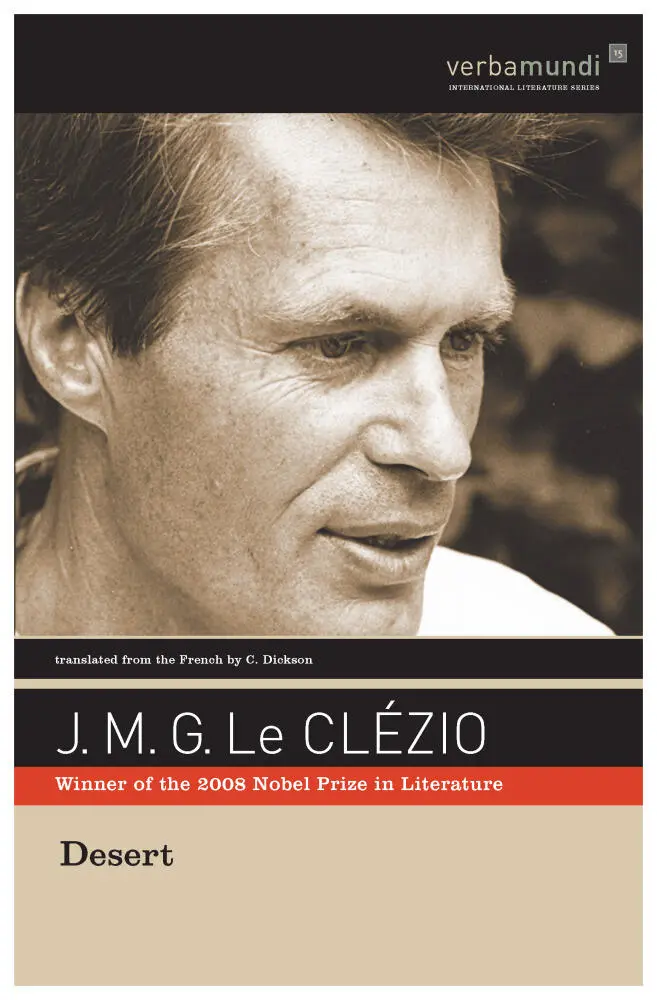
- Название:Desert
- Автор:
- Издательство:Verba Mundi Books
- Жанр:
- Год:2009
- Город:Jaffrey
- ISBN:978-1-56792-386-5
- Рейтинг книги:5 / 5. Голосов: 1
-
Избранное:Добавить в избранное
- Отзывы:
-
Ваша оценка:
Desert: краткое содержание, описание и аннотация
Предлагаем к чтению аннотацию, описание, краткое содержание или предисловие (зависит от того, что написал сам автор книги «Desert»). Если вы не нашли необходимую информацию о книге — напишите в комментариях, мы постараемся отыскать её.
Available for the first time in English translation, Desert is a novel composed of two alternating narratives, set in counterpoint. The first takes place in the desert between 1909 and 1912 and evokes the migration of a young adolescent boy, Nour, and his people, the Blue Men, notorious warriors of the desert. Driven from their lands by French colonial soldiers, Nour's tribe has come to the valley of the Saguiet El Hamra to seek the aid of the great spiritual leader known as Water of the Eyes. The religious chief sends them out from the holy city of Smara into the desert to travel still further. Spurred on by thirst, hunger, and suffering, Nour's tribe and others flee northward in the hopes of finding a land that can harbor them at last.
The second narrative relates the contemporary story of Lalla, a descendant of the Blue Men. Though she is an orphan living in a shantytown known as the Project near a coastal city in Morocco, the blood of her proud, obstinate tribe runs in her veins. All too soon, Lalla must flee to escape a forced marriage with an older, wealthy man. She travels to France, undergoing many trials there, from working as a hotel maid to becoming a highly-paid fashion model, and yet she never betrays the blood of her ancestors.
Desert — читать онлайн бесплатно полную книгу (весь текст) целиком
Ниже представлен текст книги, разбитый по страницам. Система сохранения места последней прочитанной страницы, позволяет с удобством читать онлайн бесплатно книгу «Desert», без необходимости каждый раз заново искать на чём Вы остановились. Поставьте закладку, и сможете в любой момент перейти на страницу, на которой закончили чтение.
Интервал:
Закладка:
His breath reeks of garlic, tobacco, and wine, but Lalla is glad he’s there; she thinks he’s nice with his somewhat shiny eyes. He notices that, and starts talking again, like he does, every which way, asking questions and then answering them.
“You’re not hungry anymore? Will you have a little something to drink? A cognac? No, better have something sweet, it’s good for you when you’re feeling weak, a Coke? Or some fruit juice? I’m not bothering you, am I? You know, that’s the first time I’ve ever seen someone faint right in front of me like that, fall on the ground, and it — it really threw me. I work — I’m an employee for the Post and Telecommunications, you see, I’m not used to — well, I mean, maybe you should go and see a doctor all the same, would you like me to go and phone one?”
He’s already getting up, but Lalla shakes her head, and he sits back down. Later, she drinks a little hot tea, and her exhaustion dissipates. Her face is once again copper-colored, light is shining in her eyes. She stands up and the man accompanies her out into the street.
“You’re — you’re sure you’ll be all right now? Can you walk?”
“Yes, yes, thank you,” Lalla says.
Before leaving, Paul Estève writes his name and address on a scrap of paper.
“If you need anything…”
He squeezes Lalla’s hand. He’s barely any taller than she is. His blue eyes are still all misty with emotion.
“Good-bye,” says Lalla. And she walks away as quickly as she can without looking back.
THERE ARE DOGS almost everywhere. But they’re not like the beggars, they prefer to live in the Panier, between Place de Lenche and Rue du Refuge. Lalla looks at them when she passes by, she’s wary of them, their coats bristle up, they’re very scrawny, but they don’t look anything like the wild dogs that used to steal chickens and sheep back in the Project; these dogs are bigger and stronger, and there’s something dangerous and desperate about the way they look. They go around scrounging for food in all the piles of garbage, they gnaw on old bones, fish heads, the waste the butchers throw out to them. There’s one dog that Lalla knows well. He’s always in the same spot every day, at the bottom of the stairway, near the street that leads to the big striped church. He’s all black with a collar of white fur that grows down onto his chest. His name is Dib, or Hib, she’s not sure, but in the end, his name isn’t important at all because he doesn’t really have a master. Lalla heard a little boy calling him that in the street. When he sees Lalla, he looks kind of glad and wags his tail, but he doesn’t come near her, and he won’t let anyone get near him. Lalla merely says a few words to him; she asks him how he is, but without stopping, just in passing, and if she has something to eat, she throws him a little piece.
Here in the Panier neighborhood, everyone knows everyone, more or less. It’s not the same in the rest of the city, where there are those streams of men and women flowing along the avenues, creating that great din of shoes and motors. Here in the Panier, the streets are short; they twist and open into other streets, alleyways, stairways, and it’s more like a big apartment with halls and rooms that fit together. Yet except for the big dog, Dib or Hib, and a few children whose names she doesn’t know, most people don’t even seem to see her. Lalla slips along without making a sound, going from one street to another, she follows the path of the sun and the light.
Maybe the people here are afraid? Afraid of what? It’s hard to say; it’s as if they feel they are being watched, and they have to be careful about everything they do and say. But no one is really watching them. So maybe it comes from the fact that they speak so many diVerent languages? There are the people from North Africa, the Magrhebis, Moroccans, Algerians, Tunisians, Mauritanians, and then people from Africa, the Senegalese, the Malians, the Dahomeyans, and also the Jews, who come from all over, but never really speak the language of their country; there are the Portuguese, the Spaniards, the Italians, and also the odd people, who don’t resemble the others, the Yugoslavians, the Turks, the Armenians, the Lithuanians; Lalla doesn’t know what those names mean, but that’s what everyone here calls them, and Aamma is quite familiar with all of those names. Most of all, there are the gypsies, like the ones who live in the house next door, so many of them you never know whether you’ve already seen them, or if they’ve just arrived; they don’t like Arabs, or Spaniards, or Yugoslavians; they don’t like anyone, because they’re not used to living in a place like the Panier, so they’re always ready to get into a fight, even the little boys, even the women, who, according to what Aamma says, carry razor blades in their mouths. Sometimes, at night, you’re awakened by the sound of a battle in the alleyways. Lalla goes down the stairs to the street and, in the pale light of the streetlamp, sees a man crawling on the ground holding a knife stuck in his chest. The next day, there is a long gooey streak on the ground that the flies come buzzing around.
Sometimes people from the police come too; they stop their big black cars at the bottom of the stairways and go into the houses, especially those where the Arabs and the gypsies live. There are policemen with uniforms and caps, but those aren’t the ones who are the most dangerous; it’s the others, the ones who are dressed like everyone else, gray suits and turtleneck sweaters. They knock on the doors very hard, because you have to open up right away, and they go into the apartments without saying anything, to see who’s living there. At Aamma’s, the policeman goes and sits on the vinyl sofa that Lalla uses as a bed, and she thinks he’s going to make it sag and that tonight when she goes to bed the mark where the fat man sat down will still be there.
“Name? First name? Tribal name? Resident card? Work permit? Name of employer? Social security number? Lease, rent receipt?”
He doesn’t even look at the papers Aamma gives him one after the other. He’s sitting on the sofa, smoking a Gauloise, looking bored. He does look at Lalla though, who is standing at attention in front of the door to Aamma’s room. He says to Aamma, “Is she your daughter?”
“No, she’s my niece,” Aamma says.
He takes all of the papers and examines them.
“Where are her parents?”
“They’re dead.”
“Ah,” says the policeman. He looks at the papers as if he were thinking something over.
“Does she work?”
“No, not yet, sir,” says Aamma; she says “sir” when she’s afraid.
“But she’s going to work here?”
“Yes, sir, if she finds work. It’s not easy for a young girl to find work.”
“She’s seventeen?”
“Yes, sir.”
“You must be careful, there are a lot of dangers here for a young seventeen-year-old girl.”
Aamma doesn’t say anything. The policeman thinks she hasn’t understood and insists. He talks slowly, carefully articulating each word, and his eyes are shining as if he were more interested now.
“Be careful your daughter doesn’t end up in Rue du Poids de la Farine, eh? There are lots of them over there, girls just like her, you understand?”
“Yes, sir,” says Aamma. She doesn’t dare repeat that Lalla isn’t her daughter.
But the policeman feels Lalla’s cold eyes on him, and it makes him feel uneasy. He says nothing more for several seconds, and the silence becomes unbearable. So then, in an outburst, the fat man starts over again with a furious voice, eyes squinted in anger.
“‘Yes, I know, yes,’ that’s what you say, and then one day your daughter will be on the sidewalk, a whore at ten francs a pass, so then you’d better not come crying to me and say you didn’t know, because I warned you.”
Читать дальшеИнтервал:
Закладка:
Похожие книги на «Desert»
Представляем Вашему вниманию похожие книги на «Desert» списком для выбора. Мы отобрали схожую по названию и смыслу литературу в надежде предоставить читателям больше вариантов отыскать новые, интересные, ещё непрочитанные произведения.











Обсуждение, отзывы о книге «Desert» и просто собственные мнения читателей. Оставьте ваши комментарии, напишите, что Вы думаете о произведении, его смысле или главных героях. Укажите что конкретно понравилось, а что нет, и почему Вы так считаете.