Michael Chabon - Telegraph Avenue
Здесь есть возможность читать онлайн «Michael Chabon - Telegraph Avenue» — ознакомительный отрывок электронной книги совершенно бесплатно, а после прочтения отрывка купить полную версию. В некоторых случаях можно слушать аудио, скачать через торрент в формате fb2 и присутствует краткое содержание. Город: New York, Год выпуска: 2012, ISBN: 2012, Издательство: Harper, Жанр: Современная проза, на английском языке. Описание произведения, (предисловие) а так же отзывы посетителей доступны на портале библиотеки ЛибКат.
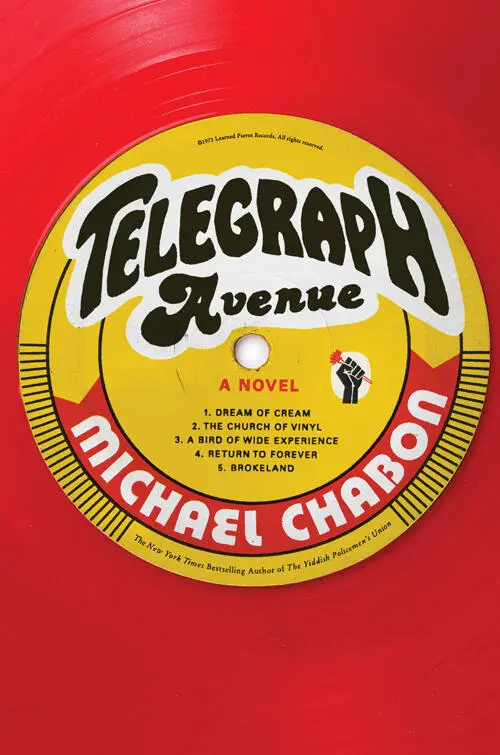
- Название:Telegraph Avenue
- Автор:
- Издательство:Harper
- Жанр:
- Год:2012
- Город:New York
- ISBN:978-0-06-149334-8
- Рейтинг книги:3.5 / 5. Голосов: 2
-
Избранное:Добавить в избранное
- Отзывы:
-
Ваша оценка:
Telegraph Avenue: краткое содержание, описание и аннотация
Предлагаем к чтению аннотацию, описание, краткое содержание или предисловие (зависит от того, что написал сам автор книги «Telegraph Avenue»). Если вы не нашли необходимую информацию о книге — напишите в комментариях, мы постараемся отыскать её.
When ex–NFL quarterback Gibson Goode, the fifth-richest black man in America, announces plans to build his latest Dogpile megastore on a nearby stretch of Telegraph Avenue, Nat and Archy fear it means certain doom for their vulnerable little enterprise. Meanwhile, Aviva and Gwen also find themselves caught up in a battle for their professional existence, one that tests the limits of their friendship. Adding another layer of complication to the couples’ already tangled lives is the surprise appearance of Titus Joyner, the teenage son Archy has never acknowledged and the love of fifteen-year-old Julius Jaffe’s life.
An intimate epic, a NorCal
set to the funky beat of classic vinyl soul-jazz and pulsing with a virtuosic, pyrotechnical style all its own,
is the great American novel we’ve been waiting for. Generous, imaginative, funny, moving, thrilling, humane, triumphant, it is Michael Chabon’s most dazzling book yet.
Telegraph Avenue — читать онлайн ознакомительный отрывок
Ниже представлен текст книги, разбитый по страницам. Система сохранения места последней прочитанной страницы, позволяет с удобством читать онлайн бесплатно книгу «Telegraph Avenue», без необходимости каждый раз заново искать на чём Вы остановились. Поставьте закладку, и сможете в любой момент перейти на страницу, на которой закончили чтение.
Интервал:
Закладка:
Part of her, call it most of her, knew that to some extent she had been playacting, licensed by her hormones to express through the theater of her departure and her return all the humiliation that Archy had forced her to endure. As Nat played, she avoided meeting Archy’s gaze and wondered if the sadness she had seen on his face was for her and him. Archy had decided to leave right after the funeral, she decided, his duffel bag and ten crates of records loaded into the back of his El Camino. She had thrown him out in pique, but now he would be leaving in earnest, just as she had always known and feared he would do. The certainty of his imminent departure came over her so strongly that she was confused by it and wondered if Nat had selected the music on purpose as a comment on her relationship with Archy.
Aviva leaned over and whispered into Gwen’s ear without taking her eyes off her husband. “This was Mr. Jones’s theme song,” she said. “According to Nat.”
Gwen understood then that whatever its ostensible subject or situation, “It’s Too Late” was about Cochise Jones. Lying useless in his casket. Sitting at the bedside of his wife when she had lain dying. The song was about the people gathered here who might never have had the chance to meet Mr. Jones, and those who might have spoken differently, said more, the last time they saw him, had they known. It was about Titus growing up with no father, and Aviva trying to hold on to her one and only baby, and the dream of Brokeland Records. It was about some large percentage of the aggregate wishes, plans, and ambitions espoused by the people gathered here today. Nat had not needed to choose “It’s Too Late” in order to comment directly on her situation with Archy. It was Mr. Jones’s theme song, and its sentiment was always appropriate.
“Perfect,” Gwen said.
“My name is Archy Stallings. All right, now. Thank you. Yes. Thank you. Those of you, some of you who don’t know me, I am one of the co-proprietors of these premises, Brokeland Records, thank you, a neighborhood institution since, count it one way, twelve years, but really, you have to count back a lot further than that. For real. Back, like, before they had vinyl records, back before they even had Mr. Jones, and Mr. Jones was here a good long time. And I mean he was right here . Seriously. Right there, on that stool, where his picture’s looking at you, in prime form if I may say, got to love that Borsalino. Mr. Jones spent a lot of time and money at this address over the years, first when it used to be a barbershop. Spencer’s Barbershop, that’s right. I got my hair cut here quite a few times, I was a youngster. And then Mr. Jones spent even more of his money here, the past twelve years, buying records! A whole lot of records, from me and my partner, Nat Jaffe, who just now tore it up, am I right? Yes, I am. Tore it up on Mr. Jones’s signature tune, ‘It’s Too Late,’ thank you, Nat, for that.
“Now, if you talked to Mr. Jones for any length of time, and it took a long time to get anything out of Mr. Jones, man preferred to listen, witness, I bet most of you had no idea until this very afternoon, all due respect to Dr. Hanselius from the library, oh my goodness, Cochise Jones, look at you, dressing like that all the time, riding around town in your big old van with your gold toothpick, and all the time you secretly a Communist ! Mr. Jones was like, almost like a father to me, used to pass me a little cash every now and then, kept an eye on me. Talked to me, and like I’m saying, that was, you know, it took an effort for him.
“Anyway, if you could drag it out of him, you found out sooner or later that Mr. Jones came here to Oakland from somewhere down in Louisiana, outside of New Orleans, was it Slidell? Yes, when he was fourteen, fifteen. His dad got a job working at the cannery, the one where the DMV is now? The Lusk Cannery, yes. That is all long before my time. But Mr. Jones used to tell me things, you know, every so often the parrot would lay off talking, Nat there just about finished up with the daily rant, ha, ha, something used to bubble up out of Mr. Jones. About the neighborhood. Things he remembered. Coming up a little boy in Louisiana, hearing things from the old folks, some of those people went way on back, back up almost to slavery times.
“I don’t know how many black folks came up to Oakland from Louisiana, Alabama, Texas, you know, back at the time when Mr. Jones and his family came here. Many, many thousands, tens of thousands. Yeah, so, they left most of what little they had down south, but they brought the music they liked, going back to like Congo Square or whatever. Jazz and boogie, church music. And then getting off the train in Oakland, everything’s booming. That’s when, if you came inside here, you most likely would be hearing that rocking postwar blues, that jump music, coming out of the radio Eddie Spencer used to keep on this shelf behind me.
“You listen to that music now, like Joe Houston, it’s rock and roll, right? Same music. Joe Turner. And that’s the kind of music Mr. Jones started out playing in public. That and church music, and church music, that’s like, that’s the original rock and roll. I can tell, looking at his face, my partner has certain bones to pick with my theorizing on this subject, but hey, we did that roshambo and I drew the eulogy, so hang with me, all right? I think you are going to like where this is going.
“Yeah, so, when he was in high school, Mr. Jones had a band, they were all black kids, played rhythm and blues, Drifters covers. But he also used to play sometimes with a bunch of white boys, I think they were called the Pearl Tones, was that it? Based out of Skyline High. Even when he first got known, in like ’64, ’65, playing straight-ahead jazz, kind of following on the organ a little bit what Ahmad Jamal was doing on the piano, even then he never totally lost that rocking touch. I know it always used to, not bother him, but make him a little sad the way people sat around listening to jazz. To those Eric Dolphy joints he played on, people nodding a little bit, tapping their feet, but not, you know, not up jumping around, getting wild, the way black folks generally, historically speaking, have tended to do.
“Meanwhile, on the radio, Mr. Jones is hearing Jimi Hendrix, hearing Sly Stone. Not just white boys playing black music, like always, or even black dudes playing in a white style, but really, like, this moment, this one moment, lasted four, five years, when the styles and the players were mixing it all up. The Temptations, some of that late stuff is heavy in the true rock-and-roll vernacular. And Mr. Jones, he knew Sly Stone, they was even related by marriage somehow, he started working some of that same idea into the jazz that he started to play.
“And even though he never lost that smooth approach, that soft touch on the right hand, his left hand, ’67, ’68, it started to get extremely funky. But Mr. Jones didn’t call his style ‘funky,’ I don’t believe I ever heard him use that term at all. Church music, jump music, rock and roll, hard bop, soul-jazz, none of that. We get into a lot of, like, genre arguments around here, like, is Donald Byrd’s Street Lady soul-jazz, or is it more to the side of jazz-funk? Is ‘hard bop’ redundant? Mr. Jones never took part in those discussions. But one time, I do remember, he called what he played ‘Brokeland Creole.’
“Creole, that’s, to me, it sums it up. That means you stop drawing those lines. It means Africa and Europe cooked up in the same skillet. Chopin, hymns, Irish music, polyrhythms, talking drums. And people. Cochise Jones, his mother was mostly, uh, Choctaw, I think it was. Me, my father’s half Mexican, which is already half something else. Brokeland Creole. Around here used to be Mexico, before that, Spain, before that, Ohlone. And then white people, Chinese, Japanese, black folks bringing that bayou, that Seminole, that Houston vibe. Filipinos. Toss ’em on the grill, go ’head. Brokeland Creole. And some more Mexicans, Guatemalans. Thai, Vietnamese. Hmong. Uh, Persian. Punjab, Mr. Mirchandani. Mr. Mirchandani, here’s an example right here. All them good samosas back there, piled up next to the fried chicken? I— Yeah. I know I had a point I was going to make. Ha, seriously. Yeah, no, okay.
Читать дальшеИнтервал:
Закладка:
Похожие книги на «Telegraph Avenue»
Представляем Вашему вниманию похожие книги на «Telegraph Avenue» списком для выбора. Мы отобрали схожую по названию и смыслу литературу в надежде предоставить читателям больше вариантов отыскать новые, интересные, ещё непрочитанные произведения.







Обсуждение, отзывы о книге «Telegraph Avenue» и просто собственные мнения читателей. Оставьте ваши комментарии, напишите, что Вы думаете о произведении, его смысле или главных героях. Укажите что конкретно понравилось, а что нет, и почему Вы так считаете.