Michael Chabon - Telegraph Avenue
Здесь есть возможность читать онлайн «Michael Chabon - Telegraph Avenue» — ознакомительный отрывок электронной книги совершенно бесплатно, а после прочтения отрывка купить полную версию. В некоторых случаях можно слушать аудио, скачать через торрент в формате fb2 и присутствует краткое содержание. Город: New York, Год выпуска: 2012, ISBN: 2012, Издательство: Harper, Жанр: Современная проза, на английском языке. Описание произведения, (предисловие) а так же отзывы посетителей доступны на портале библиотеки ЛибКат.
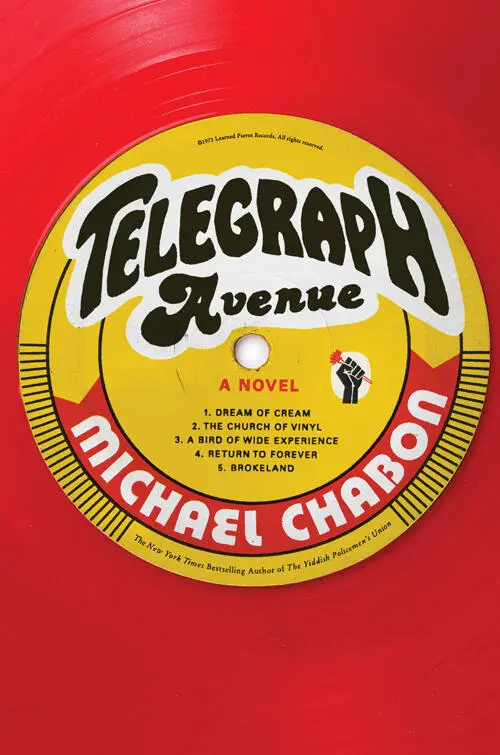
- Название:Telegraph Avenue
- Автор:
- Издательство:Harper
- Жанр:
- Год:2012
- Город:New York
- ISBN:978-0-06-149334-8
- Рейтинг книги:3.5 / 5. Голосов: 2
-
Избранное:Добавить в избранное
- Отзывы:
-
Ваша оценка:
Telegraph Avenue: краткое содержание, описание и аннотация
Предлагаем к чтению аннотацию, описание, краткое содержание или предисловие (зависит от того, что написал сам автор книги «Telegraph Avenue»). Если вы не нашли необходимую информацию о книге — напишите в комментариях, мы постараемся отыскать её.
When ex–NFL quarterback Gibson Goode, the fifth-richest black man in America, announces plans to build his latest Dogpile megastore on a nearby stretch of Telegraph Avenue, Nat and Archy fear it means certain doom for their vulnerable little enterprise. Meanwhile, Aviva and Gwen also find themselves caught up in a battle for their professional existence, one that tests the limits of their friendship. Adding another layer of complication to the couples’ already tangled lives is the surprise appearance of Titus Joyner, the teenage son Archy has never acknowledged and the love of fifteen-year-old Julius Jaffe’s life.
An intimate epic, a NorCal
set to the funky beat of classic vinyl soul-jazz and pulsing with a virtuosic, pyrotechnical style all its own,
is the great American novel we’ve been waiting for. Generous, imaginative, funny, moving, thrilling, humane, triumphant, it is Michael Chabon’s most dazzling book yet.
Telegraph Avenue — читать онлайн ознакомительный отрывок
Ниже представлен текст книги, разбитый по страницам. Система сохранения места последней прочитанной страницы, позволяет с удобством читать онлайн бесплатно книгу «Telegraph Avenue», без необходимости каждый раз заново искать на чём Вы остановились. Поставьте закладку, и сможете в любой момент перейти на страницу, на которой закончили чтение.
Интервал:
Закладка:
Gwen showed up almost twenty minutes late, working on fifteen hours of sleep in her very own bed, feeling like she had taken a powerful cortico-stimulant. Feeling dauntless, even when it turned out she could barely get in the front door. All kinds of people had come to represent for Mr. Jones. Neighborhood folks, hipsters, beefy and bearded record collectors. Kai and her bandmates, eighteen women all resplendent in leisure suits from Mr. Jones’s collection. The regulars, Moby, Mr. Mirchandani, Singletary. By the casket, Chan Flowers, arms folded, that James Brown shine on his big old hair, eyed the face of the dead man with a critical squint. Everybody standing, except for a few lucky folks right toward the front counter who had been granted the use of folding chairs.
Gwen’s gaze found Archy’s. He stood way at the back by the beaded curtain, towering mournfully over the buffet. Gwen did not linger on his sweet, sad, pouchy eyes. They had brought in some kind of platform and shone a light on the killer B-3. Nat stood beside it, arms folded, as though to restrain it from further acts of violence. He arched an eyebrow in greeting and then returned his attention to an unknown old white man standing on the far side of the organ, in front of the Leslie. In an indefinite European accent, the old man was speaking earnestly to the crowd, talking about Mr. Jones’s political beliefs, of which Gwen (like most people in the room) had been ignorant until now. Red, as it turned out, as Cochise himself.
Aviva’s jungly head scarf caught Gwen’s eye, in the row by the front counter. Aviva was one of the people in chairs. She raised a hand to Gwen: There was an empty seat beside her. Gwen would have to take it. She knew that Aviva was angry, and knowing that was enough to make Gwen angry, too. But she was too pregnant to stand.
As Gwen worked her way into the crowd like an icebreaker shouldering the floes, Aviva picked up her purse, which she had been using to save the seat for Gwen.
“Who is this guy?” Gwen whispered into Aviva’s ear when she sat down. Aviva’s hair had a bay leaf smell.
“He’s from, I guess a Marxist library down the street.”
Gwen had been unaware, as well, that Telegraph Avenue featured a Marxist library. She tried to imagine it as a place that would feel congenial to a man who not only dressed the way Mr. Jones dressed but also understood, according to the fluty-voiced old Marxist librarian, the interactions of base and superstructure, the way ultimately, class struggle underpinned all the racism in America.
“That the Aztec number?” Gwen whispered, grasping for the first time the splendor of the corpse.
Aviva nodded.
“Shh,” said the woman on the other side of Gwen. She was a freaky-looking old Cruella with a brindle shih tzu perched on her lap.
“Sorry,” Gwen said to the scary old lady.
“Me, too,” Aviva said to Gwen immediately, as if she had been holding that for Gwen’s arrival as well.
Gwen considered correcting Aviva’s misapprehension that she had apologized for what Aviva had called her “performance” in the hearing at Chimes. But some impulse restrained her. It was not a qualm—far from it. Maybe it was the soft, snowy mantle of sleep under which she had passed the previous night, but she felt more justified than ever in taking on those tools of the insurance companies, more justified at having thrown Archy out of the house so that she could at last get some rest. It was not the possibility that she might have been wrong, excessive, manipulative, over the top yesterday afternoon, which led Gwen to let stand the misapprehended apology. It was pure calculation, albeit buried deep: Let Aviva think she had been apologized to; it would make things easier later.
After the man from the Marxist library, there was a gap-toothed drummer who looked older than he probably was, a hundred and ten in dope years, and then Moby got up and told a story about how the first time he came into Brokeland Records, Mr. Jones had been sitting at the counter in his usual spot, rewarding his parrot, Fifty-Eight, with sunflower seeds from his jacket pocket, trying to teach him, with a deck of playing cards, to recognize the difference between the red and black suits. “‘This bird smarter than anybody you know,’” said Moby, quoting Mr. Jones too faithfully, maybe, laying on as usual with the Ebonics. “‘He don’t learn how to play poker, just mean I didn’t give him a adequate schooling.’”
Most of the room broke up into laughter. Gwen looked over at the organ to see how Nat was taking the lawyer’s routine. She knew how much he detested the way Moby slipped into his wannabe shtick. And he was really ill equipped for it, there was no denying that. If he were not so sweet and fat with that preposterous swoop-back haircut, Gwen might have taken a measure of offense at the way Moby talked, the style cobbled (with unquestionably sincere intentions of tribute) from the discarded materials of rap records, Grady Tate on Sanford and Son , a touch of Martin Lawrence, and then at the core, something really questionable, maybe Morgan Freeman as Easy Reader on The Electric Company. It sure bothered the hell out of Nat, though, look at him up there, turned around on the organ bench, working the pedals of his irritation, shooting his cuffs. If you were trying to pass as white, the thing was always to keep your distance from your darker relatives, but if you were a white guy living along the edge of blackness all your life, the worst thing was somebody around you trying to do the same.
Having concluded his remarks, Moby worked his way back to his seat, free throws made, pounding and dapping folks right and left.
“Thank you, Moby,” Nat said from the back. Everybody craned around to look at him. “You would not be so fond of that bird if you owed him as much money as I do.”
He meant it as a joke, and Aviva laughed, but it came out sounding angry, and if Gwen were a detective investigating the bird’s disappearance, she definitely would have brought Nat in for questioning.
“I’m going to play a little now,” Nat announced, as if it were a procedure and he a periodontist. Making it sound like it was not going to be any fun for anyone. “And then Mr. Stallings is going to offer the eulogy.”
Gwen tried to remember the last time she had heard Nat call Archy “Mr. Stallings.” She turned to Aviva to see if she might have picked up on something amiss between their men, but Aviva had eyes only for Nat. She was sitting up and watching him as carefully as Flowers was watching the body in the casket: wanting him to be perfect.
Nat turned to the Leslie amplifier and honored it with a bow, snapped it on. It rose throbbing to life. A wind flowed through its mysterious antique machinery. Nat sat down at the Hammond that had taken, in every sense, Mr. Jones’s life. It was not Nat’s instrument, but he had a gift, could pick up pretty much any instrument and quickly figure it out well enough to fake it. He played piano, and Gwen assumed that his organ playing would resemble that: modernistic, angular, Monk-style stuff, hard to listen to.
Nat loosened his tie. He mediated a dispute among his shirttails, his waistband, his belt, and his ass. He fiddled with the drawbars and switches of the Hammond, more for the sake of ritual than precision. With a count and a duck of his head on four, he began to play. She recognized the song as the old Carole King number “It’s Too Late.” The organ had a reedy, bluesy sound, smoke in its throat. Nat did not fool around with angles and flatted notes. His feet stoked the pedals. She did not remember any of the lyrics apart from those of the chorus, though those were enough to convey the melancholy of the song. She wanted to look for Archy, but she was afraid that if their eyes met while this song was being played, he would think she intended to send the message that Carole King had been sending to the man in her song.
Читать дальшеИнтервал:
Закладка:
Похожие книги на «Telegraph Avenue»
Представляем Вашему вниманию похожие книги на «Telegraph Avenue» списком для выбора. Мы отобрали схожую по названию и смыслу литературу в надежде предоставить читателям больше вариантов отыскать новые, интересные, ещё непрочитанные произведения.








Обсуждение, отзывы о книге «Telegraph Avenue» и просто собственные мнения читателей. Оставьте ваши комментарии, напишите, что Вы думаете о произведении, его смысле или главных героях. Укажите что конкретно понравилось, а что нет, и почему Вы так считаете.