Michael Chabon - Telegraph Avenue
Здесь есть возможность читать онлайн «Michael Chabon - Telegraph Avenue» — ознакомительный отрывок электронной книги совершенно бесплатно, а после прочтения отрывка купить полную версию. В некоторых случаях можно слушать аудио, скачать через торрент в формате fb2 и присутствует краткое содержание. Город: New York, Год выпуска: 2012, ISBN: 2012, Издательство: Harper, Жанр: Современная проза, на английском языке. Описание произведения, (предисловие) а так же отзывы посетителей доступны на портале библиотеки ЛибКат.
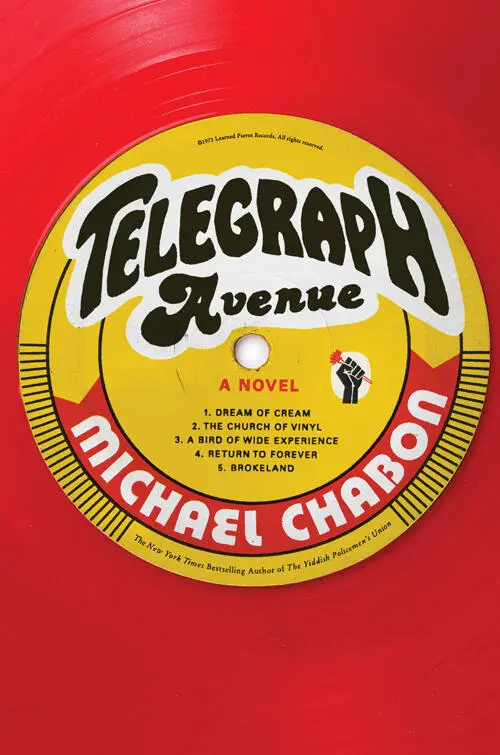
- Название:Telegraph Avenue
- Автор:
- Издательство:Harper
- Жанр:
- Год:2012
- Город:New York
- ISBN:978-0-06-149334-8
- Рейтинг книги:3.5 / 5. Голосов: 2
-
Избранное:Добавить в избранное
- Отзывы:
-
Ваша оценка:
Telegraph Avenue: краткое содержание, описание и аннотация
Предлагаем к чтению аннотацию, описание, краткое содержание или предисловие (зависит от того, что написал сам автор книги «Telegraph Avenue»). Если вы не нашли необходимую информацию о книге — напишите в комментариях, мы постараемся отыскать её.
When ex–NFL quarterback Gibson Goode, the fifth-richest black man in America, announces plans to build his latest Dogpile megastore on a nearby stretch of Telegraph Avenue, Nat and Archy fear it means certain doom for their vulnerable little enterprise. Meanwhile, Aviva and Gwen also find themselves caught up in a battle for their professional existence, one that tests the limits of their friendship. Adding another layer of complication to the couples’ already tangled lives is the surprise appearance of Titus Joyner, the teenage son Archy has never acknowledged and the love of fifteen-year-old Julius Jaffe’s life.
An intimate epic, a NorCal
set to the funky beat of classic vinyl soul-jazz and pulsing with a virtuosic, pyrotechnical style all its own,
is the great American novel we’ve been waiting for. Generous, imaginative, funny, moving, thrilling, humane, triumphant, it is Michael Chabon’s most dazzling book yet.
Telegraph Avenue — читать онлайн ознакомительный отрывок
Ниже представлен текст книги, разбитый по страницам. Система сохранения места последней прочитанной страницы, позволяет с удобством читать онлайн бесплатно книгу «Telegraph Avenue», без необходимости каждый раз заново искать на чём Вы остановились. Поставьте закладку, и сможете в любой момент перейти на страницу, на которой закончили чтение.
Интервал:
Закладка:
“Yeah. It’s called real life.”
“You’re saying that until now Gwen Shanks and Archy Stallings have been living in a fantasy world.”
“I bet Gwen feels like she’s been living in a fantasy world. Black midwife and a million white mommies. Black people live their whole lives in a fantasy world, it’s just not their fantasy.”
“Uh-huh,” Aviva said, sensing with a migraine throb a session in Jaffean theoretics coming on. “So, okay, let’s talk about what you’re going to do.”
“What I’m going to do. Okay. Let’s. One thing? I don’t want to sell fucking used vinyl records anymore.”
“Nat.”
“I actually, you know, I actually hate records. No. Let me restate that: I hate music . All music. Yeah, I repudiate it. Fuck you, music! Music is Satan. We serve its hidden agenda. It’s like a virus from space, the Andromeda strain, propagating itself. We’re just vectors for the contagion. Music is the secret puppet master.”
“Nat.”
“Think about it, Aviva. Music actually has us to the point, we’re walking around with fucking pods, with buds in our ears. Nah, I’m out. I think I’m going to get into, like, I don’t know, cheesemongering. I’m going to monger cheese. You can help me. Forget birthing babies. Christ, we already have enough babies in the world. What we need more of is really good cheese. I mean, tell me, why should we have to go all the way up to North Berkeley, there, to go to the Cheese Board for the top-quality cheese product? Why shouldn’t Oakland have a cheese collective, too, you know, South Berkeley/Oakland? Wait, no, fuck cheese. Cheese is all about spores and, and, molds and all that shit. Maybe cheese is trying to colonize our brains, too. Cheese and music duking it out for control of the human nervous system.”
“Nat—”
Rap of a hand. They both jumped. Nat rolled down his window, and Julie was there, looking cute in his little-boy grown-up shirt, with Titus beside him just looking grown up. Two boys, chomping two big hunks of gum.
“Hey, Ms. Jaffe,” Titus said.
“What are you guys doing?” said Julie, making a quick study of the dishevelment of Nat’s face, hair, and suit. “What’s wrong with Dad?”
“What’s wrong? It’s a funeral, Julie,” Aviva said. “I want you and Titus to unload all that crap out of the back of the car. The ice, the sodas. Carry it in.”
Chomp, chomp.
“Okay,” Julie said eventually. “Come on, T.”
The boys went around to the Volvo’s hatch and threw it open. Aviva watched in the rearview mirror as Titus encircled four bags of ice with his long arms and hoisted them, his face showing only a faint tautness from the strain. Duly, Julie tied the ribbon of his arms around four bags and lurched, pitched forward like a man with a stomach cramp, away from the car.
“‘Come on, T,’” Nat said. “Fucking little poseur.”
She laughed, happy to see him irritable again. She let go of every part of him except for his hand, which she squeezed between both of hers until their wedding rings clinked like flint and steel or a pair of champagne flutes. “You’ll be all right?”
“Yeah,” he said.
“You know it’s all going to work out in the end?”
“No,” he said. “But I guess I can probably fake it.”
They got out. He grabbed two cases of Coke pony cans, and she grabbed a case of orange Jarritos, and they followed the boys into the store.
“Whoa,” Aviva said when she saw the body laid out in a casket pimped with brass like something from Jules Verne. On a flood tide of burgundy velour, the face of Mr. Jones bobbed like a hunk of driftwood worn smooth. The leisure suit gave way at its extremities to the devouring work of fire and vines. “Is that the famous Aztec number?”
“Its farewell appearance.”
“Hey, Aviva.”
She turned to Archy, standing by the food table, stuffed with partial success into an undertaker suit. She searched his face, legible as a baby’s, and saw only a mournful squint appropriate to the occasion. No sign of guilt or remorse over whatever had passed between him and Nat this morning. No hangdog skulk to his shoulders. She knew enough of his history with Gwen—in fact, she knew well more than enough—to know that regret might be days in making its appearance.
“You are looking fine, Aviva,” he said. “Wore Fernanda’s scarf, I see.”
“Thank you, Archy,” Aviva said.
Nat put a hand on her shoulder. She felt the weight of him transfer like a message. Without turning around, she knew that he was scowling at Archy, who bunched up his lips and rolled his eyes in an impatient way that confirmed her intuition.
“Sure you got enough fried chicken?” Aviva said.
Along the food table ran a sawtooth of fried-chicken mountains. Wreathed in clouds. Air tanks and Sherpas were required to reach its peaks.
“You’re kidding, right?” Nat said. “Wait, seriously, should I go get some more?”
They had brought the food in from Taco Sinaloa and from the Merritt bakery, Mr. Jones’s favorite places to eat. Endless llanos of green enchiladas and tamales, a Popocatépetl of al pastor . From Merritt, that high sierra of fried chicken. Aviva knew it pained Nat not to serve his own fried chicken at this of all parties, but Aviva had made him promise, like God postdiluvian, never to destroy the kitchen again.
“I’m kidding,” she said. “But I will mention, when black folks and Jews feed a crowd, you know many chickens will die.”
“I told Aviva how we’re closing down the store,” Nat said. “For good. Per your wishes.”
“You’re—closing—the store?” Julie said, the words emerging between grunts as he staggered past on his way to the drinks table with two cases of Martinelli’s.
“Never you mind,” Aviva said. “Archy, is it true? Did you take the job at Dogpile?”
“No,” Archy said. “I didn’t do anything, which I intend to keep on doing for as long as I can, at least until tomorrow. Nat’s just bugging out.”
Aviva grabbed hold of Nat by the elbow and turned him, boxing in his gaze with her own until he gave up and met it. “Nat, are you bugging out? If so, I need you to stop. For like the next four hours. No bugging, no tripping, no rapid cycling. You need Archy. And Archy needs you. Right, Archy?”
“From time to time,” Archy said.
“You have, what, fifty people about to show up, plus a dead guy.”
“More like a hundred,” Archy said.
“So man up,” she told her husband. “Maybe you won’t be partners after today, maybe you will. But today you definitely very much still are. And as partners, you have an obligation to stand up, to represent, for Mr. Jones.”
“That all sounds great, Aviva, and you’re such a grown-up, my hat is off to you,” Nat said. “But there’s a level underlying this thing between Archy and me that you can never hope, for all your wisdom and maturity, to understand. And that level is the one that’s all about vinyl.”
Aviva considered a number of possible replies, pointed, dismissive, sardonic. She held her tongue, because if it was about vinyl—and men like Archy and Nat would wage wars, found empires, lose their dignity and their fortunes for the sake of vinyl—then Nat was right. She would never understand.
“But I take your point,” Nat said. “And so I’m going to think of this as our last day, and live it accordingly, and do my best to honor the memory of Cochise Jones. All right? Just don’t expect me to speak to Archy.”
“He give you the silent treatment?” Aviva asked Archy.
“Might have. I didn’t notice.”
“He did,” Titus said. “Most definitely.”
Everyone turned to look at him. For Titus Joyner, in the presence of adults, it was a pretty long speech.
Читать дальшеИнтервал:
Закладка:
Похожие книги на «Telegraph Avenue»
Представляем Вашему вниманию похожие книги на «Telegraph Avenue» списком для выбора. Мы отобрали схожую по названию и смыслу литературу в надежде предоставить читателям больше вариантов отыскать новые, интересные, ещё непрочитанные произведения.








Обсуждение, отзывы о книге «Telegraph Avenue» и просто собственные мнения читателей. Оставьте ваши комментарии, напишите, что Вы думаете о произведении, его смысле или главных героях. Укажите что конкретно понравилось, а что нет, и почему Вы так считаете.