Jennifer DuBois - Cartwheel
Здесь есть возможность читать онлайн «Jennifer DuBois - Cartwheel» весь текст электронной книги совершенно бесплатно (целиком полную версию без сокращений). В некоторых случаях можно слушать аудио, скачать через торрент в формате fb2 и присутствует краткое содержание. Город: New York, Год выпуска: 2013, ISBN: 2013, Издательство: Random House, Жанр: Современная проза, Триллер, на английском языке. Описание произведения, (предисловие) а так же отзывы посетителей доступны на портале библиотеки ЛибКат.
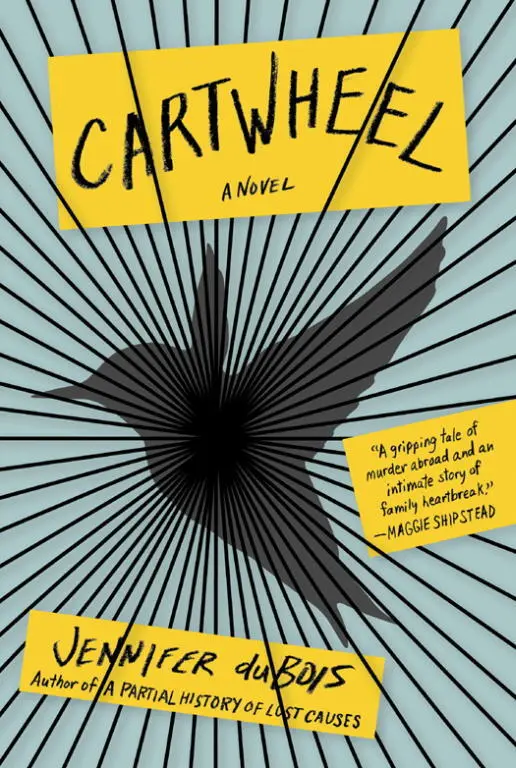
- Название:Cartwheel
- Автор:
- Издательство:Random House
- Жанр:
- Год:2013
- Город:New York
- ISBN:9780812995879
- Рейтинг книги:3 / 5. Голосов: 1
-
Избранное:Добавить в избранное
- Отзывы:
-
Ваша оценка:
Cartwheel: краткое содержание, описание и аннотация
Предлагаем к чтению аннотацию, описание, краткое содержание или предисловие (зависит от того, что написал сам автор книги «Cartwheel»). Если вы не нашли необходимую информацию о книге — напишите в комментариях, мы постараемся отыскать её.
is a suspenseful and haunting novel of an American foreign exchange student arrested for murder, and a father trying to hold his family together. Cartwheel When Lily Hayes arrives in Buenos Aires for her semester abroad, she is enchanted by everything she encounters: the colorful buildings, the street food, the handsome, elusive man next door. Her studious roommate Katy is a bit of a bore, but Lily didn’t come to Argentina to hang out with other Americans.
Five weeks later, Katy is found brutally murdered in their shared home, and Lily is the prime suspect. But who is Lily Hayes? It depends on who’s asking. As the case takes shape—revealing deceptions, secrets, and suspicious DNA—Lily appears alternately sinister and guileless through the eyes of those around her: the media, her family, the man who loves her and the man who seeks her conviction. With mordant wit and keen emotional insight,
offers a prismatic investigation of the ways we decide what to see—and to believe—in one another and ourselves.
In
, duBois delivers a novel of propulsive psychological suspense and rare moral nuance. No two readers will agree who Lily is and what happened to her roommate.
will keep you guessing until the final page, and its questions about how well we really know ourselves will linger well beyond.
Starred Review
A
Pick for Biggest Books of the Fall • A Pick for
’ Most Anticipated Books of 2013
From
“A tabloid tragedy elevated to high art.”
—
“[A] compelling, carefully crafted, and, most importantly, satisfying novel.”
—
Lily Hayes, 21, is a study-abroad student in Buenos Aires. Her life seems fairly unexceptional until her roommate, Katy, is brutally murdered, and Lily, charged with the crime, is remanded to prison pending her trial. But is she guilty, and who is Lily, really? To find answers to these questions, the novel is told from multiple points of view—not only that of Lily but also that of her family; of sardonic Sebastien, the boy with whom she has been having an affair; and of the prosecutor in the case. In the process, it raises even more questions. What possible motive could Lily have had? Why, left momentarily alone after her first interrogation, did she turn a cartwheel? And has she, as her sister asserts, always been weird? In her skillful examination of these matters, the author does an excellent job of creating and maintaining a pervasive feeling of foreboding and suspense.
Sometimes bleak, duBois’ ambitious second novel is an acute psychological study of character that rises to the level of the philosophical, specifically the existential. In this it may not be for every reader, but fans of character-driven literary fiction will welcome its challenges. Though inspired by the Amanda Knox case,
is very much its own individual work of the author’s creative imagination. —Michael Cart
Cartwheel — читать онлайн бесплатно полную книгу (весь текст) целиком
Ниже представлен текст книги, разбитый по страницам. Система сохранения места последней прочитанной страницы, позволяет с удобством читать онлайн бесплатно книгу «Cartwheel», без необходимости каждый раз заново искать на чём Вы остановились. Поставьте закладку, и сможете в любой момент перейти на страницу, на которой закончили чтение.
Интервал:
Закладка:
“What’s wrong?” said Eduardo. She needed money, probably. If she did, he would not need or want to ask why. If she said she needed it, he would believe her. Everybody should have someone whose belief in them is unwavering, unconditional, always. “Do you need money?” he said. “Is that it?”
Maria shimmied her head in a gesture that was neither affirmative nor negative—it was more like she was shaking water out of her ear, or a thought out of her head. She turned and stared out the window for a moment, and by the time she turned back her mood seemed to have already shifted. Eduardo knew better than to be surprised.
“Doesn’t it look like magic outside?” she said.
“It looks like a storm outside.”
Eduardo had never believed in Maria’s sign reading and portents and impulses; toward the end, he had stopped pretending to try, and most of the time statements of this kind provoked something terribly decretory and disappointed from her. But this time she just looked at him and clapped her hands and said, “Oh, but storms are magic!”
Eduardo shook his head. Either everything was magical or nothing was. “Do you want to take a shower or something?” he said. “You must be freezing.”
Maria ignored this and turned back to the window. “I hear you’ve got a big case,” she said. “That murderer of yours is gorgeous. Don’t you think so?”
Eduardo shrugged. He had never found Lily Hayes beautiful, particularly, though he respected her alleged beauty’s effect on the case: If she was thought to be beautiful, then indeed she was. “Is that why you’re back?” he said.
It had crossed his mind once or twice, it was true—the acclaim that might come with a conviction, the way it might hoist him up in Maria’s esteem. The way it might make her see, finally—but then, he did not know, really, what it was he thought she’d see.
Her face froze for a moment, and then she pouted and smiled. “Aren’t you glad I’m back?”
“I don’t know. Are you going to stay?”
She shrugged. “Did that girl do it?”
“Yes.”
“I think so, too,” she said with sudden fervor. “Girls are strange.” Her eyes were like black little embers now, bright and fierce. She laughed once, manically, girlishly. “But then again,” she said, “maybe not. Maybe she really didn’t do it. Do you ever think about that, Eduardo? About what if she didn’t do it?”
She shimmered over to him and began nibbling his ear. Eduardo felt a sickening sense of suspension. “Maybe she didn’t, Eduardo. Wouldn’t that be tragic?”
He should not, and yet it did not matter if he did. He’d only be left with his own solitary ruined heart either way. “It would certainly be tragic if she didn’t do it,” said Eduardo formally. He covered his ear protectively so that she would stop nibbling it. “But I assure you that it’s also very, very unlikely.”
“She fulfills a certain role, though, don’t you think?” Maria moved away from him and crossed her arms. “She’s got a symbolic function. She animates certain feelings. She’s like the sacrificial virgin. Or the sacrificial whore.”
“You’re not talking seriously,” said Eduardo. “I understand what you’re saying, but you’re not being serious. You’re not really talking about this particular girl. You’re speaking very abstractly right now.”
Maria sighed, delicately and emphatically. “I’m just musing, of course. You’re probably right. I’m sure you’re right, Eduardo. I have never known a man of as much generosity as you.”
Eduardo knew in his heart that this could not be true. And yet, here she was. She was here. Her face was sweet and even. How could he not almost believe it was true? It took so much strength not to believe it.
“I’ve missed you,” she said, and he gathered her into his arms. Her smell was heart piercing; it did violence to all other memories. She kissed him on the neck. Perhaps this was manipulation, but Eduardo did not want to be cynical enough to be sure. He was open to being wounded. He was willing to be wrong. This was, he thought, the cost of being alive.
“You’re so good to me,” said Maria, as he carried her up the stairs to the bedroom. She sighed. “I don’t know what I would do without you,” she said, as he turned out the light.
He could have left it there—he could have backed out of the room and tiptoed down the stairs to pour a tumbler of whiskey and marvel at the stunning luck of his own life—but he did not. He waited for a moment in the darkness. He wavered.
“Maria,” he said finally. “How much is it that you need?”
She sighed again. “Oh, Eduardo,” she said. He could hear her burrowing further into the sheets. “It’s kind of a lot.”
The next day, Eduardo awoke to even breathing. Beside him, Maria was a hummock of sheet crowned by a spray of dark hair. Strips of light from the window, fat and white as candles, were flattening themselves on the floor. And Eduardo felt a quiet elation that quickly turned to energy. He wanted to go to work.
He would not have expected this from himself. He would not have imagined that, having somehow conjured Maria’s return, he would be willing to even momentarily leave her again—let alone that he would actually want to go back to the jail to listen to the tearful exegesis of a murderous postadolescent’s life. Eduardo’s work was performed from love, but it was a very abstract love; he would have predicted that, blessed once more with a love that was concrete—that was sleeping right beside him—he would retreat, immediately and gratefully, into happy selfishness. He would have expected himself to want only to lie here now, lazy with his own luck, and let himself forget about the dead.
But he didn’t. Eduardo looked at Maria, and now, more than ever, he wanted to help them. Ever since he’d met her, of course, Maria had been the compass he followed when charting paths to unimaginable sorrow. He’d known that it was important to have some emotional access point when dealing with victims’ families, and so when he talked with them, he’d often spent a moment or two (a moment or two was all he could stand) contemplating what it would be like to lose Maria to violence. He had imagined the phone call, the terrible certainty he was somehow terribly certain he would somehow feel. But then she had left him, and now she was back, and the miracle of her return made more vivid to Eduardo, somehow, the unfathomability of her permanent disappearance. He thought of his grief over the past months, and he saw how shallow it had really been; now when he thought of the Kellerses—the father’s slumped shoulders, the mother’s shattered face—he could suddenly imagine, more acutely than ever before, a sadness that would truly be unending. He could imagine their unendurable rage, and the way they’d have to live in that rage in order to live at all. And he could imagine—finally, fully, with a terrible clarity—their need to have all of this witnessed. Eduardo had always known that victims’ families were not motivated by revenge—some kind of biblical, primordial desire for hurt to accompany hurt—and he had always believed that society was built on a question of witness. But never before now—as he sat gazing at his sleeping Maria—had he felt so fully the power of a love that kept looking. All these years later, the Mothers still congregated daily at the Plaza del Mayo, wearing their white shawls. This is what Maria would teach him.
Eduardo rose and went to the kitchen. He left out some fruit and instant coffee alongside a note saying that he would be back that evening. He was halfway out the door before he turned around and went back upstairs, pulled out his wedding ring from the box where he’d kept it, and put it on.
Читать дальшеИнтервал:
Закладка:
Похожие книги на «Cartwheel»
Представляем Вашему вниманию похожие книги на «Cartwheel» списком для выбора. Мы отобрали схожую по названию и смыслу литературу в надежде предоставить читателям больше вариантов отыскать новые, интересные, ещё непрочитанные произведения.











Обсуждение, отзывы о книге «Cartwheel» и просто собственные мнения читателей. Оставьте ваши комментарии, напишите, что Вы думаете о произведении, его смысле или главных героях. Укажите что конкретно понравилось, а что нет, и почему Вы так считаете.