Jennifer DuBois - Cartwheel
Здесь есть возможность читать онлайн «Jennifer DuBois - Cartwheel» весь текст электронной книги совершенно бесплатно (целиком полную версию без сокращений). В некоторых случаях можно слушать аудио, скачать через торрент в формате fb2 и присутствует краткое содержание. Город: New York, Год выпуска: 2013, ISBN: 2013, Издательство: Random House, Жанр: Современная проза, Триллер, на английском языке. Описание произведения, (предисловие) а так же отзывы посетителей доступны на портале библиотеки ЛибКат.
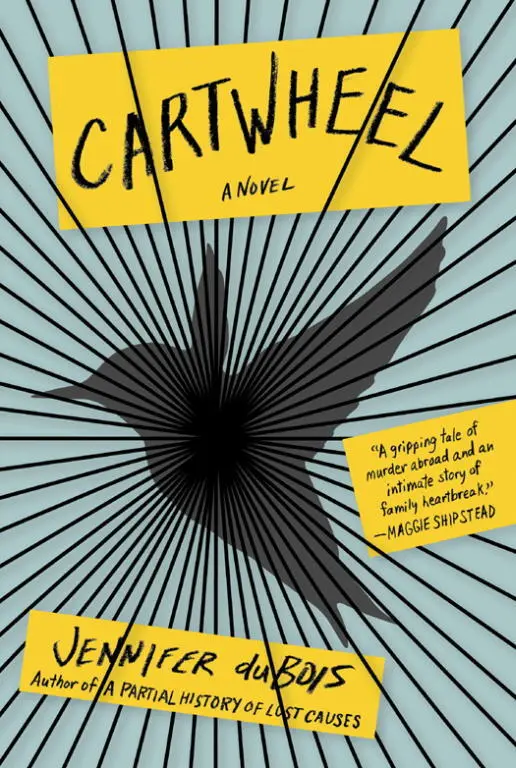
- Название:Cartwheel
- Автор:
- Издательство:Random House
- Жанр:
- Год:2013
- Город:New York
- ISBN:9780812995879
- Рейтинг книги:3 / 5. Голосов: 1
-
Избранное:Добавить в избранное
- Отзывы:
-
Ваша оценка:
Cartwheel: краткое содержание, описание и аннотация
Предлагаем к чтению аннотацию, описание, краткое содержание или предисловие (зависит от того, что написал сам автор книги «Cartwheel»). Если вы не нашли необходимую информацию о книге — напишите в комментариях, мы постараемся отыскать её.
is a suspenseful and haunting novel of an American foreign exchange student arrested for murder, and a father trying to hold his family together. Cartwheel When Lily Hayes arrives in Buenos Aires for her semester abroad, she is enchanted by everything she encounters: the colorful buildings, the street food, the handsome, elusive man next door. Her studious roommate Katy is a bit of a bore, but Lily didn’t come to Argentina to hang out with other Americans.
Five weeks later, Katy is found brutally murdered in their shared home, and Lily is the prime suspect. But who is Lily Hayes? It depends on who’s asking. As the case takes shape—revealing deceptions, secrets, and suspicious DNA—Lily appears alternately sinister and guileless through the eyes of those around her: the media, her family, the man who loves her and the man who seeks her conviction. With mordant wit and keen emotional insight,
offers a prismatic investigation of the ways we decide what to see—and to believe—in one another and ourselves.
In
, duBois delivers a novel of propulsive psychological suspense and rare moral nuance. No two readers will agree who Lily is and what happened to her roommate.
will keep you guessing until the final page, and its questions about how well we really know ourselves will linger well beyond.
Starred Review
A
Pick for Biggest Books of the Fall • A Pick for
’ Most Anticipated Books of 2013
From
“A tabloid tragedy elevated to high art.”
—
“[A] compelling, carefully crafted, and, most importantly, satisfying novel.”
—
Lily Hayes, 21, is a study-abroad student in Buenos Aires. Her life seems fairly unexceptional until her roommate, Katy, is brutally murdered, and Lily, charged with the crime, is remanded to prison pending her trial. But is she guilty, and who is Lily, really? To find answers to these questions, the novel is told from multiple points of view—not only that of Lily but also that of her family; of sardonic Sebastien, the boy with whom she has been having an affair; and of the prosecutor in the case. In the process, it raises even more questions. What possible motive could Lily have had? Why, left momentarily alone after her first interrogation, did she turn a cartwheel? And has she, as her sister asserts, always been weird? In her skillful examination of these matters, the author does an excellent job of creating and maintaining a pervasive feeling of foreboding and suspense.
Sometimes bleak, duBois’ ambitious second novel is an acute psychological study of character that rises to the level of the philosophical, specifically the existential. In this it may not be for every reader, but fans of character-driven literary fiction will welcome its challenges. Though inspired by the Amanda Knox case,
is very much its own individual work of the author’s creative imagination. —Michael Cart
Cartwheel — читать онлайн бесплатно полную книгу (весь текст) целиком
Ниже представлен текст книги, разбитый по страницам. Система сохранения места последней прочитанной страницы, позволяет с удобством читать онлайн бесплатно книгу «Cartwheel», без необходимости каждый раз заново искать на чём Вы остановились. Поставьте закладку, и сможете в любой момент перейти на страницу, на которой закончили чтение.
Интервал:
Закладка:
On Eduardo’s desk was a note from the secretary saying that the Kellerses were going to be late. Eduardo sat and called down for the newspaper. When it arrived, he was not surprised to find a grainy Lily Hayes staring back at him from the front page. The picture was a still from the Changomas security videotape; in it, Lily’s face was tense, her expression suggestive, Eduardo thought, of some kind of barely subdued rage. Inside the paper, the story of Katy Kellers’s murder was described in lurid fonts and blaring tones. Eduardo read with mild interest. The media was usually, though not always, a help to the prosecution. This made sense, in a way: After all, the media wasn’t some abstract monolith; it was composed of people, people who—like everyone else—wanted a story they could believe. And by the time a defendant made it into the news, there was a high likelihood that that defendant was, in fact, guilty; the state had already applied its considerable resources toward establishing that truth. This presumption of guilt bled into the reporting, of course, and the handling of Lily Hayes’s case was no exception: The media had managed to unearth everything she had ever written online (the coarse and callow emails, the narcissistic and weirdly long-winded diary entries on publicly viewable journals, the Facebook status updates that had endured out in the ether, long after she’d forgotten them) as well as everything anyone had ever written about her (her childhood friends had some interesting stories). Eduardo was aware that all of this gave him an unfair advantage. Nevertheless, he could not bring himself to regret it. He was glad to live in a nation that spent some amount of attention on the victims of crimes. How could a country like Argentina be otherwise? You brutalize a people for long enough, and they start paying pretty close attention to brutality.
The Kellerses were announced, and moments later they appeared—mother, father, and remaining daughter, all huddled in a little unit.
“I am so sorry for your loss,” said Eduardo, extending his hand to Mr. Kellers. This was the truest thing, and the most important thing to say, and so it came first.
“Thank you,” said Mr. Kellers. He took Eduardo’s hand slowly, as though he were moving through water, though his handshake, when it finally came, was firm. His wife and daughter hung behind him. They were small and fair and wore expensive-looking yoga clothes—soft gray workout pullovers that looked like they were made of cashmere, form-fitting black breathable fabrics that clung to their shapely hindquarters. The whole family gave off some kind of sleek Los Angeles glamour even though, as Eduardo kept having to remind people, none of them were in the movie business. Glamour must have been in the air out in California; at a certain point, one absorbed and internalized and metabolized it. And Eduardo could see how telegenic this family would be, how tearful and wholesome; he could see how, in their press conferences, they would almost certainly say the right things. It was not cynical to notice this. It was Eduardo’s job to notice this. And the only way he could help the Kellerses now was by doing his job very, very well.
Eduardo ushered the family into chairs and offered them glasses of water. They responded with syncopated thank-yous, vacant and reflexive. When you looked at them more closely, the wages of their grief became more apparent. The sister’s lips were so dry they looked nearly shattered. The mother’s hair, pulled back tight into a ponytail, had clearly gone without its touch-up dye job for longer than was typical; a few stray hairs, white and brittle, fanned out from the part in her hair, where Eduardo could see a few blushes of skull, pink as the interior of a seashell.
His heart broke for all of them.
As quickly as possible, Eduardo explained to them the contours of the case—his belief in Lily Hayes’s involvement, the certainty of another person’s, his confidence that he was on the verge of putting the entire puzzle together. The Kellerses nodded in staggered nods, baffled and bereft.
After he had explained everything he could, Eduardo attempted a few forays at small talk (how had their flight been, and what arrangements had been made, and could they tell him a little bit about Katy—this last elicited such a soul-rending whimper from the mother that Eduardo found himself leaning away from her, as though he could somehow physically retract the question). At a certain point, Katy’s sister began crying quietly, and the way her mother comforted her—giving half-conscious strokes that disowned with every gesture the idea that any of this could actually be made survivable, while quietly beginning to cry herself—made it clear to Eduardo that this was a scene that had been repeated many times already, and would continue long after they were back in Los Angeles and their part here had been concluded.
On their way out the door, Mr. Kellers paused. “How long have you been doing this work?” It did not sound challenging. He was just trying to keep track of all the new realities. That was his job.
“Seven years,” said Eduardo.
“Do you get a lot of convictions?”
“Yes.”
Mr. Kellers nodded crisply, as though pleased with a purchase, though both he and Eduardo knew that he had no choice about Eduardo.
“We’ll meet in a few days,” said Eduardo. “Once you’ve all settled in and have had a chance to process things a bit.”
They nodded. Eduardo walked them out to their rental car. Mrs. Kellers produced sunglasses from her bag; they were huge and ornate, a throwback to less utilitarian times than these. The sister did not have any, and she looked painfully away—Eduardo had to think on purpose—into the sun’s wretched brightness.
By the time Eduardo got home that night, a storm was starting. It was only seven o’clock, and he peered warily into the yawning maw of the evening; he could feel the black edge of depression clamping down on his shoulders already. Sometimes he thought of it as weather, and sometimes as a wild beast. Most often he thought of it as the lid of an enormous pot in which he was being set to boil; sometimes—like tonight—he could almost hear it clattering above him.
The wind was making heaving sounds, shuddery and mechanical, and the air smelled vaguely brackish. Eduardo gazed out the window into the rapidly descending darkness. He suddenly felt that he was staring into, or out of, a great shroud. He shivered and went upstairs to turn on the television. There was a thumping sound from somewhere downstairs, and he congratulated himself for not jumping. He went to close the windows in the bedroom. There was another thumping sound, this one undeniable. Perhaps the house was being robbed; perhaps a disgruntled former defendant had come back, finally, to kill him. Eduardo considered this possibility with abstract interest, then went downstairs.
Standing just outside the open door, her hair streaming wet, was Maria.
“Can I come in?” she said. Her face was electric, aflame within the wild dendrites of her hair. Eduardo felt as though he’d been slammed into a wall. He stepped away from the door to let her inside.
“I’m sorry. I still had a key,” she said irrelevantly, holding it up and then falling into Eduardo’s arms. He held her numbly. Because of the rain on her face, it was very hard to tell if she’d been crying.
“What’s happened?” he said. “Are you okay?”
She looked up at him and laughed a little. “I’m sorry,” she said. Her mouth was full and dark. “Do you mind if I take off my shoes? They’re wet.”
“Everything you’re wearing is wet.”
“You’re so literal.”
Maria kicked off her shoes and padded barefoot to the window. Her dress was plastered to her body. She was dripping on the carpet but did not seem to notice.
Читать дальшеИнтервал:
Закладка:
Похожие книги на «Cartwheel»
Представляем Вашему вниманию похожие книги на «Cartwheel» списком для выбора. Мы отобрали схожую по названию и смыслу литературу в надежде предоставить читателям больше вариантов отыскать новые, интересные, ещё непрочитанные произведения.












Обсуждение, отзывы о книге «Cartwheel» и просто собственные мнения читателей. Оставьте ваши комментарии, напишите, что Вы думаете о произведении, его смысле или главных героях. Укажите что конкретно понравилось, а что нет, и почему Вы так считаете.