Jennifer DuBois - Cartwheel
Здесь есть возможность читать онлайн «Jennifer DuBois - Cartwheel» весь текст электронной книги совершенно бесплатно (целиком полную версию без сокращений). В некоторых случаях можно слушать аудио, скачать через торрент в формате fb2 и присутствует краткое содержание. Город: New York, Год выпуска: 2013, ISBN: 2013, Издательство: Random House, Жанр: Современная проза, Триллер, на английском языке. Описание произведения, (предисловие) а так же отзывы посетителей доступны на портале библиотеки ЛибКат.
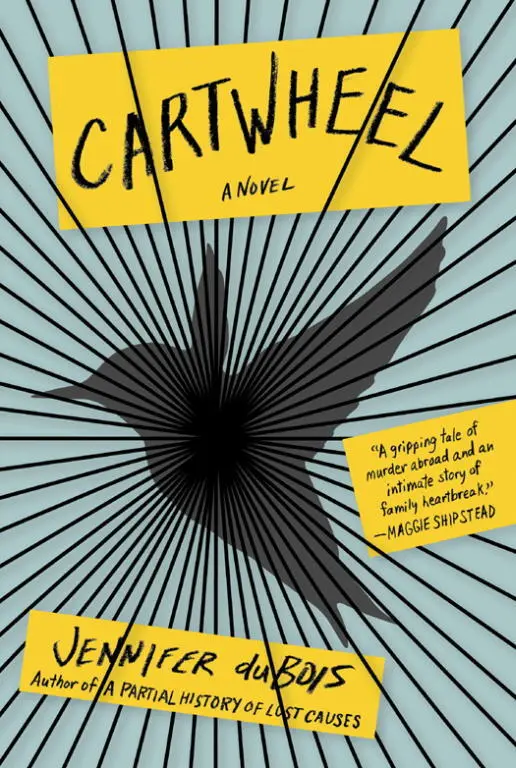
- Название:Cartwheel
- Автор:
- Издательство:Random House
- Жанр:
- Год:2013
- Город:New York
- ISBN:9780812995879
- Рейтинг книги:3 / 5. Голосов: 1
-
Избранное:Добавить в избранное
- Отзывы:
-
Ваша оценка:
Cartwheel: краткое содержание, описание и аннотация
Предлагаем к чтению аннотацию, описание, краткое содержание или предисловие (зависит от того, что написал сам автор книги «Cartwheel»). Если вы не нашли необходимую информацию о книге — напишите в комментариях, мы постараемся отыскать её.
is a suspenseful and haunting novel of an American foreign exchange student arrested for murder, and a father trying to hold his family together. Cartwheel When Lily Hayes arrives in Buenos Aires for her semester abroad, she is enchanted by everything she encounters: the colorful buildings, the street food, the handsome, elusive man next door. Her studious roommate Katy is a bit of a bore, but Lily didn’t come to Argentina to hang out with other Americans.
Five weeks later, Katy is found brutally murdered in their shared home, and Lily is the prime suspect. But who is Lily Hayes? It depends on who’s asking. As the case takes shape—revealing deceptions, secrets, and suspicious DNA—Lily appears alternately sinister and guileless through the eyes of those around her: the media, her family, the man who loves her and the man who seeks her conviction. With mordant wit and keen emotional insight,
offers a prismatic investigation of the ways we decide what to see—and to believe—in one another and ourselves.
In
, duBois delivers a novel of propulsive psychological suspense and rare moral nuance. No two readers will agree who Lily is and what happened to her roommate.
will keep you guessing until the final page, and its questions about how well we really know ourselves will linger well beyond.
Starred Review
A
Pick for Biggest Books of the Fall • A Pick for
’ Most Anticipated Books of 2013
From
“A tabloid tragedy elevated to high art.”
—
“[A] compelling, carefully crafted, and, most importantly, satisfying novel.”
—
Lily Hayes, 21, is a study-abroad student in Buenos Aires. Her life seems fairly unexceptional until her roommate, Katy, is brutally murdered, and Lily, charged with the crime, is remanded to prison pending her trial. But is she guilty, and who is Lily, really? To find answers to these questions, the novel is told from multiple points of view—not only that of Lily but also that of her family; of sardonic Sebastien, the boy with whom she has been having an affair; and of the prosecutor in the case. In the process, it raises even more questions. What possible motive could Lily have had? Why, left momentarily alone after her first interrogation, did she turn a cartwheel? And has she, as her sister asserts, always been weird? In her skillful examination of these matters, the author does an excellent job of creating and maintaining a pervasive feeling of foreboding and suspense.
Sometimes bleak, duBois’ ambitious second novel is an acute psychological study of character that rises to the level of the philosophical, specifically the existential. In this it may not be for every reader, but fans of character-driven literary fiction will welcome its challenges. Though inspired by the Amanda Knox case,
is very much its own individual work of the author’s creative imagination. —Michael Cart
Cartwheel — читать онлайн бесплатно полную книгу (весь текст) целиком
Ниже представлен текст книги, разбитый по страницам. Система сохранения места последней прочитанной страницы, позволяет с удобством читать онлайн бесплатно книгу «Cartwheel», без необходимости каждый раз заново искать на чём Вы остановились. Поставьте закладку, и сможете в любой момент перейти на страницу, на которой закончили чтение.
Интервал:
Закладка:
At the jail, Lily Hayes looked worse already, somehow. Her hair was duller, her eyes more glassine; there were pockets of gray underneath them, as though she’d been stroked lightly by ash. Grimy yellow light from the window cut strange angles on her face. Whether or not Lily Hayes had ever been beautiful, there was no denying the swiftness of her unraveling: She was simply no longer the girl who’d stood in front of the Basílica Nuestra Señora de Luján, wearing nothing, inebriated with her own youth. Eduardo was always amazed at how contingent good health and looks and spirits were; most people tended to look terrible and act even worse after just a few days in a jail, and Eduardo routinely left his interviews deeply unsure of the durability of character. The truth was, he did not know how he’d fare in Lily’s shoes. The other truth was, he did not want to know. The final truth was, he would never do anything that would force him to find out, and this ignorance was the reward—and maybe the only sure reward—of virtue.
Nevertheless, it was impossible not to feel some pity for Lily Hayes now, so Eduardo let himself feel it. This was the worst she’d ever had it, and things were likely to get a whole lot worse. And it was possible, of course, that she didn’t even believe she’d done it; it was possible, after all, that she had galloping undiagnosed autism or some kind of horrific chemical imbalance or that she had been sexually abused as a child. Most defendants Eduardo saw had had lives that were hard from the start, lives that would have required enormous effort and luck and preternatural goodness just to properly begin. Eduardo did not think that Lily’s life had been like that, but still, he had to acknowledge that it might have been. And even if it had not, she still might not know, not really, what she had done. Eduardo had encountered cases like that—when the perpetrator took a while to fully believe it—and he could imagine few things worse than enduring such a realization. A person who had murdered had ventured onto unmapped territories; he could not put his trouble into any kind of redeeming context, or situate it within any kind of myth; there was no consolation in the universality or inevitability of the thing. It was irreducible, and the suffering a person must feel in such times went so far beyond the pale of normal human suffering—so far beyond the natural landscapes of grief and loss and heartbreak—that only generosity could be extended to him. He was utterly alone in what he’d done. All that was left was for the details of his interminable aloneness to be codified and solidified, made formal in court. For a man like Eduardo, who feared loneliness so mightily, this fate seemed worse than any.
“Can I have a glass of water?” said Lily. Her voice was froggish and lower than the last time he’d heard it.
“Later,” said Eduardo, spreading his papers out on the table. He always made an elaborate show of doing this, as though the papers belonged in a very particular order. “I have a couple of questions for you first.”
“You’re wearing a wedding ring today.”
Eduardo felt an instinctive pull to put his hand under the table, but he resisted it. “That’s so,” he said.
Lily tilted her head back to straight. “Perhaps congratulations are in order.”
Eduardo leaned back. “We’re not here to talk about me.”
“What’s that, some kind of therapy talk?”
Eduardo smiled benignly. “It’s just a reality.”
The bottom line was that whatever might be wrong with Lily Hayes was not what really mattered: Justice was on behalf of the dead, and on behalf of those who remembered the dead. It was on behalf of the notion that lives, even mortal lives, mattered.
“Tell me about your life here,” said Eduardo.
Lily looked at him evenly and licked her lips. “It’s pretty dull, actually.” Her voice cracked slightly, and Eduardo realized that, of course, she had not spoken all day. “You’re probably the highlight.”
Eduardo was glad she could still make a joke, though he did not smile at it. “Here in Buenos Aires,” he said. “Before all of this.”
“I’ve told you everything already.”
“Tell me again.”
“Tell you what?”
“You lived with the Carrizos?”
“You know I lived with the Carrizos.”
“And you liked them?”
“I like them.”
“Tell me again about the night Katy was killed.”
“I’ve told you already.”
“Tell me again.”
“I went over to Sebastien’s. We had a few drinks.”
“How many drinks?”
“I don’t know. A few.”
“Three?”
“Maybe more.”
“Maybe four?”
“Maybe five.”
“Maybe five. Okay. And you smoked some marijuana.”
“We smoked some marijuana, yes.”
“And where did you get this marijuana?”
Lily hesitated.
“I can absolutely assure you,” said Eduardo, “that this is the very least of your problems.”
“Katy gave it to me,” she said.
Eduardo raised his eyebrows. “Did she?”
“Yes. I don’t know where she got it.”
“I see,” said Eduardo. She was obviously lying about the marijuana—most likely trying to protect some idiotic study-abroad friend of hers from getting thrown in prison; even Eduardo occasionally found his nation’s drug policy somewhat overwrought—but it probably wouldn’t matter. And if it did, Eduardo would remember. “And what time did you and Sebastien go to sleep?”
“I don’t know. Four in the morning, maybe.”
“Four in the morning, you say. Okay.” If Eduardo had worn glasses, he would have taken them off now. Instead, he squeezed the bridge of his nose. “But you’re a relatively petite woman, and you’d had five drinks, as well as some unknown quantity of marijuana. Can you really be sure of what time you went to bed?”
“I don’t know. It was late.”
“Can you really be sure of anything that happened that night, for that matter? After so much alcohol and marijuana?”
“I mean, it wasn’t LSD.”
“I’ll make a note of that.” Eduardo made the note sardonically. He wouldn’t have had to make the note even if she’d said something real, of course. But he had found that the churning muscle of his memory was most formidable when he kept it a secret.
“I know I didn’t kill anyone,” said Lily. “And I know we went to bed late, anyway. It was late.”
“And you didn’t hear or see anything suspicious that night?”
“No.”
“But again, you wouldn’t necessarily remember.”
“I’m pretty sure I would remember hearing someone get killed, actually.” Lily was becoming agitated, though this wasn’t overt in her mannerisms yet; her distress was only faintly roiling her expression, like an animal ascending to the water’s surface from its depths. “I think it would probably make a real impression on me, in fact.”
“Lily,” said Eduardo, leaning forward. “I’m going to ask you to imagine something. If you had done this thing, why would you have done it?”
“I didn’t.”
“Let’s leave that aside for now. I’m just trying to get a sense of how this could have happened. I know you want to help Katy. I know you would have wanted to help Katy. Do you have any idea why someone might have done this to her?”
“No,” said Lily. “I didn’t do it and I would never have done it and I can never, never imagine why anybody would. And you can’t make me say that I can.”
Eduardo leaned back. “Okay, Lily. You didn’t do it, okay. But you have to admit that you might have.”
“I did not . I might not have.”
“What does that mean?”
“You’re trying to trick me. You must think I’m really unbelievably stupid.”
Читать дальшеИнтервал:
Закладка:
Похожие книги на «Cartwheel»
Представляем Вашему вниманию похожие книги на «Cartwheel» списком для выбора. Мы отобрали схожую по названию и смыслу литературу в надежде предоставить читателям больше вариантов отыскать новые, интересные, ещё непрочитанные произведения.











Обсуждение, отзывы о книге «Cartwheel» и просто собственные мнения читателей. Оставьте ваши комментарии, напишите, что Вы думаете о произведении, его смысле или главных героях. Укажите что конкретно понравилось, а что нет, и почему Вы так считаете.