Jennifer DuBois - Cartwheel
Здесь есть возможность читать онлайн «Jennifer DuBois - Cartwheel» весь текст электронной книги совершенно бесплатно (целиком полную версию без сокращений). В некоторых случаях можно слушать аудио, скачать через торрент в формате fb2 и присутствует краткое содержание. Город: New York, Год выпуска: 2013, ISBN: 2013, Издательство: Random House, Жанр: Современная проза, Триллер, на английском языке. Описание произведения, (предисловие) а так же отзывы посетителей доступны на портале библиотеки ЛибКат.
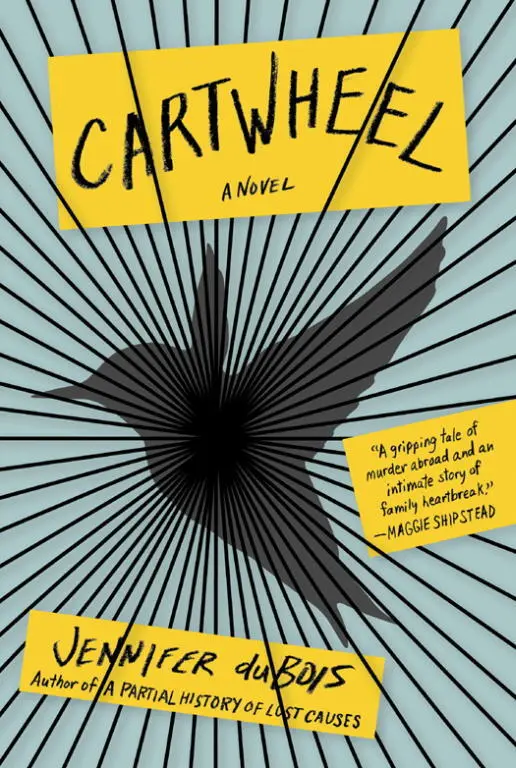
- Название:Cartwheel
- Автор:
- Издательство:Random House
- Жанр:
- Год:2013
- Город:New York
- ISBN:9780812995879
- Рейтинг книги:3 / 5. Голосов: 1
-
Избранное:Добавить в избранное
- Отзывы:
-
Ваша оценка:
Cartwheel: краткое содержание, описание и аннотация
Предлагаем к чтению аннотацию, описание, краткое содержание или предисловие (зависит от того, что написал сам автор книги «Cartwheel»). Если вы не нашли необходимую информацию о книге — напишите в комментариях, мы постараемся отыскать её.
is a suspenseful and haunting novel of an American foreign exchange student arrested for murder, and a father trying to hold his family together. Cartwheel When Lily Hayes arrives in Buenos Aires for her semester abroad, she is enchanted by everything she encounters: the colorful buildings, the street food, the handsome, elusive man next door. Her studious roommate Katy is a bit of a bore, but Lily didn’t come to Argentina to hang out with other Americans.
Five weeks later, Katy is found brutally murdered in their shared home, and Lily is the prime suspect. But who is Lily Hayes? It depends on who’s asking. As the case takes shape—revealing deceptions, secrets, and suspicious DNA—Lily appears alternately sinister and guileless through the eyes of those around her: the media, her family, the man who loves her and the man who seeks her conviction. With mordant wit and keen emotional insight,
offers a prismatic investigation of the ways we decide what to see—and to believe—in one another and ourselves.
In
, duBois delivers a novel of propulsive psychological suspense and rare moral nuance. No two readers will agree who Lily is and what happened to her roommate.
will keep you guessing until the final page, and its questions about how well we really know ourselves will linger well beyond.
Starred Review
A
Pick for Biggest Books of the Fall • A Pick for
’ Most Anticipated Books of 2013
From
“A tabloid tragedy elevated to high art.”
—
“[A] compelling, carefully crafted, and, most importantly, satisfying novel.”
—
Lily Hayes, 21, is a study-abroad student in Buenos Aires. Her life seems fairly unexceptional until her roommate, Katy, is brutally murdered, and Lily, charged with the crime, is remanded to prison pending her trial. But is she guilty, and who is Lily, really? To find answers to these questions, the novel is told from multiple points of view—not only that of Lily but also that of her family; of sardonic Sebastien, the boy with whom she has been having an affair; and of the prosecutor in the case. In the process, it raises even more questions. What possible motive could Lily have had? Why, left momentarily alone after her first interrogation, did she turn a cartwheel? And has she, as her sister asserts, always been weird? In her skillful examination of these matters, the author does an excellent job of creating and maintaining a pervasive feeling of foreboding and suspense.
Sometimes bleak, duBois’ ambitious second novel is an acute psychological study of character that rises to the level of the philosophical, specifically the existential. In this it may not be for every reader, but fans of character-driven literary fiction will welcome its challenges. Though inspired by the Amanda Knox case,
is very much its own individual work of the author’s creative imagination. —Michael Cart
Cartwheel — читать онлайн бесплатно полную книгу (весь текст) целиком
Ниже представлен текст книги, разбитый по страницам. Система сохранения места последней прочитанной страницы, позволяет с удобством читать онлайн бесплатно книгу «Cartwheel», без необходимости каждый раз заново искать на чём Вы остановились. Поставьте закладку, и сможете в любой момент перейти на страницу, на которой закончили чтение.
Интервал:
Закладка:
Eduardo put the email down. “Lily,” he said gently. “You’re in trouble. You’re scared. You’re confused. Of course you are. Who wouldn’t be? That’s natural. And I don’t know exactly what happened that night. But the best thing you can do for yourself now—and the best thing you can do for Katy—is to be completely honest. That’s the best way. I’ve seen lots of young people in trouble like you, and I can tell you—and I’m telling you this in all sincerity—that nobody ever improved their situation by lying.”
This statement itself sounded like a lie, Eduardo knew, but actually it was, in his experience, generally true. The sooner a person admitted to what had happened, the sooner they could begin the long hard work of living with themselves. Something like what Lily had done could never be made right, of course; it could not necessarily ever be made much better. But it could be made varying degrees of worse, and Eduardo believed that honesty was the way to avoid that. And one thing was certainly clear: Lily Hayes had not done this alone. And the best way to learn who she had done it with, for now, was by letting Lily externalize the scene; allowing her to watch it from a distance, as though it had happened in a movie, or to somebody else entirely. Once she could see it that way, they could work on getting her to pull back the curtain and see herself there, too, standing in the corner.
Eduardo put his hands on the folder, palms up, in a gesture he knew to be subtly imploring. “Did Katy have a lot of friends in the city?”
“Just from the program,” said Lily quietly. “And just girls.”
Just girls. As though your gender could absolve you. Was this cleverness, or was this denial? Eduardo turned his hands palms down. “Is there anybody else she knew?” he said. “Anybody you can think of? Anybody who had a problem with Katy, or anybody she had some odd dealings with?”
“No.”
“It’s a big city. It’s a dangerous city, to be frank.”
“No.” Lily’s voice was shakier.
“Any boyfriends, other than Sebastien LeCompte?”
Earlier in the week, Lily might have told him derisively that Sebastien LeCompte was not Katy’s boyfriend. But now she just shook her head weakly.
“You must have known somebody,” said Eduardo. “You’ve been in town six weeks. You had the job at Fuego. You knew so much about the city.”
“No.”
“The only way you can help yourself now is to think of someone. That’s the only way you can help Katy.”
Lily shook her head, but Eduardo could see that she’d thought of who she would say, if she had to say someone.
“Just one name,” he said. “Just one name, and we’ll check it out.”
She closed her eyes. The hollows under her eyes had turned the color of eggplant. “Maybe Javier,” her eyes still closed.
“What?”
“Javier.” She opened one eye.
“Javier Aguirre? Your boss at Fuego?”
She nodded.
“You think he could have done this?”
“No.”
“But it’s possible.”
“Anything is possible.”
It was true. Anything was possible. Maria had left once, and then she had come back again. Anything was possible, unthinkable beauty and unthinkable horror, both. The sooner Lily saw that the impossible was possible, the better it would be for everyone.
“Thank you, Lily. That’s very good. Now. Can I get you a glass of water?”
CHAPTER EIGHT
January
Because she could not bear to ask Katy about the lawsuit, Lily began looking around the house for clues. She tiptoed past the Carrizos’ bedroom and paused there, listening for revealing snatches of conversation, but somehow only ever heard the TV. She gazed at Carlos’s face searchingly during dinner; she tried to use words like “corruption” and “fraud” and “disaster” to see if any of them stuck. She realized that she was half-hoping to be able to bring some kind of treasured bit of information back to Katy—to drop some spectacular revelation casually into conversation as though it were common knowledge and then widen her eyes in shock when Katy expressed surprise. “What?” she’d squeal gleefully. “You didn’t know ?” But in spite of her best efforts, often enough Lily forgot to spy and missed the best opportunities—when the mail came in, when the phone rang, when Beatriz and Carlos spoke in hushed murmurs in the kitchen.
Around Lily, the city flashed from spectacular to hideous to ordinary, like a sky in a fast-motion video. In a strange inversion of what she’d experienced when she first arrived in Buenos Aires, Lily found herself lost in extended reveries about New England. She remembered the brutal wheels of white light coming off the rivers; the snarl of lemon-colored leaves in the fall, making crisp fragile sounds like dead insects underfoot. She remembered the celestial whiteness of winter mornings, the clean searing smell of apocalypse. She remembered the languor and contingency and drama of the summer: the heavy sulfur smell before thunderstorms; the understated nodding of the leaves, like they were acquiescing or drifting off to sleep. She remembered the way the light tongued the bark of the trees on summer late afternoons, the heartbreaking sense of time passing, time passing, time passed.
She had been away, she realized, only a month.
And when she turned her thoughts back to Buenos Aires, Lily found that the city no longer seemed so exotic. She caught herself effortlessly riding the Subte, confident in all transactions and maneuvers, without secretly feeling very independent and proud. She knew which restaurants were overpriced and which buses had pickpockets and how to avoid them both. She knew to expect sloppy cheek kisses from perfect strangers, and she had learned, finally, not to look so surprised when they came. On the weekends, she watched the tourists carrying around their cameras, timid and admiring, and felt a certain scorn. Lily was different from them now, and better; she had more in common with the porteños than the tourists. And when she saw a HELP WANTED sign at a Belgrano café/club called Fuego, she felt breezy enough to go in and apply even though she didn’t have a work visa. She walked out fifteen minutes later with a job.
Lily’s boss at the café was Javier Aguirre, a Brazilian with incredibly black skin. Lily was not sure she’d ever seen a person with skin so black—there was almost a purity to it, she thought: This was how people were supposed to look, before they began migrating north to snowy climes and growing pale and dumpy. Lily broke a wineglass her first night on the job and her drawer came up short the second—but Javier seemed to believe that this was a failure of competence, not of honesty, and he kept her on. Both times, Ignacio the weeknight bartender gave Lily cigarettes and told her dirty jokes to cheer her up afterward.
“What do you want a job for?” Beatriz said one night, rinsing cucumbers at the sink. “Don’t we feed you enough?”
Lily frowned. She didn’t know how to explain it. “Of course you do,” she said. “This is just for spending money.”
But it wasn’t, really. Lily actually liked working at Fuego. She liked the banter with the waiters and the customers, and she liked the happy noises a table made when she brought them a tray of drinks, and she liked watching the strange people she would never otherwise meet—Javier, with his impish, impossibly white grin; Ignacio the bartender, with his sleepy eyes and his face like a tortoiseshell; one very fat regular who came in with a rotating array of very thin girlfriends. It was hard work, and Lily always felt harried—but she found she sort of liked feeling harried: Sometimes she caught glimpses of herself in the bathroom mirror, looking young and tired and put-upon, and was surprised at how satisfied she was with the sight. She didn’t look her most attractive in these moments, certainly. But she did look the least like herself she ever had in her life.
Читать дальшеИнтервал:
Закладка:
Похожие книги на «Cartwheel»
Представляем Вашему вниманию похожие книги на «Cartwheel» списком для выбора. Мы отобрали схожую по названию и смыслу литературу в надежде предоставить читателям больше вариантов отыскать новые, интересные, ещё непрочитанные произведения.












Обсуждение, отзывы о книге «Cartwheel» и просто собственные мнения читателей. Оставьте ваши комментарии, напишите, что Вы думаете о произведении, его смысле или главных героях. Укажите что конкретно понравилось, а что нет, и почему Вы так считаете.