Jennifer DuBois - Cartwheel
Здесь есть возможность читать онлайн «Jennifer DuBois - Cartwheel» весь текст электронной книги совершенно бесплатно (целиком полную версию без сокращений). В некоторых случаях можно слушать аудио, скачать через торрент в формате fb2 и присутствует краткое содержание. Город: New York, Год выпуска: 2013, ISBN: 2013, Издательство: Random House, Жанр: Современная проза, Триллер, на английском языке. Описание произведения, (предисловие) а так же отзывы посетителей доступны на портале библиотеки ЛибКат.
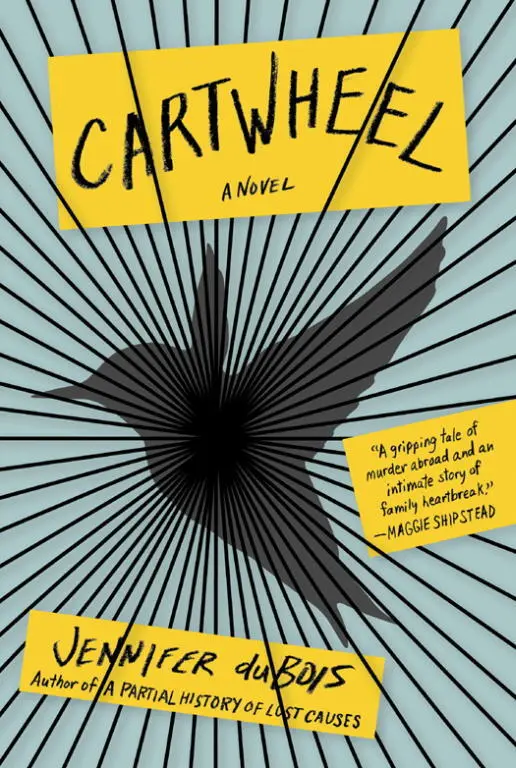
- Название:Cartwheel
- Автор:
- Издательство:Random House
- Жанр:
- Год:2013
- Город:New York
- ISBN:9780812995879
- Рейтинг книги:3 / 5. Голосов: 1
-
Избранное:Добавить в избранное
- Отзывы:
-
Ваша оценка:
Cartwheel: краткое содержание, описание и аннотация
Предлагаем к чтению аннотацию, описание, краткое содержание или предисловие (зависит от того, что написал сам автор книги «Cartwheel»). Если вы не нашли необходимую информацию о книге — напишите в комментариях, мы постараемся отыскать её.
is a suspenseful and haunting novel of an American foreign exchange student arrested for murder, and a father trying to hold his family together. Cartwheel When Lily Hayes arrives in Buenos Aires for her semester abroad, she is enchanted by everything she encounters: the colorful buildings, the street food, the handsome, elusive man next door. Her studious roommate Katy is a bit of a bore, but Lily didn’t come to Argentina to hang out with other Americans.
Five weeks later, Katy is found brutally murdered in their shared home, and Lily is the prime suspect. But who is Lily Hayes? It depends on who’s asking. As the case takes shape—revealing deceptions, secrets, and suspicious DNA—Lily appears alternately sinister and guileless through the eyes of those around her: the media, her family, the man who loves her and the man who seeks her conviction. With mordant wit and keen emotional insight,
offers a prismatic investigation of the ways we decide what to see—and to believe—in one another and ourselves.
In
, duBois delivers a novel of propulsive psychological suspense and rare moral nuance. No two readers will agree who Lily is and what happened to her roommate.
will keep you guessing until the final page, and its questions about how well we really know ourselves will linger well beyond.
Starred Review
A
Pick for Biggest Books of the Fall • A Pick for
’ Most Anticipated Books of 2013
From
“A tabloid tragedy elevated to high art.”
—
“[A] compelling, carefully crafted, and, most importantly, satisfying novel.”
—
Lily Hayes, 21, is a study-abroad student in Buenos Aires. Her life seems fairly unexceptional until her roommate, Katy, is brutally murdered, and Lily, charged with the crime, is remanded to prison pending her trial. But is she guilty, and who is Lily, really? To find answers to these questions, the novel is told from multiple points of view—not only that of Lily but also that of her family; of sardonic Sebastien, the boy with whom she has been having an affair; and of the prosecutor in the case. In the process, it raises even more questions. What possible motive could Lily have had? Why, left momentarily alone after her first interrogation, did she turn a cartwheel? And has she, as her sister asserts, always been weird? In her skillful examination of these matters, the author does an excellent job of creating and maintaining a pervasive feeling of foreboding and suspense.
Sometimes bleak, duBois’ ambitious second novel is an acute psychological study of character that rises to the level of the philosophical, specifically the existential. In this it may not be for every reader, but fans of character-driven literary fiction will welcome its challenges. Though inspired by the Amanda Knox case,
is very much its own individual work of the author’s creative imagination. —Michael Cart
Cartwheel — читать онлайн бесплатно полную книгу (весь текст) целиком
Ниже представлен текст книги, разбитый по страницам. Система сохранения места последней прочитанной страницы, позволяет с удобством читать онлайн бесплатно книгу «Cartwheel», без необходимости каждый раз заново искать на чём Вы остановились. Поставьте закладку, и сможете в любой момент перейти на страницу, на которой закончили чтение.
Интервал:
Закладка:
“You harlot.”
Lily laughed mirthlessly. “I suppose.” The flash of gaiety was gone, and she felt a strange numbness in her chest, a mournful aching under her left flank. Perhaps she was developing pancreatitis from all the wine. Perhaps service industry work was disagreeing with her. Perhaps she was finally getting old, as everyone had always assured her she one day would.
“So,” said Katy, closing her book with a decisive thump. “How was it?”
“Okay, I guess. We got into a weird fight afterward.” Lily patted her hip bones through her thin skirt; they seemed to fit awkwardly into their sockets now, like jigsaw pieces put in wrong. “And he told me he loved me.”
Katy’s perfect mouth fell open. “No,” she said. “He did not .”
“He did.”
“Holy shit.”
Lily sighed. “I just wish he knew he didn’t have to try so hard.”
“Is that what your fight was about?”
“No.”
“What was it about?”
“Luck,” said Lily. “I think.”
“So, I mean, what did you say?”
Lily exhaled heavily. She was sobering up, which made her realize she’d been a little drunk. She wanted to hang on to the plucky sense of savvy she’d had when she’d responded to Sebastien’s declaration. She’d had things figured out then—only an hour ago—and Katy was mucking things up with her naïveté.
“I mean, what was I supposed to say?” said Lily. “I said, like, ‘Oh yeah, uh-huh, I’m sure.’ Or something like that.”
“Lily!”
“What?”
“You didn’t.”
“I mean, really ,” said Lily. “He doesn’t mean it. You’ve met the guy: He never means anything.” Lily already wished she hadn’t told Katy. It was so tiresome having to explain everything to her all the time. “Anyway, I’m not an idiot. I’m just kind of disappointed that he thinks I am.”
“I don’t know, Lily.” Katy blew on her bangs; they puffed out like an animal projecting aggression. “What if he really does?”
“Ugh, you’re such a romantic.”
“Maybe. But we’re twenty-one! We’re supposed to be romantics. Who wants to be so cynical at our age? There’s something wrong with you if you’re so cynical at twenty-one.”
“I’m twenty. I’m twenty-one at the end of the month.”
“So there you go. That’s even worse.”
Lily turned her back to Katy and began to undress. Normally she was pretty immodest—not because she thought so much of her body, but because she thought so little of it (what kind of vanity was required to think your body was so special it had to be protected from sight, when billions, literally billions of people, were built exactly like you?)—but it seemed strange to undress in front of Katy now, when she’d been with Sebastien only a few moments ago. She thought it might invite a new kind of evaluative scrutiny she didn’t care to consider too fully.
“So what are you going to do for your birthday, do you think?” said Katy.
“What?”
“You just said you’re turning twenty-one soon.”
“Oh. Yeah. On the seventeenth. I don’t know. Nothing. Go out somewhere, I guess.”
“You should see if your boss will let you have a room at Fuego.”
“He won’t,” said Lily. In the low light, she could see the fans of blue veins skirting her upper thighs. She had a hard time believing she was actually warm-blooded sometimes—her blood was just so visibly blue; it looked Arctic in origin. She could feel the vaguely unpleasant dampness and stinging from where Sebastien had been. Her face was slightly raw from his; Lily always felt that she was being vigorously sanded down when she kissed a man.
“You never know,” Katy was saying.
“Sometimes you do. My boss doesn’t like me that much. I drop things and my drawer comes up short.”
“You drop things?”
“Well, I dropped one thing. A glass. Not like a whole platter of things. But trust me, is the point, about the party idea. It’s not going to happen.”
“Fine.” Katy took out her textbook again. “You’re awfully dour.”
“I’m not dour,” said Lily, wincing at how much she sounded like her parents. “I’m just a realist.”
CHAPTER NINE
February
One night, amid all the rolling around, it finally happened. That beat of lulled momentum—the point at which Lily usually turned over, or lightly took Sebastien’s hand, or asked him some jejune question, or got up to get a glass of water—came and went, and she continued to kiss him, with more urgency than she ever had before. In Sebastien’s head, constellations, luminous and slow moving, were created and destroyed. His hand crept slowly, and then faster, to the side table to produce an atavistic condom. Afterward he said, “I love you,” matter-of-factly. He meant it. He did not mean anything, but he meant this.
“Uh-huh,” said Lily. She was trying to sound savvy and cold, or maybe she really was. Years of reflexive mordancy had left Sebastien with few tools to assess other people’s emotional states. All communication was maneuver. And he felt oddly alone in the bed afterward, with the sheets now twisted into knots and the room growing dark in the evening chill, and Lily only a foot away from him.
Then she’d asked him something about his parents. (What kind of criminally banal pillow talk this was! He blamed the American movies.) She’d said that she was sorry about them—and she did look sorry, though frankly she also looked a little annoyed at having to be sorry—and remarked that the loss must have been “shocking.” And this—not earlier, let the record show, not out of any sense that he was entitled to love (hers or anyone’s), and not from any wounded pride (he had no pride to wound)—was when Sebastien had become angry. Shocking? His parents’ deaths were shocking ? Yes, shocking, of course, though expectations being wildly subverted was not, in the end, the most challenging aspect of that whole ordeal. He’d thought of the picture of his father on the mantel; his father had been young in that photo, Sebastien realized, only a little over forty. Surely one still wanted things at forty. Shocking? Sure. But primarily devastating, shattering. Life ending, as Lily surely had noticed. The wrongness of the word made Sebastien bellicose, and he’d led them into a stupid fight—transparent, pitiful, composed of serious nonsense—in which he condescended and dismissed, offering dark prophecies about Lily’s future and his own. He monologued about all the bad luck she would one day have, all the medium-sized difficulties that would one day befall her. He didn’t really believe any of it, of course—he didn’t really believe anything—and he could feel the mood in the room darken: first with Lily’s anger, then with her pedestrian defensiveness, her need to let him know that she had suffered enough already. That’s all anybody wanted anyone to know about them—how hard it all had been, how valiantly they had tried, how much unseen credit they were due. Sebastien was tired of it. Sebastien was tired of everything. With every twist, Sebastien could feel the conversation taking him further away from Lily, but still he could not stop. He could have reached out then and touched her, he knew, except somehow it wouldn’t have mattered. It would have been the same as not touching her. It would have been the same as getting up and closing the door and never touching her again.
Somehow, Lily’s days were beginning to trace the same emotional arc, over and over again. She’d wake up in the mornings feeling jaunty and electrified, thrilled by her own life. She was young and nothing was really nailed down yet: It was true she was no longer a virgin; it was true she was no longer undeclared—but really, in the broadest sense, anything was still possible, and what a wonder that was. She walked around the city in the afternoons, watching herself in the third person—alone at cafés, at museums—and she mostly saw the person she had always wanted to watch herself be; a person for whom all the best things were still ahead. This feeling came back to her at nights, as she walked back to the Carrizos’ from Fuego or from Sebastien’s, the lights of the city shimmery and seductive all around her. There was absolutely nothing like a city at night. It was so easy to believe that everything that could possibly happen was happening somewhere right around her—just behind a closed door, just beyond her field of vision. And for all she knew, it was.
Читать дальшеИнтервал:
Закладка:
Похожие книги на «Cartwheel»
Представляем Вашему вниманию похожие книги на «Cartwheel» списком для выбора. Мы отобрали схожую по названию и смыслу литературу в надежде предоставить читателям больше вариантов отыскать новые, интересные, ещё непрочитанные произведения.











Обсуждение, отзывы о книге «Cartwheel» и просто собственные мнения читателей. Оставьте ваши комментарии, напишите, что Вы думаете о произведении, его смысле или главных героях. Укажите что конкретно понравилось, а что нет, и почему Вы так считаете.