Jennifer DuBois - Cartwheel
Здесь есть возможность читать онлайн «Jennifer DuBois - Cartwheel» весь текст электронной книги совершенно бесплатно (целиком полную версию без сокращений). В некоторых случаях можно слушать аудио, скачать через торрент в формате fb2 и присутствует краткое содержание. Город: New York, Год выпуска: 2013, ISBN: 2013, Издательство: Random House, Жанр: Современная проза, Триллер, на английском языке. Описание произведения, (предисловие) а так же отзывы посетителей доступны на портале библиотеки ЛибКат.
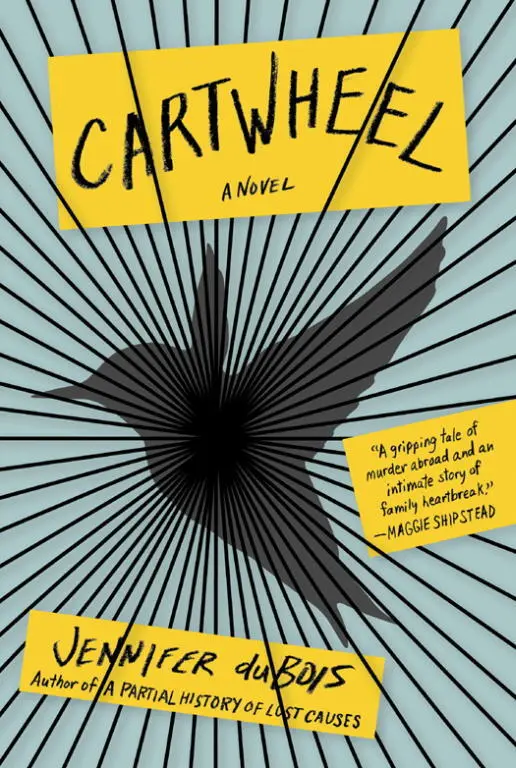
- Название:Cartwheel
- Автор:
- Издательство:Random House
- Жанр:
- Год:2013
- Город:New York
- ISBN:9780812995879
- Рейтинг книги:3 / 5. Голосов: 1
-
Избранное:Добавить в избранное
- Отзывы:
-
Ваша оценка:
Cartwheel: краткое содержание, описание и аннотация
Предлагаем к чтению аннотацию, описание, краткое содержание или предисловие (зависит от того, что написал сам автор книги «Cartwheel»). Если вы не нашли необходимую информацию о книге — напишите в комментариях, мы постараемся отыскать её.
is a suspenseful and haunting novel of an American foreign exchange student arrested for murder, and a father trying to hold his family together. Cartwheel When Lily Hayes arrives in Buenos Aires for her semester abroad, she is enchanted by everything she encounters: the colorful buildings, the street food, the handsome, elusive man next door. Her studious roommate Katy is a bit of a bore, but Lily didn’t come to Argentina to hang out with other Americans.
Five weeks later, Katy is found brutally murdered in their shared home, and Lily is the prime suspect. But who is Lily Hayes? It depends on who’s asking. As the case takes shape—revealing deceptions, secrets, and suspicious DNA—Lily appears alternately sinister and guileless through the eyes of those around her: the media, her family, the man who loves her and the man who seeks her conviction. With mordant wit and keen emotional insight,
offers a prismatic investigation of the ways we decide what to see—and to believe—in one another and ourselves.
In
, duBois delivers a novel of propulsive psychological suspense and rare moral nuance. No two readers will agree who Lily is and what happened to her roommate.
will keep you guessing until the final page, and its questions about how well we really know ourselves will linger well beyond.
Starred Review
A
Pick for Biggest Books of the Fall • A Pick for
’ Most Anticipated Books of 2013
From
“A tabloid tragedy elevated to high art.”
—
“[A] compelling, carefully crafted, and, most importantly, satisfying novel.”
—
Lily Hayes, 21, is a study-abroad student in Buenos Aires. Her life seems fairly unexceptional until her roommate, Katy, is brutally murdered, and Lily, charged with the crime, is remanded to prison pending her trial. But is she guilty, and who is Lily, really? To find answers to these questions, the novel is told from multiple points of view—not only that of Lily but also that of her family; of sardonic Sebastien, the boy with whom she has been having an affair; and of the prosecutor in the case. In the process, it raises even more questions. What possible motive could Lily have had? Why, left momentarily alone after her first interrogation, did she turn a cartwheel? And has she, as her sister asserts, always been weird? In her skillful examination of these matters, the author does an excellent job of creating and maintaining a pervasive feeling of foreboding and suspense.
Sometimes bleak, duBois’ ambitious second novel is an acute psychological study of character that rises to the level of the philosophical, specifically the existential. In this it may not be for every reader, but fans of character-driven literary fiction will welcome its challenges. Though inspired by the Amanda Knox case,
is very much its own individual work of the author’s creative imagination. —Michael Cart
Cartwheel — читать онлайн бесплатно полную книгу (весь текст) целиком
Ниже представлен текст книги, разбитый по страницам. Система сохранения места последней прочитанной страницы, позволяет с удобством читать онлайн бесплатно книгу «Cartwheel», без необходимости каждый раз заново искать на чём Вы остановились. Поставьте закладку, и сможете в любой момент перейти на страницу, на которой закончили чтение.
Интервал:
Закладка:
But between the mornings and the evenings, something was going wrong. A feeling came pricking at Lily in the late afternoons, when the sun turned a certain sickening rubescent color, casting light that made all the buildings look like glowing cinders. In those hours, Lily felt that she was kidding herself—that some central fiction of her life was growing worn with overuse, and that one day it would tear through completely. She would fall into a shaky melancholy then, as though coming down with a strange late-in-the-day hangover, and would have to go somewhere bright and capitalist and unreal to try to cheer herself up. Sometimes she’d find herself at a Changomas, staring at the children’s cereal, or at the movies, watching dubbed American films that seemed to always use the same voice-over actors. She generally tried to stay away from email—it made her life in Argentina feel contingent and small and less urgent somehow; she was on the other end of the world, and she wanted to feel like it—but sometimes in these afternoon moods she’d succumb to a kiosko, where she’d spend a couple of hours reading blogs devoted to badly written expressions of widely held opinions. She’d watch the irradiated lobes of the computers grow brighter and brighter against the falling darkness.
Then evening would come, and she would walk out into the streets and gulp the still-warm air. She’d remember that she was so far away from home that she could actually wear a tank top in February. She’d take off the sweater she’d worn against the air-conditioning in the kiosko or the theater or the store. There would be a mild breeze against her shoulders, and she would feel it creakily cantilever her into the evening. Her old innate optimism would return. She would sense, with the tender and turbulent joy of a granted reprieve, that her life was not yet over. And she would begin to feel much better.
Sebastien did not see Lily again for a time. She began to bob maddeningly in and out of availability: Texts went unanswered for days; plans were made and canceled and made yet again. When she did materialize, she was abstracted, distant, always smelling slightly of burned chorizo. All of this, she fervently attested, was due to that infernal newly acquired job of hers. She would have Sebastien believe, apparently, that she had truly become absorbed to distraction in the minutiae of utensils and tips and the wrangling of emotionally abusive customers. She would have Sebastien think, apparently, that his palpably diminishing relative claim on her attention meant nothing.
One Sunday night, after watching an Antonioni film they’d both pretended to like, Sebastien and Lily lay together in silence. Lily’s head was on his torso and he was stroking a strand of her hair with his thumb, admiring its multidimensional shininess. He was acutely aware of the rising and falling of his chest.
“So,” said Lily abruptly. “What are you going to do?”
Sebastien kept trying to slow his heartbeat down and found it galloping ever faster nonetheless. “When, my peach?” he said.
“Now.”
Through the window, Sebastien could see the gathering blueness of late twilight. He hadn’t yet thought to get up and light candles. “Likely kiss you some more,” he said. “If you’re amenable.”
“In general, I mean.” Lily rolled over onto her back. Sebastien could see a cuneate piece of flattish pale stomach right above her jeans; he could see the knobby handle of her hip bone. “In your life.”
“I can’t imagine what you’re talking about,” said Sebastien, even though he could.
“I mean, are you just going to stay here forever?” Lily stretched elaborately. Sebastien could not get over the outrageous, unfussy healthfulness of her body. You could just see her frolicking in some creek somewhere; catching little frogs and crayfish and things with her bare hands because she hadn’t yet been socialized to think those things were disgusting.
“You’ve got all this money,” she was saying. “I mean, what do you want to do with it?”
Sebastien had known this would come eventually, but he was sorry it was coming already. “Support a revolving cast of lovely women, I suppose,” he said. “Until I age into impotence, at least.”
“No, really,” said Lily. “You’re a smart guy.” Sebastien winced at this. Nobody felt the need to remark upon intelligence that they actually believed in. “You’ve got to go back to school at some point, right?”
“Not really.”
“You could get a job, you know. Have you ever thought of that? I mean, I know you don’t need to. I know you don’t need the money. But it might be good for you. It might be good for you to get out once in a while.”
“I’ve been out plenty. I’m retired now.”
“It might make you less depressed.”
Sebastien turned his back to her and stared at the cracks in the wall. Maybe, in a way, this bossiness was a good sign—maybe instead of reflecting grievous disappointment, it suggested a certain proprietary concern. “Who’s depressed?” he said. “Depression is for the middle class. I’m having the time of my life.”
“So you’re just going to sit here and rot then?”
“Well, I’ve got to sit somewhere and rot. It might as well be here.”
“That’s awful.”
“I’m sorry,” he said, and stood up. He could hear his knees crack, and it made him feel old. You had to live so terribly long to actually be old, but Sebastien was starting to wonder if people began to feel that way quite a bit earlier, and spent their lives waiting for their bodies to match their souls. “Could you tell me more specifically what you’re imagining? Some kind of a start-up? Socially conscious investments? Venture capitalism? Get involved in the what—dot-com boom? I assume that’s still happening? Or maybe it’s not too late to cash in on the tail end of the Gold Rush.” Lily was visibly waiting for Sebastien to stop talking, but he could not. “Or should I set my sights lower, perhaps? Start taking in washing from the neighborhood? What are we thinking here? You tell me.”
“You mean to say your plan is seriously to just sit here and order takeout until the day you die.”
“This is everyone’s plan, broadly.”
“You’re just like my family.”
“I have to suspect that’s meant unkindly.”
There was a long pause in which Sebastien could sense Lily circling around what she wanted to say, thinking better of it and then veering back toward it again, each time getting a little closer. “You just want to wallow—” she finally began.
“Wallow! Who doesn’t want a good wallow?”
“You want to wallow in the passive acceptance of death.”
“As opposed to what? The active rejection of death? Or the active acceptance of death?” Sebastien grinned to show her that it was not too late for them to stop it. “The passive rejection of death, perhaps?”
Lily laughed a little. “You’re impossible.”
“I just want to know what my options are here.”
“You are. Impossible.” She kissed him again then, hard, but it was a complicated kind of kiss, a little bit vicious and fierce, and when he peeked halfway through he saw that her eyes were still open.
Her second weekend at Fuego, Lily picked up an extra shift and forgot to call Carlos and Beatriz to tell them. Halfway through the second shift she remembered, but the club was slammed, and she didn’t even have time to pee until her break. At ten-thirty, as she maneuvered a tray of cocktails over to a tableful of Belgians, Lily spotted Katy standing at the bar near the door. It was strange to see Katy here. From a distance, she looked shy and beautiful and wide-eyed—like some sort of nocturnal jungle creature, a baby ocelot or something—and Lily could see that she’d already attracted the vulture-like attentions of several tables’ worth of inebriated young men, as well as Ignacio, the tortoise-faced bartender. Katy did not seem to notice any of this. Lily looked down at her hands, bald and raw from the scalding hot water, smelling like the stewed detritus of the sink where she had, moments ago, despaired of ever dislodging an especially despicable layer of grime from a pan. Looking at Katy, Lily realized that she felt strangely self-conscious, as though Katy had caught her wearing a costume for a performance she’d hoped would stay a secret. Once Lily had been cleaning up puke in the men’s room and a man had come in and smirked at her and said, in English, “I bet you wish you’d gone to college.” And along with her indignation, Lily had experienced a sliver of pleasure at being mistaken in this way. This was a costume, of course. She didn’t really need this job.
Читать дальшеИнтервал:
Закладка:
Похожие книги на «Cartwheel»
Представляем Вашему вниманию похожие книги на «Cartwheel» списком для выбора. Мы отобрали схожую по названию и смыслу литературу в надежде предоставить читателям больше вариантов отыскать новые, интересные, ещё непрочитанные произведения.












Обсуждение, отзывы о книге «Cartwheel» и просто собственные мнения читателей. Оставьте ваши комментарии, напишите, что Вы думаете о произведении, его смысле или главных героях. Укажите что конкретно понравилось, а что нет, и почему Вы так считаете.