Jennifer DuBois - Cartwheel
Здесь есть возможность читать онлайн «Jennifer DuBois - Cartwheel» весь текст электронной книги совершенно бесплатно (целиком полную версию без сокращений). В некоторых случаях можно слушать аудио, скачать через торрент в формате fb2 и присутствует краткое содержание. Город: New York, Год выпуска: 2013, ISBN: 2013, Издательство: Random House, Жанр: Современная проза, Триллер, на английском языке. Описание произведения, (предисловие) а так же отзывы посетителей доступны на портале библиотеки ЛибКат.
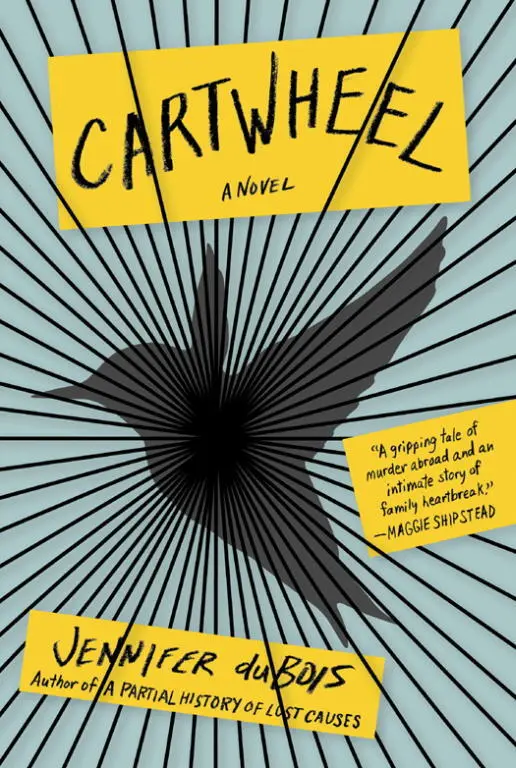
- Название:Cartwheel
- Автор:
- Издательство:Random House
- Жанр:
- Год:2013
- Город:New York
- ISBN:9780812995879
- Рейтинг книги:3 / 5. Голосов: 1
-
Избранное:Добавить в избранное
- Отзывы:
-
Ваша оценка:
Cartwheel: краткое содержание, описание и аннотация
Предлагаем к чтению аннотацию, описание, краткое содержание или предисловие (зависит от того, что написал сам автор книги «Cartwheel»). Если вы не нашли необходимую информацию о книге — напишите в комментариях, мы постараемся отыскать её.
is a suspenseful and haunting novel of an American foreign exchange student arrested for murder, and a father trying to hold his family together. Cartwheel When Lily Hayes arrives in Buenos Aires for her semester abroad, she is enchanted by everything she encounters: the colorful buildings, the street food, the handsome, elusive man next door. Her studious roommate Katy is a bit of a bore, but Lily didn’t come to Argentina to hang out with other Americans.
Five weeks later, Katy is found brutally murdered in their shared home, and Lily is the prime suspect. But who is Lily Hayes? It depends on who’s asking. As the case takes shape—revealing deceptions, secrets, and suspicious DNA—Lily appears alternately sinister and guileless through the eyes of those around her: the media, her family, the man who loves her and the man who seeks her conviction. With mordant wit and keen emotional insight,
offers a prismatic investigation of the ways we decide what to see—and to believe—in one another and ourselves.
In
, duBois delivers a novel of propulsive psychological suspense and rare moral nuance. No two readers will agree who Lily is and what happened to her roommate.
will keep you guessing until the final page, and its questions about how well we really know ourselves will linger well beyond.
Starred Review
A
Pick for Biggest Books of the Fall • A Pick for
’ Most Anticipated Books of 2013
From
“A tabloid tragedy elevated to high art.”
—
“[A] compelling, carefully crafted, and, most importantly, satisfying novel.”
—
Lily Hayes, 21, is a study-abroad student in Buenos Aires. Her life seems fairly unexceptional until her roommate, Katy, is brutally murdered, and Lily, charged with the crime, is remanded to prison pending her trial. But is she guilty, and who is Lily, really? To find answers to these questions, the novel is told from multiple points of view—not only that of Lily but also that of her family; of sardonic Sebastien, the boy with whom she has been having an affair; and of the prosecutor in the case. In the process, it raises even more questions. What possible motive could Lily have had? Why, left momentarily alone after her first interrogation, did she turn a cartwheel? And has she, as her sister asserts, always been weird? In her skillful examination of these matters, the author does an excellent job of creating and maintaining a pervasive feeling of foreboding and suspense.
Sometimes bleak, duBois’ ambitious second novel is an acute psychological study of character that rises to the level of the philosophical, specifically the existential. In this it may not be for every reader, but fans of character-driven literary fiction will welcome its challenges. Though inspired by the Amanda Knox case,
is very much its own individual work of the author’s creative imagination. —Michael Cart
Cartwheel — читать онлайн бесплатно полную книгу (весь текст) целиком
Ниже представлен текст книги, разбитый по страницам. Система сохранения места последней прочитанной страницы, позволяет с удобством читать онлайн бесплатно книгу «Cartwheel», без необходимости каждый раз заново искать на чём Вы остановились. Поставьте закладку, и сможете в любой момент перейти на страницу, на которой закончили чтение.
Интервал:
Закладка:
About what? he wanted to ask. About not being able to get what you wanted? Even the narrow-minded narcissism of children should be able to accommodate enough generosity toward their parents for Anna to understand that this was not true—probably not in anyone’s case, and certainly not in his.
“We’ll get her the things she needs, Anna,” he said. The things you need and do not get and nevertheless manage to survive without—were those things ever really needs ? If somebody’s need was vast, and eternally unmet, and nonfatal, had what seemed necessary really only been desirous? After Janie died, everyone was always asking Andrew if he was okay, and he never knew what to say. Because what, really, was on the other side of okay? When you stopped being okay, you were just okay in a worse and different way.
“We’ll get them to her just as soon as we can,” he said.
Anna nodded seriously.
“You were very good to think of them,” said Andrew. He hoped he sounded as tired as he felt.
“Well,” said Anna, and her voice was stronger, the voice of an adult or a pragmatist. “It was the least I could do.”
The next morning Maureen arrived.
Andrew had tracked her flight online in the hotel’s business center, calculating how long it would take her to find her luggage and hail a taxi and traverse the city’s allegedly Parisian boulevards. He waited until he thought she’d probably checked in to the hotel, then forced himself to wait ninety minutes more. Finally, he got in the elevator and rode down a floor—to room 408, which was, he figured, nearly directly below his own—and knocked on her door.
She appeared after a moment. “Hello, Maureen,” said Andrew. He wanted to tell her she looked great, though the tone seemed off, and, anyway, she didn’t. Her hair was messy—probably from sleeping thrashily on the plane—and under her eyes were two bluish pits of exhaustion. He tried to detect if she was thinner than usual; he couldn’t tell.
“Hello, dear,” said Maureen. She always called him something sweet and absolving and fond, and he always called her “Maureen.” Andrew wasn’t sure what this meant about who wanted or expected more from their postdivorce relationship, or who’d summoned greater depths of humanity or charity in their dealings, but he suspected that they’d both staked some kind of bet on their own way of doing things and he now felt fully committed to his own. They hugged with elaborate formality, which they always did, although Andrew never quite knew why. After everything they had been through together, they should slump against each other now like brothers, or puppies, or soldiers, or mental patients; the proximity of their bodies should be utterly meaningless. And yet a crisp distance had grown up between them, vinelike and intricate, and when Andrew touched Maureen, feeling the forbidding landscape of her clavicle through her T-shirt, he sensed the assertion of a new strangeness. She smelled like the airplane, vaguely clinical and foreign, nothing like her smell from their marriage—he remembered the faint chivelike scent of her body underneath some rose perfume she had that always made him sneeze.
Maureen pulled away and patted him neutrally on the shoulder. “How are you holding up?”
“Okay,” said Andrew. “You know.”
Maureen nodded and gave him that rueful look of hers he sometimes found so annoying—there was something about it that reminded him faintly of an expression of reproach, as though Andrew had failed her terribly but she was going to be a tremendous good sport about it. Maybe that was the problem with this family—they were all in direct competition with one another to see who could bend over backward the farthest, who could suffer the most. But then, Andrew reminded himself, he and Maureen had unlinked themselves in order to disrupt these precise dynamics. They were not a family anymore; they were only old friends, and pretty decent ones at that.
“How is she?” said Maureen.
“She seems okay,” said Andrew. “She’s holding up.”
Maureen raised an eyebrow, but Andrew already knew that this answer was insufficient. Over the brief years of Janie’s life and death, he and Maureen had developed an involved shorthand, rife with pseudonyms and talismans and symbols, complete with its own vocabulary and syntax and etiquette. Certain euphemisms were encouraged; others were scorned. Referencing the possibility of Janie’s death was unacceptable, but it was also unacceptable to use the phrase “passed away” to refer to the deaths of the other children on the ward—and the other children died, too; they died horribly and they died quietly and their deaths were the deaths that prophesied Janie’s death, that made it thinkable though, of course, not endurable, and certainly never mentionable. When Andrew and Maureen were forced to mark the fact of the other children’s deaths, they did not say that those children had passed away. They said that they had died. They understood—they had tacitly agreed—that anything evasive was disrespectful. She’s holding up was, Andrew knew, just about the worst thing he could say to Maureen.
Maureen pursed her lips. “How does she look?”
“The same. Mostly.”
“Did she seem upset?”
“I mean, not visibly.”
“What do you mean, ‘not visibly’?”
Andrew squirmed. “I mean—she wasn’t crying or anything.”
“She stopped crying already?”
“Had she been?” In every conversation Andrew had had with her, Lily had seemed tired but brave, determined to show him that she was as tough as they’d always told her she was. Andrew thought of her now—crying and concealing this in order to protect him—and he knew that this was a bigger and worse kind of trouble.
Maureen’s face was crumpling into an expression of terrible kindness. “Do you want to come in and sit for a bit?”
In the room, Maureen’s clothes were spread across the bed, delicate cardigans and wool pants, things that looked all wrong for the weather. Maureen always dressed cartoonishly warmly, because she was always cold.
“It occurs to me that I don’t have anything to offer you that you don’t already have in your own room,” she said, peering into the mini-fridge. “You want a soda? Granola bar? Shot and a half of vodka?”
“I’m okay,” said Andrew, sitting heavily on the bed.
“Did you get her those things she wanted?” said Maureen. She was still bent over the mini-fridge. “The tampons and the shampoo and whatnot?”
“Anna got them.”
“Oh.”
There was nothing fraught about this “oh”—no hint of surprise or guilt-tripping, just the monosyllabic acknowledgment of information received—but it made Andrew defensive nonetheless. “You probably know better how she’s doing than I do, you know,” he said. “I mean, obviously.”
“I’m sure that’s not true,” said Maureen, standing up. “It’s just that she talks to me. She’s a girl.”
“They were all girls,” said Andrew darkly. He wondered if Maureen had known about Lily’s smoking, but he was afraid to ask; he felt that it would be understood to be his fault somehow—perhaps because he’d discovered it, perhaps because of some kind of labor division he’d never been briefed on (Maureen handles the sex, Andrew handles the carcinogens?)—and that he’d be revealed as a fool for not knowing why.
“They were all girls,” said Maureen. “But you really can’t blame me for that.”
Andrew nodded, though part of him vaguely suspected that he could, a little. It wasn’t that he didn’t love his daughters—and yes, in a way, he still loved Maureen, with a strange and calcified love. But the fact of their united femininity could sometimes seem a bit prosecutorial.
Читать дальшеИнтервал:
Закладка:
Похожие книги на «Cartwheel»
Представляем Вашему вниманию похожие книги на «Cartwheel» списком для выбора. Мы отобрали схожую по названию и смыслу литературу в надежде предоставить читателям больше вариантов отыскать новые, интересные, ещё непрочитанные произведения.











Обсуждение, отзывы о книге «Cartwheel» и просто собственные мнения читателей. Оставьте ваши комментарии, напишите, что Вы думаете о произведении, его смысле или главных героях. Укажите что конкретно понравилось, а что нет, и почему Вы так считаете.