Arthur Hailey - Evening News
Здесь есть возможность читать онлайн «Arthur Hailey - Evening News» весь текст электронной книги совершенно бесплатно (целиком полную версию без сокращений). В некоторых случаях можно слушать аудио, скачать через торрент в формате fb2 и присутствует краткое содержание. Жанр: Современная проза, на английском языке. Описание произведения, (предисловие) а так же отзывы посетителей доступны на портале библиотеки ЛибКат.
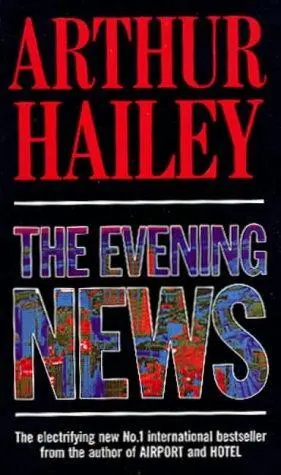
- Название:Evening News
- Автор:
- Жанр:
- Год:неизвестен
- ISBN:нет данных
- Рейтинг книги:3.5 / 5. Голосов: 2
-
Избранное:Добавить в избранное
- Отзывы:
-
Ваша оценка:
Evening News: краткое содержание, описание и аннотация
Предлагаем к чтению аннотацию, описание, краткое содержание или предисловие (зависит от того, что написал сам автор книги «Evening News»). Если вы не нашли необходимую информацию о книге — напишите в комментариях, мы постараемся отыскать её.
Evening News — читать онлайн бесплатно полную книгу (весь текст) целиком
Ниже представлен текст книги, разбитый по страницам. Система сохранения места последней прочитанной страницы, позволяет с удобством читать онлайн бесплатно книгу «Evening News», без необходимости каждый раз заново искать на чём Вы остановились. Поставьте закладку, и сможете в любой момент перейти на страницу, на которой закончили чтение.
Интервал:
Закладка:
No one, including Miguel, had any answers. All they knew for sure was that they were committed to going; the machinery of their transfer was in motion and they must take their chances.
Another reason for tension, perhaps inevitable, was the increasing disenchantment of the conspirators with one another. Having been in close confinement for more than a month with only the most limited outside contacts, some personal irritations became magnified into something close to hatred.
Particularly obnoxious to the others was Rafael's habit of coughing up mucus, then spitting it out wherever he found himself, including at the meal table. At one mealtime Carlos was so offended that he called Rafael jun bruto odiosol, prompting Rafael to grab Carlos by the shoulders, throw him against a wall, then pummel him with hamlike fists. Only Miguel's intervention saved Carlos from injury. Since then, Rafael had not changed his habit though Carlos seethed.
Luis and Julio had also become antagonists. The week before, Julio had accused Luis of cheating at cards. A fistfight ensued which neither won, but next day they had swollen faces and the two had scarcely spoken since.
Now, Socorro was another source of friction. Despite her earlier rejection of sexual overtures, last night she had bedded with Carlos. The animal noises had aroused envy in the other men and intense jealousy in Rafael, who had wanted Socorro for himself and reminded her this morning. But, she told him in front of the others during breakfast, "You will have to change your filthy manners before you stick your Yerga in me.”
That situation was complicated by Miguel's own strong desire for Socorro. But as the group's leader he continually reminded himself that he could not afford to join in the competition over her.
His leadership role, he realized, had had other eflects as well. Looking in his shaving mirror recently, he realized he was shedding his unremarkable "everyman”appearance. Less and less did he resemble an innocuous clerk or minor manager, which had once been his natural camouflage. Age and responsibility were giving him the look of what he was—a seasoned, strong commander.
Well, he thought today, all commanders made mistakes and White Plains clearly had been one of his.
Thus, for everyone's varying reasons, it was a big relief as 7:40 P.m. neared and final pullout procedures got underway.
* * *
Julio would drive the hearse, Luis the "Serene Funeral Homes” truck. Both vehicles were loaded and ready.
The hearse contained a single casket in which Jessica lay, under deep sedation. Angus and Nicholas, also unconscious and in closed caskets, were in the truck. On top of each casket Carlos had placed a garland of white chrysanthemums and pink carnations, the flowers he had obtained that morning.
Strangely, the sight of the caskets and flowers subdued the conspirators, as if the roles they had rehearsed in their minds and were about to act out had somehow become easier to assume.
Only Baudelio, fussing around the three caskets, taking lastminute readings with his external equipment, remained solely attuned to immediate concerns, this being one of several times during the next few hours when the success of the enterprise would depend totally on his prior judgments. If one of the captives should regain consciousness and struggle or cry out while the group was en route, especially while being questioned, all could be lost.
Even a suspicion that the caskets were in any way unusual could result in their being opened and the entire plan foiled—as happened at Britain's Stansted Airport in 1984. On that occasion a Nigerian, Dr. Umaru Dikko, having been kidnapped and drugged, was about to be flown to Lagos in a sealed crate. Airport workers reported a strong "medicine-type smell”and British Customs officers insisted that the crate be opened. The victim was discovered, unconscious but alive.
Miguel and Baudelio both knew of that 1984 incident and wanted no repetition.
As the moment to leave for Teterboro approached, Socorro had appeared, strikingly seductive in a black linen dress with matching jacket trimmed with braid. Her hair was tucked under a black cloche and she wore gold earrings and a thin gold necklace. She was crying copiously, the result of Baudelio's prescription of a grain of pepper beneath each lower eyelid. She now gave the same treatment to Rafael; at first he had objected, but Miguel insisted and the big man gave in. Soon after Rafael adjusted to the mild discomfort, his tears rolled out too.
Rafael, Miguel and Baudelio, each wearing their dark suits and ties, looked suitably cast as mourners. If questions were asked, Rafael and Socorro would pose as brother and sister of a dead Colombian woman, killed in a fiery auto accident while visiting the U.S., whose remains were being flown home for burial. And since the woman's young son—so the cover story went—was one of two others killed in the same accident, Rafael and Socorro would be Nicky's sorrowful uncle and aunt. The third "dead”person, Angus, would be described as an older distant relative who had been traveling with the other two.
Baudelio would be a supportive member of the bereaved family, Miguel a close family friend.
Elaborate documentation corroborated the cover story fake death certificates from Pennsylvania where the fatal accident supposedly occurred, graphic photos of a turnpike traffic disaster scene, and even press clippings purportedly from the Philadelphia Inquirer, but in fact printed on a private press. The documents had included new passports for Miguel, Rafael, Socorro and Baudelio and two spare death certificates, one of which had since been used for Angus. The document "package”had been obtained through another of Miguel's Little Colombia contacts and cost more than twenty thousand dollars.
Included in the cover story and false news reports was a critical feature: All three bodies were so badly mangled and burned that they were unrecognizable. Miguel counted on that to deter any opening of the caskets during their removal from the United States.
The hearse and truck now had their engines running and behind them was the Plymouth Reliant, with Carlos in the driver's seat. He would follow the other vehicles at a distance, though ready to intervene in case of trouble. With the exception of Baudelio, they were all armed.
The immediate plan was to proceed directly to the airport, which should take about ten minutes, fifteen at the most.
In the courtyard of the Hackensack house, Miguel checked his watch. 7:35 P.m. He instructed the others, "Everyone aboard.”
Alone he made a final inspection of the house and outbuildings, satisfying himself that no significant traces of their occupancy remained. Only one thing troubled him. The ground where the hole had been dug to bury the cellular phones and other equipment was uneven compared with the area surrounding it. Julio and Luis had done their best to level the earth and spread leaves, but signs of disturbance remained. Miguel supposed it didn't matter greatly and at this point nothing could be done.
Returning to the hearse, he climbed into the front seat and told Julio tersely, "Go!”
Dusk had settled in, with the last traces of sunset on their right as they headed for Teterboro.
* * *
Luis was first to see the flashing police lights ahead. He swore softly as he braked. From the passenger side of the hearse, Miguel saw the lights too, then craned to survey their own position in relation to other traffic. Socorro was in the middle, seated between the two men.
They were on State Highway 17 headed south, with the elevated Passaic Expressway a mile behind. Traffic both ways on 17 was heavy. Between themselves and the flashing lights there was no turnoff to the right, and central dividers made a U-turn out of the question. Miguel, beginning to sweat, tightened his hold on himself and instructed Luis, "Keep going.” He checked to make sure the "Serene Funeral Homes” truck was immediately behind.
Читать дальшеИнтервал:
Закладка:
Похожие книги на «Evening News»
Представляем Вашему вниманию похожие книги на «Evening News» списком для выбора. Мы отобрали схожую по названию и смыслу литературу в надежде предоставить читателям больше вариантов отыскать новые, интересные, ещё непрочитанные произведения.


Обсуждение, отзывы о книге «Evening News» и просто собственные мнения читателей. Оставьте ваши комментарии, напишите, что Вы думаете о произведении, его смысле или главных героях. Укажите что конкретно понравилось, а что нет, и почему Вы так считаете.