Arthur Hailey - Evening News
Здесь есть возможность читать онлайн «Arthur Hailey - Evening News» весь текст электронной книги совершенно бесплатно (целиком полную версию без сокращений). В некоторых случаях можно слушать аудио, скачать через торрент в формате fb2 и присутствует краткое содержание. Жанр: Современная проза, на английском языке. Описание произведения, (предисловие) а так же отзывы посетителей доступны на портале библиотеки ЛибКат.
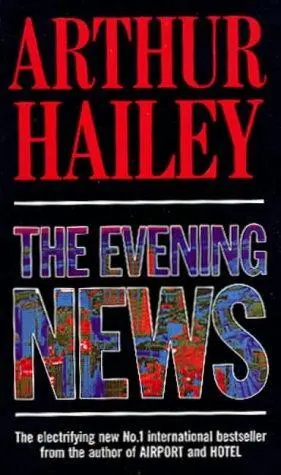
- Название:Evening News
- Автор:
- Жанр:
- Год:неизвестен
- ISBN:нет данных
- Рейтинг книги:3.5 / 5. Голосов: 2
-
Избранное:Добавить в избранное
- Отзывы:
-
Ваша оценка:
Evening News: краткое содержание, описание и аннотация
Предлагаем к чтению аннотацию, описание, краткое содержание или предисловие (зависит от того, что написал сам автор книги «Evening News»). Если вы не нашли необходимую информацию о книге — напишите в комментариях, мы постараемся отыскать её.
Evening News — читать онлайн бесплатно полную книгу (весь текст) целиком
Ниже представлен текст книги, разбитый по страницам. Система сохранения места последней прочитанной страницы, позволяет с удобством читать онлайн бесплатно книгу «Evening News», без необходимости каждый раз заново искать на чём Вы остановились. Поставьте закладку, и сможете в любой момент перейти на страницу, на которой закончили чтение.
Интервал:
Закладка:
Instead he asked Socorro, "When we need it, can you cry?”
As part of the planned tableau, she also would be a grieving mourner.
"Si."
Baudelio added, with the professional pride which occasionally surfaced, "I will place a grain of pepper beneath each of her lower eyelids. The same for mine. The tears are then copious and will not stop until the pepper is out.” He regarded Miguel.”I will do the same for you if you wish.”
"We'll see.”
Baudelio completed his strategy catalog.”Finally, in all three caskets will be tiny monitors to record breathing and depth of sedation. I'll have a connection to read them from outside. The propofol infusion can be adjusted from outside too.”
Reviewing their exchange, and despite earlier misgivings, Miguel felt satisfied that Baudelio knew what he was doing. Socorro too.
Now it was simply a question of waiting through the day. The hours ahead seemed interminable.
11
At CBA News headquarters on Saturday morning, the special task force meeting called for 10 A.m. had scarcely begun when it was abruptly interrupted.
Harry Partridge, seated at the head of the conference table, had opened a discussion when a speakerphone broke in—an announcement from the main newsroom. Partridge paused as he and the six others at the table listened.
"Assignment desk. Richardson. This bulletin just in from UPI . . .
”White Plains, New York—A passenger van, believed to be the vehicle used in Thursday's kidnap of the Crawford Sloane family, exploded violently a few minutes ago. At least three persons are dead, others injured. Police were on their way to inspect the van when the explosion occurred in a parking building adjoining Center City shopping mall. It happened as many weekend shoppers were arriving in their cars. The building is extensively damaged. Firefighters, rescue crews and ambulances are on the scene which a witness describes as 'like a nightmare from Beirut.”
Even as the bulletin was continuing, chairs in the conference room were being pushed back, the task force members scrambling to their feet. As the speakerphone fell silent, Partridge was first out, on the run, hurrying to the newsroom one floor below, with Rita Abrams close behind.
* * *
Saturday morning in any network news department was a relatively informal time. Most of the Monday-to-Friday staff stayed home. The few on weekend duty, while sometimes under pressure, were aware of the absence of the high command. For this reason dress was casual, jeans predominating, and men showed up without ties.
The main CBA newsroom was eerily quiet, with barely a third of the desks occupied and that day's assignment manager, Orv Richardson, covering for the national desk as well. Young, fresh-faced and eager, Richardson had recently come to the network from a regional bureau. While not unhappy to be in charge, the important breaking story from White Plains made him slightly nervous. He wanted to be sure of doing the right thing.
It was with some relief, therefore, that he saw a Big Foot correspondent, Harry Partridge, and a senior producer, Abrams, burst into the newsroom and hurry his way.
While Partridge skimmed a printout of the United Press bulletin and read a follow-up story feeding in on a computer monitor, Rita told Richardson, "We should go on air immediately. Who has authority?”
"I have a number.” With a phone tucked into his shoulder and consulting a note, the assignment manager tapped out digits for a CBA News vice president available at home. When the man answered, Richardson explained the situation and asked for authorization to take air with a special bulletin. The vice president shot back, "You have it. Go!”
What followed was a near-replay of Thursday's intrusion into the network when the kidnap news broke shortly before noon. The differences were the nature of today's report and the cast involved. Partridge was in the flash facility studio, occupying the correspondent's hot seat, Rita was acting executive producer, and in the control room a different director appeared, having come hastily from another section of the building after hearing a "special bulletin”call.
CBA was on air within four minutes after receiving the UPI bulletin. The other networks—observed from control room monitors—broke into their own programming at almost the same time.
Harry Partridge was, as always, collected and articulate, the ultimate professional. There was no time to write a script or use a Teleprompter. Partridge simply memorized the contents of the wire reports and ad-libbed.
The special broadcast was over in two minutes. There were the bare facts only, few details, and no on-scene pictures merely hastily gathered stills, projected over Partridge's shoulder, of the Sloane family, their Larchmont home and the Grand Union store where the Thursday kidnap had taken place. A fuller report with pictures from White Plains, Partridge promised viewers, would be aired later on CBA's Saturday National Evening News.
As soon as the red camera lights went out in the flash studio, Partridge phoned Rita in the control room.”I'm going to White Plains,” he told her.”Will you set it up?”
"I have already. Iris, Minh and I are going as well. Iris will produce a piece for tonight. You can do a standup there and cut a sound track later. There's a car and driver waiting.”
* * *
The city of White Plains had a long history going back to 1661 when it was an encampment of the Siwanoy Indians who called it Quarropas—which means white plains, or white balsam—after the trees that grew there. In the eighteenth century it was an important iron-mining center and a transportation crossroads. In 1776, during the American Revolution, a battle on nearby Chatterton Hill forced Washington's retreat, but in the same year a Provincial Congress in White Plains approved the Declaration of Independence and the creation of New York State. There were other milestones, good and bad, though none exceeded in infamy the explosion engineered by the Medellin cartel and Sendero Luminoso in the Center City Mall parking building.
There was, it became clear later, a certain inevitability to the cycle of events.
During the preceding night a patrolling security guard had recorded the license numbers and makers' names of vehicles left there overnight—a normal procedure and a precaution against cheating by drivers who might claim to have lost their parking stub and to have parked for one day only.
The presence of a Nissan passenger van with New York plates had also been noted the night before which, again, was not unusual. Sometimes, for a variety of reasons, vehicles were left parked for a week or more. But during the second night a different and more alert security guard wondered if the Nissan van could be the one he had heard about as being sought in connection with the Sloane family kidnapping.
He wrote a query to that effect on his report and the maintenance supervisor, on reading it next morning, promptly called the White Plains Police who ordered a patrol car to investigate. The time, according to police records, was 9:50 A.M.
The maintenance supervisor, however, did not wait for the police arrival. Instead he went to the Nissan van, taking along a large bunch of car keys he had accumulated over the years. It was a source of pride with him that there were few locked vehicles which, aided by his key collection, he could not open.
All of this was at a time when Saturday shoppers, in their cars, were beginning to stream into the parking building.
Quite quickly the supervisor found a key that fitted the Nissan van and opened the driver's door. It was his final act in the few remaining seconds of his life.
With a roar which someone later described as "like fifty thunderstorms,” the Nissan van disintegrated in an intense, engulfing ball of flame. So did a substantial part of the building and several cars nearby, fortunately unoccupied, though what was left of them burned fiercely. The explosion punched wide holes in the parking building above and below where the Nissan van had been and caused flaming cars to cascade through the holes to the lower floors.
Читать дальшеИнтервал:
Закладка:
Похожие книги на «Evening News»
Представляем Вашему вниманию похожие книги на «Evening News» списком для выбора. Мы отобрали схожую по названию и смыслу литературу в надежде предоставить читателям больше вариантов отыскать новые, интересные, ещё непрочитанные произведения.






Обсуждение, отзывы о книге «Evening News» и просто собственные мнения читателей. Оставьте ваши комментарии, напишите, что Вы думаете о произведении, его смысле или главных героях. Укажите что конкретно понравилось, а что нет, и почему Вы так считаете.