Arthur Hailey - Evening News
Здесь есть возможность читать онлайн «Arthur Hailey - Evening News» весь текст электронной книги совершенно бесплатно (целиком полную версию без сокращений). В некоторых случаях можно слушать аудио, скачать через торрент в формате fb2 и присутствует краткое содержание. Жанр: Современная проза, на английском языке. Описание произведения, (предисловие) а так же отзывы посетителей доступны на портале библиотеки ЛибКат.
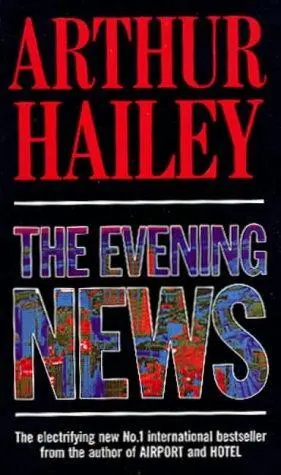
- Название:Evening News
- Автор:
- Жанр:
- Год:неизвестен
- ISBN:нет данных
- Рейтинг книги:3.5 / 5. Голосов: 2
-
Избранное:Добавить в избранное
- Отзывы:
-
Ваша оценка:
Evening News: краткое содержание, описание и аннотация
Предлагаем к чтению аннотацию, описание, краткое содержание или предисловие (зависит от того, что написал сам автор книги «Evening News»). Если вы не нашли необходимую информацию о книге — напишите в комментариях, мы постараемся отыскать её.
Evening News — читать онлайн бесплатно полную книгу (весь текст) целиком
Ниже представлен текст книги, разбитый по страницам. Система сохранения места последней прочитанной страницы, позволяет с удобством читать онлайн бесплатно книгу «Evening News», без необходимости каждый раз заново искать на чём Вы остановились. Поставьте закладку, и сможете в любой момент перейти на страницу, на которой закончили чтение.
Интервал:
Закладка:
Among those at the bar was a former Colombian, now a U.S. resident, who wrote a column for an obscure Spanish language weekly published in Queens. On the back of an envelope, using a stub of pencil, the man wrote the gist of Godoy's story, translating it to Spanish as he did. It would make a good little item, he thought, for next week's column.
7
At CBA News it had been a frantic day, especially for the Sloane kidnap task force.
Producing a comprehensive report on the kidnapping for the National Evening News continued to be the focus of activity, though other events, some major, were happening elsewhere in the world.
The kidnap story had been allotted five and a half minutes —an extraordinary duration in a business where fifteen-second segments were fiercely fought over. As a result, almost the entire effort of the task force was devoted to that day's production, leaving virtually no time for longer-term planning or reflection.
With Harry Partridge anchoring the opening portion of the news, the evening broadcast began:
"After thirty-six hours of agonized waiting there is no fresh news about the family of CBA anchorman Crawford Sloane, whose wife, young son and father were kidnapped yesterday morning in Larchmont, New York The where- abouts of Mrs. Jessica Sloane, eleven-year-old Nicholas, and Mr. Angus Sloane remain unknown.”
As each name was mentioned, a still photo appeared over Partridge's shoulder.
" Also unknown are the identities, objectives, or affiliations of the kidnappers"
A fast cut to Crawford Sloane's troubled face filling the screen. Sloane's distraught voice pleaded, " Whoever you are, wherever you are, for god's sake make yourself known! Let us hear from you!”
Partridge's voice returned over an exterior shot of FBI headquarters, the J. Edgar Hoover Building in Washington. “While the FBI, now in charge of the investigation, is withholding comment . ."
“Briefly the scene changed to the FBI press office and a spokesman saying, "At this moment it would not be helpful to make any statement.”
Partridge again: " ...privately, FBI officials admit no progress has been made."
"Since yesterday an outpouring of concern and anger have come from highest levels — “
A dissolve to the White House press room, the President speaking: "Such evil has no place in America. The criminals will be hounded down and punished.”
Partridge: ". . . and in humbler places. .."
From Pittsburgh, a hard-hatted black steelworker, his face shining in the light from a fiery furnace: "I 'm ashamed something like this could happen in my country.”
In a bright Topeka kitchen, a white housewife: "I cannot understand why no one foresaw what's happened and took precautions. My heart goes out to Crawford.” Gesturing to a TV set: "In this house he's like family. ”
Seated at her classroom desk in California, a young, softvoiced Eurasian girl: "I'm worried about Nicholas Sloane. It isn't fair they took him.”
* * *
During the day, camera crews of CBA and affiliated stations across the country had sought public reactions. The network had viewed fifty and selected those three.
* * *
The scene shifted to the Sloane house at Larchmont that morning in the rain—a long shot of the waiting crowd in the street, then, moving in close, a pan across their faces. Over the image, Partridge's voice: "In part because of intense public interest, today new tragedy intruded.”
The voice-over continued, alternating with natural sound, more pictures: emergence of the two unmarked FBI cars from the driveway . . . the surge of onlookers into the first car's path . . . the first car braking, then out of control and sliding a shriek of tires followed by screams from the injured . . . others frantically scrambling clear of the second car, which then continued on . . . a close-up of Crawford Sloane's bewildered face . . . the second car speeding away.
During editing, some objections had been raised about including the shots of Sloane's face and the disappearing car. Sloane himself claimed, "It gives a wrong impression.”
But Iris Everly, who put most of the spot together, working through the day with one of CBA's best tape editors, Bob Watson, argued for its inclusion and won.”Whether Crawf likes it or not.” she pointed out, "it's news and we should stay objective. Also, we're looking at the only piece of action since yesterday.” Rita and Partridge had supported Iris.
* * *
The tempo changed to a skillful recap of the previous day. It began with Priscilla Rhea, the frail and elderly ex-schoolteacher, again describing the brutal seizure of Jessica, Nicky and. Angus Sloane outside the Larchmont supermarket.
* * *
Minh Van Canh had used his camera creatively, going in for an extreme close-up of Miss Rhea's face. It showed the deep lines of age with every wrinkle in sharp relief, but also brought out her intelligence and sturdy character. Minh had coaxed her with geride questions, an occasionally used procedure. When no correspondent was present, experienced camera people sometimes asked questions of those they were photographing. The questions were erased later from the audio recording, but the answers remained for use as statements.
* * *
After describing the struggle on the parking lot and the Nissan van's departure, Miss Rhea said of the kidnappers, her voice rising, "They were brutal men, beasts, savages!”
Next, the Laremont police chief confirmed that there had been no breakthrough in the case and the kidnappers had not been heard from.
Following the recap was an interview with the criminologist, Ralph Salerno.
* * *
With Salerno in a Miami studio and Harry Partridge in New York, the interview had been recorded via satellite late that afternoon. The recommendation by Karl Owens proved a good one and Salerno, an authoritative figure, was eloquent and well informed. He so impressed Rita Abrams that she arranged for him to be available exclusively to CBA for the duration of the crisis. He would be paid $1,000 for each broadcast appearance, with a minimum guarantee of four.
Although TV networks claimed not to pay for news interviews—a statement not always true—a consultant fee was different and acceptable.
" The progress of investigation after any efficiently executed kidnap, “ Ralph Salerno declared, "depends on hearing from the kidnappers. Unless and until that happens, there is usually a stalemate.”
Answering a question by Partridge, he continued: "The FBI has a high success ratio in kidnappings; they solve ninety-two percent of cases. But if you look carefully at who was caught and how, you'll find most solutions depended on first hearing from the kidnappers, then trapping them during negotiations or payment of a ransom.”
Partridge prompted, "So the likelihood is that not much will happen until these kidnappers are heard from."
”Exactly.”
A final statement in the special news segment was made by CBA's corporate president, Margot Lloyd-Mason.
* * *
It had been Leslie Chippingham's idea to include Margot. Soon after breaking into the network with the kidnap bulletin yesterday, he reported to her by telephone and did so again this morning. Her reaction had, on the whole, been sympathetic and after their first conversation she telephoned Crawford Sloane, expressing hope that his family would be recovered quickly. While speaking with the news president, though, she added two caveats.
”Part of the reason something like this happens is that networks have misguidedly let anchor people become larger than life, so the public thinks of them as something extra-special, almost gods.” She did not elaborate on how a network could control public concepts, even if it wished, and for his part, Chippingham saw no point in arguing the obvious.
Читать дальшеИнтервал:
Закладка:
Похожие книги на «Evening News»
Представляем Вашему вниманию похожие книги на «Evening News» списком для выбора. Мы отобрали схожую по названию и смыслу литературу в надежде предоставить читателям больше вариантов отыскать новые, интересные, ещё непрочитанные произведения.


Обсуждение, отзывы о книге «Evening News» и просто собственные мнения читателей. Оставьте ваши комментарии, напишите, что Вы думаете о произведении, его смысле или главных героях. Укажите что конкретно понравилось, а что нет, и почему Вы так считаете.