Arthur Hailey - Evening News
Здесь есть возможность читать онлайн «Arthur Hailey - Evening News» весь текст электронной книги совершенно бесплатно (целиком полную версию без сокращений). В некоторых случаях можно слушать аудио, скачать через торрент в формате fb2 и присутствует краткое содержание. Жанр: Современная проза, на английском языке. Описание произведения, (предисловие) а так же отзывы посетителей доступны на портале библиотеки ЛибКат.
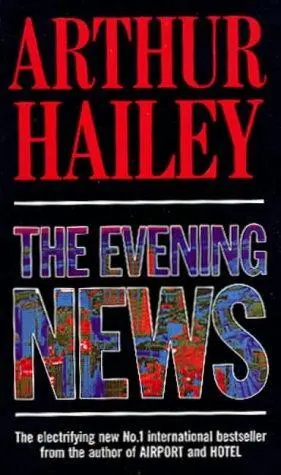
- Название:Evening News
- Автор:
- Жанр:
- Год:неизвестен
- ISBN:нет данных
- Рейтинг книги:3.5 / 5. Голосов: 2
-
Избранное:Добавить в избранное
- Отзывы:
-
Ваша оценка:
Evening News: краткое содержание, описание и аннотация
Предлагаем к чтению аннотацию, описание, краткое содержание или предисловие (зависит от того, что написал сам автор книги «Evening News»). Если вы не нашли необходимую информацию о книге — напишите в комментариях, мы постараемся отыскать её.
Evening News — читать онлайн бесплатно полную книгу (весь текст) целиком
Ниже представлен текст книги, разбитый по страницам. Система сохранения места последней прочитанной страницы, позволяет с удобством читать онлайн бесплатно книгу «Evening News», без необходимости каждый раз заново искать на чём Вы остановились. Поставьте закладку, и сможете в любой момент перейти на страницу, на которой закончили чтение.
Интервал:
Закладка:
A year ago Partridge had done him a favor—or so the lawyer thought. The man's daughter, on a college trip to Venezuela, had been part of a messy drug orgy that made U.S. national news. Eight students were involved; two had died. Through a Caracas agency, CBA News had obtained exclusive on-the-spot pictures, with close-ups of participants—the lawyer's daughter among them—being arrested by police. Partridge, who was in Argentina, flew north to cover the story.
In New York, the girl's father somehow learned about the coverage, also the pictures, and tracked Partridge down by phone. He pleaded with Partridge not to use his daughter's name or image, arguing she was the youngest of the group, had never been in trouble before, and national exposure would ruin her life.
Partridge had by that time seen the pictures; he knew about the girl and had decided not to use her in his story. Ever. so, keeping his options open, he merely promised to do the best he could.
Later, when it became clear that CBA had made no direct reference to the girl, the lawyer sent Partridge a check for a thousand dollars. Partridge returned the check with a polite note, and since then the two had not communicated.
Today, aftei listening to Partridge's casual opener, the lawyer responded bluntly, "I owe you. Now you want something. Tell me what it is.”
Partridge explained.
”I haven't heard anything, except on TV,” the lawyer said, "and I'm sure as I can be that none of my clients are involved. It isn't the kind of thing they'd touch. Sometimes, though, they get to hear about things that others don't. Over the next few days I'll do some discreet asking around. If I find out anything I'll call you.”
Partridge had a feeling that he would.
At the end of an hour, when he had covered half the names on his list, Partridge took a break and went to the conference room to pour himself coffee. Returning, he did what almost everyone in TV news did daily—went through the New York Times and Washington Post. It always surprised visitors to TV news centers to see how many copies of those newspapers were around. The fact was, despite TV's own news achievements, a subtle, ingrained attitude persisted that nothing was really news until printed in the Times or Post.
The strong voice of Chuck Insen broke into Partridge's reading.
”I bring tonight's lineup, Harry,” the executive producer said, entering the office.”The word is, we'll do a split-anchor news. You're to be half the horse.”
"Rear end or front?”
Insen smiled faintly.”Which of us ever knows? Anyway, from tonight on, you'll anchor anything to do with the Sloane family kidnap which—unless the President gets shot before air time—will be our lead again. Crawf will anchor the rest of the news as usual, the point being that all of us feel we're damned if a bunch of thugs, whoever they are, are going to dictate how life goes on at CBA.”
"Fine with me,” Partridge said.”I presume it is with Crawf.”
"Frankly, it was Crawf's idea. Like any king he feels insecure if off his throne too long. Besides which, his staying invisible would achieve nothing. Oh, another thing—right at the end of the news, Crawf will say a few spontaneous words thanking those who've sent messages about his family, or otherwise care.”
"Spontaneous?”
"Of course. We have. three writers toiling over them now.”
Amused, despite the circurnstances, Partridge said, "You two are managing to agree for the time being.”
Insen nodded.”We've declared an unspoken armistice until all this is over.”
"And afterward?”
"Let's wait and see.”
6
Almost a month earlier, soon after Miguel had entered the United States illegally, he had attempted to buy funeral caskets to be used for transporting his two intended kidnap victims to Peru. The plan had been developed well before his arrival on the scene and Miguel assumed their purchase could he accomplished quickly and quickly—a simple matter. He discovered it was not.
He had gone to a funeral home in Brooklyn, wanting to spread out his activities rather than confine them to the Little Colombia area of Queens, his operating center at the time. The establishment he chose was near Prospect Park—an elegant white building labeled "Field's,” with a spacious parking lot.
Miguel entered through heavy oak doors which opened onto a 1cbby with golden-beige carpeting, tall potted plants and paintings of peaceful landscapes. Inside he was greeted by a decorous middle-aged man wearing a black jacket with a white carnation, black-and-gray-striped trousers, white shirt and a dark tie.
”Good morning, sir,” the sartorial paragon said.”I am Mr. Field. How can I be of service?”
Miguel had rehearsed what he would say.”I have two elderly parents who wish certain planning to be done about their eventual . . . er, passing.”
With an inclination of his head, Field conveyed approval and sympathy.”I understand, sir. Many older people, at the sunset of their years, wish to be comfortable and assured about their future.”
"Exactly. Now, what my parents would like "Excuse me, sir. It might be more suitable if we stepped into my office.”
"Very well.”
Field led the way. Perhaps intentionally, they passed several salon-type rooms with settees and armchairs, one with rows of chairs prepared for a service. In each room was a corpse, gilded with cosmetics and propped on a frilly pillow in its open casket. Miguel noticed a few visitors, but some rooms were empty.
The office was at the end of a corridor, discreetly hidden. On the walls were framed diplomas, much as in a doctor's office, except that one was for "beautification”of dead bodies (it was adorned with purple ribbons), and another for embalming. At Field's gesture, Miguel took a chair.
”May I ask your name, sir.”
"Novack,” Miguel lied.
”Well, Mr. Novack, to begin we should discuss the overall arrangements. Do you or your parents have a cemetery plot chosen and obtained?”
"Well, no.”
"Then that must be our first consideration. We ought to get that for you right away because it's becoming difficult to obtain a plot, especially a choice one. Unless, of course, you are considering cremation.”
Miguel, curbing his impatience, shook his head.”No. But what I really want to talk about . . . "
"Then there's the question of your parents' religion. What service will be required? And there are other decisions to be made. Perhaps you would care to study this.”
Field passed over what resembled an elaborate restaurant menu. It included a long list of separate items and costs such as, "Bathing, disinfecting, handling and cosmetizing of deceased—$250,” “Special care for autopsied cases—$125”and "Clerical assistance in the completion of various forms—$ 100.”A "full traditional service”at $5,900 included, among other things, a $30 crucifix placed in the deceased's hands. A casket was extra, ranging up to $20,600.
”It's the caskets I came to discuss,” Miguel said.
”Certainly.” Field stood up.”Please come with me.”
This time he led the way down a stairway to a basement. They entered a display room where the carpeting was red and Field went first to the $20,600 casket.”This is our very best. It's of 18-gauge steel, has three covers—glass, brass and quilted brass—and will last and last and last.” Elaborate ornaments adorned the casket's exterior. The inside was lined with lavender velvet.
”Maybe something a little simpler,” Miguel told him.
They settled on two caskets, one smaller than the other, priced at $2,300 and $1,900.”My mother is a tiny lady,” Miguel explained. About the size of an eleven-year-old boy , he thought.
Miguel's curiosity had been piqued by several plain, simple boxes. When asked about them, Field explained, "They are for religious Jews who require simplicity. The boxes have two holes in the bottom, the theory being 'earth to earth.' You are not Jewish?” When Miguel shook his head, Field confided, "Frankly, that is not the kind of repository I would choose for my own loved ones.”
Читать дальшеИнтервал:
Закладка:
Похожие книги на «Evening News»
Представляем Вашему вниманию похожие книги на «Evening News» списком для выбора. Мы отобрали схожую по названию и смыслу литературу в надежде предоставить читателям больше вариантов отыскать новые, интересные, ещё непрочитанные произведения.







Обсуждение, отзывы о книге «Evening News» и просто собственные мнения читателей. Оставьте ваши комментарии, напишите, что Вы думаете о произведении, его смысле или главных героях. Укажите что конкретно понравилось, а что нет, и почему Вы так считаете.