Arthur Hailey - Evening News
Здесь есть возможность читать онлайн «Arthur Hailey - Evening News» весь текст электронной книги совершенно бесплатно (целиком полную версию без сокращений). В некоторых случаях можно слушать аудио, скачать через торрент в формате fb2 и присутствует краткое содержание. Жанр: Современная проза, на английском языке. Описание произведения, (предисловие) а так же отзывы посетителей доступны на портале библиотеки ЛибКат.
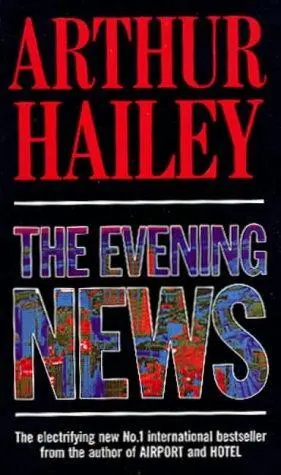
- Название:Evening News
- Автор:
- Жанр:
- Год:неизвестен
- ISBN:нет данных
- Рейтинг книги:3.5 / 5. Голосов: 2
-
Избранное:Добавить в избранное
- Отзывы:
-
Ваша оценка:
Evening News: краткое содержание, описание и аннотация
Предлагаем к чтению аннотацию, описание, краткое содержание или предисловие (зависит от того, что написал сам автор книги «Evening News»). Если вы не нашли необходимую информацию о книге — напишите в комментариях, мы постараемся отыскать её.
Evening News — читать онлайн бесплатно полную книгу (весь текст) целиком
Ниже представлен текст книги, разбитый по страницам. Система сохранения места последней прочитанной страницы, позволяет с удобством читать онлайн бесплатно книгу «Evening News», без необходимости каждый раз заново искать на чём Вы остановились. Поставьте закладку, и сможете в любой момент перейти на страницу, на которой закончили чтение.
Интервал:
Закладка:
”Well,” Partridge said, "since you ask, I do mind.”
Rita Abrams queried Havelock, "Aren't you Mr. FBI!'
He answered amiably, "You mean like 'Miss America! My colleagues might not think so.”
"What I really mean,” Rita said, "is you shouldn't be in here at all. This area is off limits to anyone except those working here.”
Havelock seemed surprised.”Part of my job is to protect Mr. Sloane. Besides, you're investigating the kidnapping. Right?”
"Yes.”
"Then we have the same objective, to locate Mr. Sloane's family. So anything you people discover, such as what goes up there"—he gestured to the "Sequence of Events” board—"the FBI needs to know as well.”
Several others in the room, among them Leslie Chippingham, had fallen silent.
”In that case,” Rita said, "it should be a two-way deal. Can I send a correspondent, right now, over to the FBI's New York office to examine all your reports that have come in?”
Havelock shook his head.”I'm afraid that isn't possible. Some are confidential.”
"Exactly!”
"Look, folks.” Havelock, aware of the growing attention around the room, was clearly trying to be restrained.”I'm not sure you fully understand that we're dealing with a crime. Anyone with knowledge has a legal obligation to pass it on, in this instance to the FBI. Failing to do so could be a criminal offense.”
Rita, seldom long on patience, objected, "For chrissakes, we're not children! We do investigations all the time and know the score.”
Partridge added, "I should tell you, Mr. Havelock, that I've worked close to the FBI on several stories and your people are notorious for taking all the information they can get and giving back nothing.”
Havelock snapped, "The FBI isn't obliged to give anything back.” His earlier restraint was gone.”We're a government agency with the power of the President and Congress behind us. What you people seem to be doing here is setting yourself up as competitors. Well, let me advise you that if anyone impedes the official investigation by withholding information, they're likely to face serious charges.”
Chippingham decided it was time to intervene.
”Mr. Havelock,” the news president said, "I assure you we are not people who break the law. However, we are free to do all the investigating we want and sometimes we're more successful at it than what you call the 'official investigation.'
"What's really involved here,” Chippingham continued, "is something called 'reporter privilege.' While I admit there are some gray areas, what's important is that reporters can investigate, then protect their sources unless a court rules otherwise. So you see, it would be an infringement on our freedom if we allowed you to have instant, total access to whatever comes in. Therefore I must tell you that while we're glad to have you here, there's a limit to your clearance and a line you may not cross—right there.” He pointed to the conference-room doorway.
"Well, sir,” Havelock said, "I'm not sure I buy all that, and you won't mind if I discuss the whole matter with the Bureau.”
"Not in the least. I'm sure they'll tell you we're acting within our rights.”
What Chippingham did not say was that CBA, like any news organization, would make its own decisions about what to reveal and when, even if it meant ruffling some FBI feathers. He knew that most others in the News Division felt the same way. As to possible consequences, the network would have to deal with those as and if they happened.
After Havelock had left to make a phone call, Chippingham told Rita, "Call the building superintendent. Ask for some keys to these offices and keep them locked.”
* * *
In the privacy of Partridge's office, he and Sloane began their interview with a tape recorder running. Partridge covered the now familiar ground, repeating earlier questions in more detailed ways, but nothing new emerged. At length, Partridge asked, "Is there anything in your mind, Crawf, even down in your subconscious that you might have to search for, something that could vaguely relate to what has happened? Is there the smallest incident you might have wondered about, then dismissed?”
"You asked me that yesterday,” Sloane answered thoughtfully. His attitude to Partridge had changed noticeably over the past twenty-four hours. In one sense it was friendlier. In another, Sloane was less wary of Partridge, even relying on him mentally in a way he never had before. Strangely, Sloane was almost deferential, as if seeing in Harry Partridge his greatest hope of getting Jessica, Nicky and his father back.
”I know I did,” Partridge said, "and you promised to think about it.”
"Well, I thought last night and maybe there is something, though I can't be sure, and it's only the vaguest feeling.” Sloane spoke awkwardly. He was never comfortable with hazy, unformed ideas.
Partridge urged, "Keep talking.”
"I think, before this happened, I might have had a feeling of being followed. Of course, it could be I'm thinking this way after discovering there was a watch on the house . . .”
"Forget that. So you think you were followed. Where and when?”
"That's the trouble. It's so hazy I could have made it up, maybe feeling I had to find something.”
"Do you think you made it up?”
Sloane hesitated.”No, I don't.”
"Give me more details.”
"I've a feeling I might have been followed sometimes while driving home. Also I have an instinct, and it's damned elusive, that someone may have been observing me here, inside CBA News~—someone who should not have been here.”
"All this over how long a period?”
"Maybe a month?” Sloane threw up his hands.”I simply can't be sure I'm not inventing. In any case, what difference does it make?”
"I don't know,” Partridge said.”But I'll talk it over with the others.”
Afterward, Partridge typed out a summary of the Sloane interview and pinned it on the conference room "Miscellaneous” board. Then, back in his office, he began the procedure known to all journalists as "working the phones.”
Open in front of him was his private "blue book"—a catalog of people he knew worldwide who had been useful before and might be again. It also included others he had helped by supplying information when they, in turn, needed it. The news business was full of debits and credits; at times like this, credits were called in. Also helpful was that most people were flattered to be sought after by TV news.
The night before, referring to the blue book, Partridge had made a list of those he would call today. The names beside him now included contacts in the Justice Department, White House, State Department, CIA, Immigration, Congress, several foreign embassies, New York's Police Department, the Royal Canadian Mounted Police in Ottawa, Mexico's Judicial Police, an author of real-life crime books, and a lawyer with organized crime clients.
The ensuing phone conversations were mostly low-key and began, "Hi, this is Harry Partridge. We haven't been in touch for a while. Just called to see how life is treating you.” The personal mode continued with inquiries about wives or husbands, lovers, children—Partridge kept notes of those names too—then eased into the current scene.”I'm working on the Sloane kidnapping. I wonder if you've heard any rumbles, or have ideas of your own.”
Sometimes the questions were more specific. Have you heard speculation on who might be responsible? Do you think terrorist involvement is a possibility,— if so, from where? Are any rumors floating, even wild ones? Will you ask around and call me back if you hear anything?
It was standard practice, at times tedious and always requiring patience. Sometimes it produced results, occasionally delayed ones, often none. From today's telephoning nothing specific emerged, though the most interesting conversation, Partridge decided afterward, was with the organized crime lawyer.
Читать дальшеИнтервал:
Закладка:
Похожие книги на «Evening News»
Представляем Вашему вниманию похожие книги на «Evening News» списком для выбора. Мы отобрали схожую по названию и смыслу литературу в надежде предоставить читателям больше вариантов отыскать новые, интересные, ещё непрочитанные произведения.









Обсуждение, отзывы о книге «Evening News» и просто собственные мнения читателей. Оставьте ваши комментарии, напишите, что Вы думаете о произведении, его смысле или главных героях. Укажите что конкретно понравилось, а что нет, и почему Вы так считаете.