Arthur Hailey - Evening News
Здесь есть возможность читать онлайн «Arthur Hailey - Evening News» весь текст электронной книги совершенно бесплатно (целиком полную версию без сокращений). В некоторых случаях можно слушать аудио, скачать через торрент в формате fb2 и присутствует краткое содержание. Жанр: Современная проза, на английском языке. Описание произведения, (предисловие) а так же отзывы посетителей доступны на портале библиотеки ЛибКат.
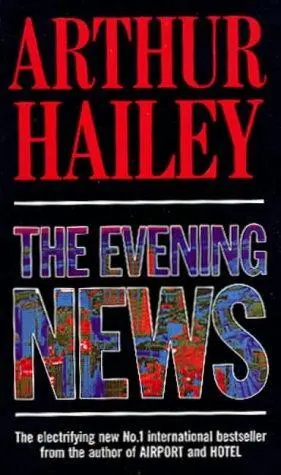
- Название:Evening News
- Автор:
- Жанр:
- Год:неизвестен
- ISBN:нет данных
- Рейтинг книги:3.5 / 5. Голосов: 2
-
Избранное:Добавить в избранное
- Отзывы:
-
Ваша оценка:
Evening News: краткое содержание, описание и аннотация
Предлагаем к чтению аннотацию, описание, краткое содержание или предисловие (зависит от того, что написал сам автор книги «Evening News»). Если вы не нашли необходимую информацию о книге — напишите в комментариях, мы постараемся отыскать её.
Evening News — читать онлайн бесплатно полную книгу (весь текст) целиком
Ниже представлен текст книги, разбитый по страницам. Система сохранения места последней прочитанной страницы, позволяет с удобством читать онлайн бесплатно книгу «Evening News», без необходимости каждый раз заново искать на чём Вы остановились. Поставьте закладку, и сможете в любой момент перейти на страницу, на которой закончили чтение.
Интервал:
Закладка:
The experienced master control operator who received the call knew the command "now”meant exactly that. In the absence of that word, if a program in progress were within a minute and a half of finishing, he would wait until its conclusion before breaking into the network feed. Similarly, if a commercial were airing, he would allow it to finish.
But "now”meant no delay, no holding. A one-minute commercial was being broadcast and had thirty seconds to go. But moving a switch, the operator cut it, thereby costing CBA in lost revenue some $25,000. With another switch he put the "Special Bulletin”slide on the network video feed. Instantly the bright red words appeared on the screens of more than twelve million television sets.
For five seconds, as he watched a digital clock in front of him, the master control operator kept the audio feed silent. This was to allow control rooms of affiliate stations which had not been broadcasting the network program to interrupt their local programming and take the special bulletin. Most did.
At the end of five seconds the audio feed was opened and an announcer's voice heard.
”We interrupt our regular programming to bring you a special report from CBA News. Now, from New York, here is correspondent Don Kettering.”
In the news control room, the director ordered, "Cue Don!”
Across the nation, the face of CBA's business correspondent filled television screens.
His voice and expression serious, Kettering began, "Police in Larchmont, New York, have reported the apparent kidnapping of the wife, young son and father of CBA News anchorman Crawford Sloane.”
A slide of Sloane's familiar face appeared as Kettering continued, "The kidnapping, by unidentified persons, occurred about forty minutes ago. According to police and a witness at the scene, it was preceded by a violent assault
The time was 11:56 A.M.
Beating out its competitors, CBA News had broken the story first.
PART TWO
1
The after effects of CDA's special bulletin announcing the Sloane family kidnap were instantaneous and widespread.
NBC News, whose decent, courteous gesture of informing CBA had robbed it of a possible lead, followed with its own bulletin barely a minute later—ahead of its original plan to break the story at noon.
CBS, ABC and CNN, alerted by wire reports from AP and Reuters, were all on the air with the news within minutes. So were TV stations across the country not connected to a network, but with their own news services.
Canadian television also made the Sloane kidnapping the lead item on noon news broadcasts.
Radio stations, with their lightning immediacy, were even faster than television in spreading the story.
From coast to coast, afternoon newspapers at once began replating front pages with banner headlines. Major out-of-state papers instructed their New York correspondents to work on individual by-line stories.
News photo agencies began a frantic search for pictures of Jessica, Nicholas and Angus Sloane. There was no shortage of Crawford Sloane photos.
The main switchboard of CBA was flooded with calls for Crawford Sloane. When the callers were told politely that Mr. Sloane was not available, most left sympathetic messages.
The press and other media reporters, knowing better than to call a switchboard, used direct lines into CBA News. As a result, some telephones were constantly blocked, making outside communication difficult. Journalists who got through, wanting to interview Sloane, were advised that he was too distressed to talk with anyone and that, in any case, there was no more information than had already been broadcast.
One caller who did reach Sloane was the President of the United States.
”Crawf, I've just been told this awful news,” the President said.”I know you have too much on your mind to talk right now, but I wanted you to know that Barbara and I are thinking about you and your family, and hoping for good news very soon. Like you, we want this ordeal to be over.”
"Thank you, Mr. President,” Sloane said.”That means a lot.”
"I've given orders to the Justice Department,” the President said, "that the FBI's search for your family is to have priority, and any other resources of government that are needed will be used.”
Sloane repeated his thanks.
The substance of the President's call was immediately made public by a White House spokesman, adding to the growing flow of information which clearly would dominate the evening news broadcasts of all networks.
TV camera crews from New York stations and the networks reached Larchmont shortly after the initial bulletins, and interviewed—as an observer put it—"almost every breathing body in sight,” including some with only a tenuous connection to the case. The ex-schoolteacher, Priscilla Rhea, blossoming under all the attention, proved to be the favorite interviewee, with the Larchmont police chief a close second.
A startling new development emerged when several people living near the Sloanes came forward with information that the Sloane house had apparently been under observation for several weeks, perhaps a month. A succession of different cars, and several times a truck, had been seen to arrive. They remained parked near the house for long periods, with whoever came in the vehicles remaining inconspicuously inside. Some makes of cars were mentioned, though detailed information was sketchy. There was agreement among the observers that sometimes the cars had New York license plates, at other times New Jersey's. No one, though, remembered numbers.
One of the cars described by a neighbor matched the description of that seen by the Sloanes' maid, Florence—the same car that followed Jessica Sloane's Volvo when Jessica, Nicky and Angus left to do the household shopping.
Press and TV interviewers asked the obvious question: Why had no one reported the apparent surveillance to the police?
In each case the answer was the same. It was assumed that some kind of security protection was being provided for the famous Mr. Crawford Sloane, and why would neighbors interfere with that?
Now, belatedly, information about the various vehicles was being sought by police.
Overseas media, too, were showing keen interest in the kidnap story. While the face and voice of Crawford Sloane were not as familiar to foreigners as to North Americans, the involvement of a major TV personality seemed of international consequence in itself.
This overwhelming reaction was proof that the modem network anchorman—species Homo promulgare ancora, as the next day's Wall Street Journal would dub it—had become a special breed, ranking in public idolization with kings and queens, movie and rock stars, popes, presidents and princes.
* * *
Crawford Sloane's mind was a turmoil of emotions.
He moved through the next several hours partly in a daze, half-expecting to learn at any moment that the entire episode was a misunderstanding, a readily explained mistake. But as time went by, with Jessica's Volvo still standing unclaimed in the Larchmont supermarket parking lot, this seemed increasingly less likely.
What troubled Sloane greatly was the memory of his conversation the preceding evening with Jessica. It was he who had brought up the possibility of kidnap, and it was not the coincidence which exercised him—he knew from long experience that real life and real news were full of coincidences, sometimes incredible ones. But, as he saw it at this moment, his own selfishness and self-importance made him assume that only he could be a kidnap victim. Jessica had even asked, "What about families? Could they be targets too?” But he had dismissed the idea, not believing it could happen or that Jessica and Nicky should be protected. Now, blaming himself for indifference and neglect, his sense of guilt was overwhelming.
Читать дальшеИнтервал:
Закладка:
Похожие книги на «Evening News»
Представляем Вашему вниманию похожие книги на «Evening News» списком для выбора. Мы отобрали схожую по названию и смыслу литературу в надежде предоставить читателям больше вариантов отыскать новые, интересные, ещё непрочитанные произведения.







Обсуждение, отзывы о книге «Evening News» и просто собственные мнения читателей. Оставьте ваши комментарии, напишите, что Вы думаете о произведении, его смысле или главных героях. Укажите что конкретно понравилось, а что нет, и почему Вы так считаете.