Arthur Hailey - Evening News
Здесь есть возможность читать онлайн «Arthur Hailey - Evening News» весь текст электронной книги совершенно бесплатно (целиком полную версию без сокращений). В некоторых случаях можно слушать аудио, скачать через торрент в формате fb2 и присутствует краткое содержание. Жанр: Современная проза, на английском языке. Описание произведения, (предисловие) а так же отзывы посетителей доступны на портале библиотеки ЛибКат.
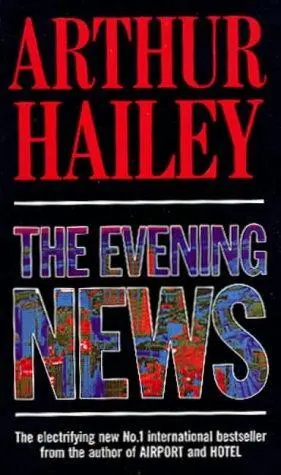
- Название:Evening News
- Автор:
- Жанр:
- Год:неизвестен
- ISBN:нет данных
- Рейтинг книги:3.5 / 5. Голосов: 2
-
Избранное:Добавить в избранное
- Отзывы:
-
Ваша оценка:
Evening News: краткое содержание, описание и аннотация
Предлагаем к чтению аннотацию, описание, краткое содержание или предисловие (зависит от того, что написал сам автор книги «Evening News»). Если вы не нашли необходимую информацию о книге — напишите в комментариях, мы постараемся отыскать её.
Evening News — читать онлайн бесплатно полную книгу (весь текст) целиком
Ниже представлен текст книги, разбитый по страницам. Система сохранения места последней прочитанной страницы, позволяет с удобством читать онлайн бесплатно книгу «Evening News», без необходимости каждый раз заново искать на чём Вы остановились. Поставьте закладку, и сможете в любой момент перейти на страницу, на которой закончили чтение.
Интервал:
Закладка:
By now, Nicholas, struggling too, had been hauled inside. Carlos held him while he received the same treatment.
Baudelio, still working quickly, used scissors to cut the sleeve of Jessica's dress, then injected the contents of a hypodermic syringe intramuscularly into her upper arm. The drug was midazolam, a strong sedative that would ensure continued unconsciousness for at least an hour. He gave the boy a similar injection.
Miguel, meanwhile, had dragged the unconscious Angus over to the van. Rafael, now freed of Jessica, jumped down and pulled out a pistol, a Browning automatic. Clicking the safety off, he urged Miguel, "Let me finish him!”
"No, not here!” The entire operation of seizing the woman and boy had gone with incredible speed, occupying barely a minute. To Miguel's amazement, no one else appeared to have witnessed what had happened. One reason: They had been shielded by the two vehicles; also, fortuitously, there had been no passersby. Miguel, Carlos, Rafael and Luis had all come armed and there was a Beretta submachine gun in the van for use if they had to fight their way out of the parking lot. Now a fighting exit wasn't necessary and they would have a head start on any pursuit. But if they left the old man behind—his head was bleeding profusely, with blood dripping to the ground—animmediate alarm would be raised. Making a decision, Miguel ordered, "Help me get him in.”
It was accomplished in seconds. Then, as he entered the van himself and closed the side door, Miguel saw he had been wrong about no witnesses. An elderly woman, white-haired and leaning on a cane, was watching from between two cars some twenty yards away. She appeared uncertain and puzzled.
As Luis moved the Nissan van forward, Rafael caught sight of the old woman too. In a single swift movement he grabbed the Beretta, raised it, and through a rear window was taking aim. Miguel shouted to him, "No!” He didn't care about the woman, but the chances looked good that they could still get away without raising an alarm. Pushing Rafael aside and making his voice cheerful, Miguel called out, "Don't be alarmed. It's just part of a film we're making.”
He saw relief and the beginning of a smile on the woman's face. Then they left the parking lot and, soon after, Larchmont. Luis was driving skillfully, wasting no time. Within five minutes they were on Interstate 95, the New England Thruway, heading south and moving fast.
12
There had been a time when Priscilla Rhea possessed one of the sharpest minds in Larchmont. She had been a schoolteacher who pounded into several generations of area youngsters the fundamentals of square roots, quadratic equations, and how to discover—she always made it sound like the search for a holy grail—the algebraic values of x or y. Priscilla also urged them to have a sense of civic responsibility and never to shirk their obvious duty.
But all of that was prior to Priscilla's retirement fifteen years earlier, and before the toll of age and illness slowed her body, then her mind. Nowadays, white-haired and frail, she walked slowly, using a cane, and had recently described her thought processes, disgustedly, as "having the speed of a threelegged donkey going uphill.”
Nevertheless Priscilla was exercising her thought processes now, moving them along as best she could.
She had watched two people—a woman and a boy—being taken into what looked like a small bus, apparently against their will. They were certainly struggling and Priscilla thought she'd heard the woman cry out, though about that she wasn't sure, her hearing having deteriorated along with everything else. Then another person, a man who seemed unconscious and hurt, was lifted into the same small bus before it drove away.
Her natural anxiety at seeing this was immediately relieved by the shouted information that it was all part of a film show. That made sense. Film and television crews seemed to be everywhere nowadays, photographing their stories against real backgrounds and even interviewing people for TV news, right on the street.
But then, the moment the little bus had gone Priscilla looked around for the cameras and film crew which should have been recording the action she had watched, and for the life of her she couldn't find any. She reasoned that if there had been a film crew, it couldn't possibly have disappeared that fast.
The whole thing was a worry Priscilla wished she didn't have, in part because she knew that perhaps she was all mixed up in her mind, the way she had been some other times. The sensible thing to do, she told herself, was go into the Grand Union store, do her bit of shopping and mind her own business. Just the same, there was her lifelong credo of not shirking responsibility, and perhaps she shouldn't, even now. She only wished there were someone handy whom she could ask for advice, and just at that moment she saw Erica McLean, one of her old pupils, also on her way into the supermarket.
Erica, now a mother with children of her own, was in a hurry but stopped to ask courteously, "How are you, Miss Rhea?”(No one who had ever been a pupil of Miss Rhea ever presumed to address her by her first name.)
"Slightly bewildered, my dear,” Priscilla said.
"Why, Miss Rhea?”
"Something I just saw ... But I'm not sure what I saw. I'd like to know what you think.” Priscilla then described the scene, which was still remarkably clear in her mind.
”And you're sure there was no film crew?”
"I couldn't see one. Did you, as you came in?”
"No.” Within herself, silently, Erica McLean sighed. She had not the least doubt that dear old Priscilla had been subject to some kind of hallucination and it was Erica's bad luck to have come along just then and be roped in. Well, she couldn't walk away from the old duck, for whom she had a genuine fondness, so she had better forget being in a hurry and do what she could to help.
”Just where did all this happen?” Erica asked.
”Over there.” Priscilla pointed to the still—empty parking slot next to Jessica's Volvo station wagon. They walked to it together.”Here!”Priscilla said.”It happened right here.”
Erica looked around her. She had not expected to see anything significant, and didn't. Then, about to turn away, her attention was caught by a series of small pools of liquid on the ground. Against the blacktop surface of the parking lot the liquid seemed dark brown. It was probably oil. Or was it? Curiously, Erica leaned down to touch it. Seconds later she looked with horror at her fingers. They were covered in what was unmistakably blood, still warm.
* * *
It had been a quiet morning in the Larchmont police department, a small but efficient local force. In a glass cubicle a uniformed desk officer was sipping coffee and glancing through the local Sound View News when the call came in—from a pay phone on the comer of Boston Post Road, a half block from the supermarket.
Erica McLean spoke first. After identifying herself she said, "I have a lady here, Miss Priscilla Rhea . . .”
"I know Miss Rhea,” the desk officer said.
”Well, she thinks she may have seen something criminal, perhaps some kind of abduction. I'd like you to speak to her.”
"I'll do better than that,” the desk officer said.”I'll send an officer in a patrol car and you can tell it to him. Where are you ladies?”
"We'll be outside the Grand Union.”
"Stay there, please. Someone will be with you in a few minutes.”
The desk officer spoke into a radio microphone.”Headquarters to car 423. Respond to Grand Union store. Interview Mrs. McLean and Miss Rhea waiting outside. Code one.”
The answer came back, "Four twenty-three to headquarters. Ten four.”
Eleven minutes had now passed since the passenger van carrying Jessica, Nicholas and Angus had left the supermarket parking lot.
Читать дальшеИнтервал:
Закладка:
Похожие книги на «Evening News»
Представляем Вашему вниманию похожие книги на «Evening News» списком для выбора. Мы отобрали схожую по названию и смыслу литературу в надежде предоставить читателям больше вариантов отыскать новые, интересные, ещё непрочитанные произведения.



Обсуждение, отзывы о книге «Evening News» и просто собственные мнения читателей. Оставьте ваши комментарии, напишите, что Вы думаете о произведении, его смысле или главных героях. Укажите что конкретно понравилось, а что нет, и почему Вы так считаете.