Arthur Hailey - Evening News
Здесь есть возможность читать онлайн «Arthur Hailey - Evening News» весь текст электронной книги совершенно бесплатно (целиком полную версию без сокращений). В некоторых случаях можно слушать аудио, скачать через торрент в формате fb2 и присутствует краткое содержание. Жанр: Современная проза, на английском языке. Описание произведения, (предисловие) а так же отзывы посетителей доступны на портале библиотеки ЛибКат.
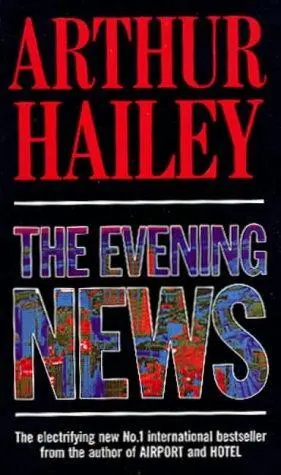
- Название:Evening News
- Автор:
- Жанр:
- Год:неизвестен
- ISBN:нет данных
- Рейтинг книги:3.5 / 5. Голосов: 2
-
Избранное:Добавить в избранное
- Отзывы:
-
Ваша оценка:
Evening News: краткое содержание, описание и аннотация
Предлагаем к чтению аннотацию, описание, краткое содержание или предисловие (зависит от того, что написал сам автор книги «Evening News»). Если вы не нашли необходимую информацию о книге — напишите в комментариях, мы постараемся отыскать её.
Evening News — читать онлайн бесплатно полную книгу (весь текст) целиком
Ниже представлен текст книги, разбитый по страницам. Система сохранения места последней прочитанной страницы, позволяет с удобством читать онлайн бесплатно книгу «Evening News», без необходимости каждый раз заново искать на чём Вы остановились. Поставьте закладку, и сможете в любой момент перейти на страницу, на которой закончили чтение.
Интервал:
Закладка:
The assistant did, however, walk over to the elevated newsroom desk where the station's woman news director presided, and tell her about the call.
After hearing him out, she confirmed his decision. But afterward a thought occurred to her and she picked up a telephone that connected her directly to CBA network news. She asked for Ernie LaSalle, the national editor with whom she sometimes exchanged information.
”Look,” she said, "this may turn out to be nothing.” Repeating what she had just heard, she added, "But it is Larchmont and I know Crawford Sloane lives there. It's a small place, it might involve someone he knows, so I thought you'd want to tell him.”
"Thanks,” LaSalle said.”Let me know if there's anything more.”
* * *
When he hung up the phone, Ernie LaSalle momentarily weighed the potential importance of the information. The likelihood was, it would amount to zero. Just the same . . .
On instinct and impulse he picked up the red reporting phone.
”National desk. LaSalle. We are advised that at Larchmont, repeat Larchmont, New York, the local police radio reports a possible kidnapping. No other details. Our friends at WCBA are following up and will inform us.”
As always, the national editor's words were carried throughout the CBA News headquarters. Some who heard wondered why LaSalle had put something so insubstantial on the speaker system. Others, unconcerned, returned their attention to whatever else they had been doing. One floor above the newsroom, senior producers at the Horseshoe paused to listen. One of them, pointing to Crawford Sloane who could be seen through the closed glassed doorway to his private office, observed, "If there's a kidnapping let's be thankful it's someone else in Larchmont and not Crawf. Unless that's his double in there.” The others laughed.
Crawford Sloane heard LaSalle's announcement through a speaker on his desk. He had closed the door for a private meeting with the president of CBA News, Leslie Chippingham. While Sloane, in asking for the meeting, had suggested he go to Chippingham's office, the other man had chosen to come here.
Both paused until the national editor's words concluded and Sloane's interest was quickened by the mention of Larchmont. At any other time he would have gone to the newsroom to seek more information. But as it was, he did not want to stop what had suddenly become a no-holds-barred confrontation which, to the anchorman's surprise, was not going at all the way he had expected.
14
"My instinct tells me, Crawf, you have a problem,” the CBA News president said, opening their conversation.
”Your instinct is wrong,” Crawford Sloane responded.”It's you who have the problem. It's readily solvable, but you need to make some structural changes. Quickly.”
Leslie Chippingham sighed. He was a thirty-year veteran of TV news who had begun his career at age nineteen as a messenger at NBC's Huntley-Brinkley Report, the premier news show of its day. Even then he had learned that an anchorman must be handled as delicately as a Ming vase and receive the deference accorded heads of state. It was Chippingham's success in doing both which, along with other talents, had raised him to executive producer, then kept him a senior management survivor while other high climbers—including a bevy of network news presidents—were exiled to TV's backwaters or the oblivion of early retirement.
Chippingham had a facility for being at ease with everyone and making others feel the same way. It was once said of him that if he fired you, he made you feel good about it.
”So tell me,” he asked Sloane.”What changes?”
"I can't continue to work with Chuck Insen. He has to go. And when we choose a new exec producer I want the casting vote.”
"Well, well. You're right about there being a problem.” Chippingham chose his words cautiously and added, "Though it's perhaps a different one, Crawf, from what you think.”
Crawford Sloane regarded his nominal superior. What he saw was a towering figure, even seated—Chippingham was six-foot-four and weighed a trim 205 pounds. The face was more rugged than handsome, the eyes bright blue and the hair a forest of tight curls, now mostly gray. Across the years a succession of women had taken pleasure in running their fingers through Chippingham's curls, that particular pleasure invariably preceding others. Women, in fact, had been Les Chippingham's lifelong weakness, their conquest an irresistible hobby. At this moment, because of those indulgences, he was facing marital and financial disaster—a fact unknown to Sloane, though he, like others, was aware of Chippingham's womanizing.
Chippingham, however, knew he must put his own concerns aside to cope with Crawford Sloane. It would be like walking a high wire, as any colloquy with an anchorman always was.
"Let's quit futzing around,” Sloane said, "and come to the point.”
Chippingham agreed, "I was about to. As we both know, many things in network news are changing . . .”
"Oh for chrissakes, Les, of course they are!” Sloane cut in impatiently.”That's why I have problems with Insen. We need to change the shape of our news—with fewer quick headlines and more important stories developed thoroughly.”
"I'm aware of your feelings. We've been over this before. I also know what Chuck believes and, by the way, he came to see me earlier this morning, complaining about you.”
Sloane's eyes widened. He had not expected the executive producer to take the initiative in their dispute; it was not the way things usually happened.”What does he think you can do?” he asked.
Chippingham. hesitated.”Hell, I suppose there's no point in not telling you. He believes the two of you are so far apart that your differences aren't reconcilable. Chuck wants you out.”
The anchorman threw back his head and laughed.”And him stay? That's ridiculous.”
The news president met his gaze directly.”Is it?”
"Of course. And you know it.”
"I knew it once; I'm not sure I do now.” Ahead of them both was untrodden ground. Chippingham eased onto it guardedly.
”What I'm trying to get through to you, Crawf, is that nothing anymore is the way it used to be. Since the networks were bought out, everything's in flux. You know as well as I do there's a good deal of feeling among our new masters—at this network and the others—about the power of the evening anchormen. Those goliaths running the parent companies want to diminish that power; also they're unhappy about some of the big salaries for which they think they're not getting value. Recently there's been talk about private, quiet agreements.”
Sloane said sharply, "What kind of agreements?”
"The way I hear, the kind big entrepreneurs reach in their exclusive clubs and private homes. For example: ' We'll tell our network not to try to hire away your network news people, provided you agree not to go after ours. That way we won't push salaries up all around, and can work on reducing some of the big ones.”
“That's collusion, restraint of trade. It's goddamned illegal!”
"Only if you can prove it happened,” Chippingham pointed out.”How can you, though, if the agreement's made over drinks at the Links Club or the Metropolitan, and no record is kept, nothing ever written down?”
Sloane was silent and Chippingham pressed the message home.”What it amounts to, Crawf, is that this is not the best of times to push too hard.”
Sloane said abruptly, "You said Insen envisaged someone else in my place. Who?”
"He mentioned Harry Partridge.”
Partridge! Once more, Sloane thought, he was looming as a competitor. He wondered if Partridge had planted the idea. As if divining the thought, Chippingham said, "Apparently Chuck mentioned the idea to Harry, who was surprised but didn't think he'd be interested.”
Читать дальшеИнтервал:
Закладка:
Похожие книги на «Evening News»
Представляем Вашему вниманию похожие книги на «Evening News» списком для выбора. Мы отобрали схожую по названию и смыслу литературу в надежде предоставить читателям больше вариантов отыскать новые, интересные, ещё непрочитанные произведения.







Обсуждение, отзывы о книге «Evening News» и просто собственные мнения читателей. Оставьте ваши комментарии, напишите, что Вы думаете о произведении, его смысле или главных героях. Укажите что конкретно понравилось, а что нет, и почему Вы так считаете.