Arthur Hailey - Evening News
Здесь есть возможность читать онлайн «Arthur Hailey - Evening News» весь текст электронной книги совершенно бесплатно (целиком полную версию без сокращений). В некоторых случаях можно слушать аудио, скачать через торрент в формате fb2 и присутствует краткое содержание. Жанр: Современная проза, на английском языке. Описание произведения, (предисловие) а так же отзывы посетителей доступны на портале библиотеки ЛибКат.
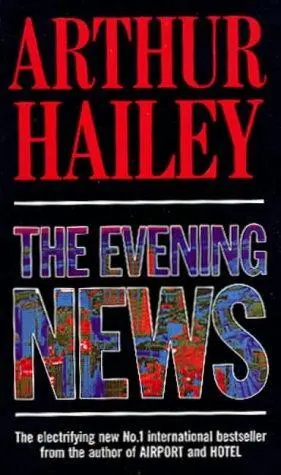
- Название:Evening News
- Автор:
- Жанр:
- Год:неизвестен
- ISBN:нет данных
- Рейтинг книги:3.5 / 5. Голосов: 2
-
Избранное:Добавить в избранное
- Отзывы:
-
Ваша оценка:
Evening News: краткое содержание, описание и аннотация
Предлагаем к чтению аннотацию, описание, краткое содержание или предисловие (зависит от того, что написал сам автор книги «Evening News»). Если вы не нашли необходимую информацию о книге — напишите в комментариях, мы постараемся отыскать её.
Evening News — читать онлайн бесплатно полную книгу (весь текст) целиком
Ниже представлен текст книги, разбитый по страницам. Система сохранения места последней прочитанной страницы, позволяет с удобством читать онлайн бесплатно книгу «Evening News», без необходимости каждый раз заново искать на чём Вы остановились. Поставьте закладку, и сможете в любой момент перейти на страницу, на которой закончили чтение.
Интервал:
Закладка:
As always in the tropics when the sun receded, darkness followed quickly. In the houses a few dim lights had come on and now the last vestiges of day were almost gone. Partridge lowered his binoculars and wiped his eyes, which were strained after more than an hour of concentration on the scene below. There was little else, he believed, that they would learn today.
At that moment Minh touched his arm, gesturing toward the huts below. Partridge picked up his binoculars and peered again. At once he saw movement in the now dim light—the figure of a man walking down the path between two groups of houses. In contrast to other movements they had seen, this man's walk seemed purposeful. Something else was different; Partridge strained to see . . . now he had it! The man was carrying a rifle, slung over his shoulder. Partridge and Minh both followed the man's movement with their binoculars.
Away from the other buildings, standing separately, was a single shack. Partridge had seen it earlier, but there had been nothing special to attract attention. Now the man reached the building and disappeared inside. There was an opening in the front wall and dim light filtered through.
Still they continued watching, and for a few minutes nothing happened. Then, from the same shack a figure emerged and walked away. Even in the faded light two things could be distinguished: This was a different man and he, too, was carrying a gun.
Could it be, Partridge wondered excitedly, that what they had just witnessed was a changing of the prisoners' guard? More confirmation was needed and they would have to keep observing. But the probability was strong that the shack standing alone was where Jessica and Nicky Sloane were being held.
He tried not to let his mind dwell on the likelihood that, until a day or two before, Angus Sloane had been confined there too.
* * *
The hours passed.
Partridge bad advised the others, "What we need to know is how much activity there is at night in Nueva Esperanza, roughly how long it lasts, and what time everything settles down, with most lights out. I'd like a written record kept, with all times noted.”
At Partridge's request, Minh stayed another hour alone at the observation point and, later, Ken O'Hara relieved him.
”Everyone get as much rest as you can,” Partridge ordered.”But we should man the observation point and the sentry post in the clearing all the time, which means only two people can sleep at once.” After discussion it was decided they would alternate duty with sleep, using two-hour shifts.
Earlier, Fernandez had rigged hammocks with mosquito netting inside the hut they had found on arrival. The hammocks were less than comfortable, but those using them were too exhausted from the day's activity to care, and quickly fell asleep. The idea of bringing plastic sheeting was justified during the night when rain fell heavily and leaked through the hut roof. Fernandez adroitly covered the hammocks so the sleepers were protected. Those outside huddled in their own plastic protection as best they could until the rain stopped half an hour later.
Nothing specific was done about meals. Food and water were handled individually, though they all knew the dried food must be used sparingly. Their water supply, brought from Lima the preceding day, had already been consumed, and several hours earlier Fernandez had filled water bottles from a jungle stream, adding sterilizing tablets. He had warned that most local water was contaminated by chemicals used by drug processors. The water in the bottles now tasted awful and everyone drank as little as possible.
By dawn next morning, Partridge had answers to his questions concerning Neuva Esperanza at night: There was very little activity—other than the strumming of a guitar and occasional strident voices and drunken laughter somewhere indoors. Such activity as there was lasted for about three and a half hours after dark. By 1:30 A.M. the entire hamlet was silent and dark.
What they still needed to know—assuming Partridge's surmises about the guards and the prisoners' location were correct —was how often a guard change occurred, and at what times. By morning no clear picture had emerged. If there had been another guard change in the night, it escaped observation.
Their routine continued through the day.
Manning of the sentry post and observation point was maintained, and even during daytime the hammocks were available to those off duty. All took advantage of them, knowing their reserves of endurance might be needed later.
During the afternoon, while it was Harry Partridge's turn in a hammock, he contemplated what he and the others were doing . . . asking himself with a sense of unreality: Is all this really happening? Should their small, unofficial force be attempting a rescue? In a few hours, no more, they would probably have to kill or be killed themselves. Was it all madness? Like that line from Macbeth, ". . . life's fitful fever . . .”
He was a professional journalist, wasn't he? A TV correspondent, an observer of wars and conflict, not a participant. Yet suddenly, by his own decision, he had become an adventurer, a mercenary, a would—be soldier. Did this switch in any way make sense?
Whatever the answer, there was another question: If he, Harry Partridge, failed to do what was needed here and now, who would?
And something else: A journalist covering wars, especially a TV correspondent, was never far from violence, mayhem, ugly wounding, sudden death. He or she lived those perils, shared them, sometimes suffered them, then brought them nightly into the clean and tidy living rooms of urban America, an environment where they were no more than images on a screen and therefore not dangerous to those who watched.
And yet, increasingly, those images were becoming dangerous, were moving closer both in time and distance, and soon would be not only pictures on a tube but harsh reality in American cities and streets where crime already prowled. Now the violence and terrorism in the underprivileged, divided, war-torn half-world was moving nearer, ever nearer, to American soil. It was inevitable and had been expected by international scholars for a long time.
The Monroe Doctrine, once thought to be an American protection, no longer worked; nowadays few bothered even speaking of it. The kidnapping of the Sloane family within the United States by foreign agents had demonstrated that international terrorism was already there. There was more, much more, to come—terrorist bombings, hostage taking, shelling in the streets. Tragically, there was no way to avoid it. Equally tragic was that many who were not participants soon would be —like it or not.
So at this moment, Partridge thought, his involvement and that of the other three was not unreal. He suspected that Minh Van Canh, especially, saw nothing contradictory in their present situation. Minh, who had lived through and survived a terrible, divisive war within his own country, would find it easier than most to accept this undertaking now.
And, in a personal way, beyond and overshadowing all those thoughts was Jessica. Jessica, who was probably close at hand, somewhere inside that hut. Jessica—Gemma whose memories and personalities, in his mind, were intertwined.
Then . . . fatigue suddenly overwhelming him . . . he fell asleep.
On awakening, some fifteen minutes before his own observation duty, he dropped down from the hammock and went outside to check the general situation.
At the sentry post, as previously, there had been no alarms or action. The observation point, however, had produced specific information and opinions.
There was a regular change of an armed person—presumably a guard—at the same location as on the night before, suggesting that prisoners were indeed housed in the building that stood apart from others. It seemed probable that a guard change was supposed to occur every four hours, but the timing was not exact. A changeover was sometimes as much as twenty minutes late and the imprecision, Partridge believed, showed a casualness on the guards' part, confirming the message conveyed by Jessica: Security here is sometimes lax.
Читать дальшеИнтервал:
Закладка:
Похожие книги на «Evening News»
Представляем Вашему вниманию похожие книги на «Evening News» списком для выбора. Мы отобрали схожую по названию и смыслу литературу в надежде предоставить читателям больше вариантов отыскать новые, интересные, ещё непрочитанные произведения.








Обсуждение, отзывы о книге «Evening News» и просто собственные мнения читателей. Оставьте ваши комментарии, напишите, что Вы думаете о произведении, его смысле или главных героях. Укажите что конкретно понравилось, а что нет, и почему Вы так считаете.