Arthur Hailey - Evening News
Здесь есть возможность читать онлайн «Arthur Hailey - Evening News» весь текст электронной книги совершенно бесплатно (целиком полную версию без сокращений). В некоторых случаях можно слушать аудио, скачать через торрент в формате fb2 и присутствует краткое содержание. Жанр: Современная проза, на английском языке. Описание произведения, (предисловие) а так же отзывы посетителей доступны на портале библиотеки ЛибКат.
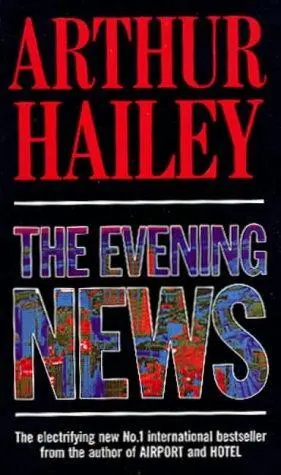
- Название:Evening News
- Автор:
- Жанр:
- Год:неизвестен
- ISBN:нет данных
- Рейтинг книги:3.5 / 5. Голосов: 2
-
Избранное:Добавить в избранное
- Отзывы:
-
Ваша оценка:
Evening News: краткое содержание, описание и аннотация
Предлагаем к чтению аннотацию, описание, краткое содержание или предисловие (зависит от того, что написал сам автор книги «Evening News»). Если вы не нашли необходимую информацию о книге — напишите в комментариях, мы постараемся отыскать её.
Evening News — читать онлайн бесплатно полную книгу (весь текст) целиком
Ниже представлен текст книги, разбитый по страницам. Система сохранения места последней прочитанной страницы, позволяет с удобством читать онлайн бесплатно книгу «Evening News», без необходимости каждый раз заново искать на чём Вы остановились. Поставьте закладку, и сможете в любой момент перейти на страницу, на которой закончили чтение.
Интервал:
Закладка:
”I heard,” she said, "and I'm sorry. About the other, you cut it fine and I was beginning to think you wouldn't call. But thank you.”
14
Away from the highway where the Cheyenne II had landed, the trek through the jungle for Partridge and the other three was difficult and slow.
The trail—if it could be called that—was often overgrown and frequently disappeared entirely. Faced with a dense and tangled mass of vegetation, it was necessary to hack a way through using machetes, hoping for a clearer space beyond. Tall trees formed a canopy above their heads, under an over- cast sky which hinted of rain to come. Many trees had grotesquely twisted trunks, thick bark and leathery leaves; Partridge had read somewhere that eight thousand known species of trees existed in Peru. At lower levels, bamboos, ferns, lianas and parasitic plants were everywhere intertwined—the result described by the same source as "green hell.”
"Hell” was appropriate today because of the sweltering, steamy heat from which all four men were already suffering. Sweat streamed from every part of them, their condition made worse by swarms of insects. At the beginning they had soaked themselves with mosquito repellent, applying more along the way, but as Ken O'Hara put it, "The little devils seem to like the stuff.”
Fortunately, when contact with the trail was reestablished, there were areas where overhead shade from closely growing trees had made ground growth less prolific, therefore it was easier to move ahead. It was obvious that without the trail, progress would be nil.
”This route isn't used much,” Fernandez pointed out, "and that's to our advantage.”
Their objective was to approach Nueva Esperanza, but to stay well clear of it while locating a position on higher ground. From there, hidden by the jungle, they would observe the hamlet, mainly during daylight hours. Then, depending on what was seen and learned, they would devise a plan.
The entire surrounding area for a hundred or more square miles, broken only by the Huallaga River, was dense jungle over an undulating plain. But the large-scale contour map acquired by Fernandez showed several hills near their objective, one of which might work as an observation post. Nueva Esperanza itself was about nine miles from their present position—a formidable distance under these conditions.
One thing Partridge had memorized was the second message Jessica managed to convey while making her videotape recording. As reported to him by Crawford Sloane, in a sealed letter which Rita hand-carried to Peru, Jessica had scratched her left earlobe to mean: Security here is sometimes lax. An attack from outside might succeed . Sometime soon that information would be put to the test.
Meanwhile, they labored on through the jungle.
It was well into the afternoon, when everyone was near exhaustion, that Fernandez warned them Nueva Esperanza might be near.”I think we have covered about seven miles,” he said; then cautioned, "we must not be seen. If we hear sounds of anyone coming, we must melt into the jungle quickly.”
Looking at dense brush and thorns on either side, Minh Van Canh said, "Makes sense, but let's hope we don't have to.”
Soon after Fernandez's warning, the going became easier and several other trails crisscrossed their own. Fernandez explained that this whole area of slopes and hills was laced with coca fields, which at other times of the year would be bustling with activity. During a four-to-six-month growing season, coca bushes needed only minor care, so most growers lived elsewhere, coming back and occupying hilltop shacks during harvest time.
Using his contour map and compass, Fernandez continued to guide the other three; at the same time, the extra effort now required in walking told them they were gradually moving uphill. After another hour they entered a clearing and, beyond it, could see a shack amid jungle trees.
By now it had become evident to Partridge that Fernandez knew the area better than he had admitted earlier. When questioned, the stringer-fixer conceded, "I have been here several times before.”
Inwardly, Partridge sighed. Was Fernandez one more among the army of pseudo-upright people who benefited in back-door, insidious ways from the ubiquitous cocaine trade? Latin America, and the Caribbean especially, were full of such pretenders, many in high places.
As if sensing the thought, Fernandez added, "I was here one time for a 'dog-and-pony show' put on by our government for your State Department. There was a visitor—your Attorney General, I think—and the media were brought along. I was one of them.”
Despite his reaction a moment earlier, Partridge smiled at the "dog-and-pony show” description. It was one applied contemptuously by reporters when a foreign government staged an anti-drug performance designed to impress a visiting American delegation. Partridge could imagine the scene here: An "invasion” by helicopter-borne troops who would uproot and burn a few acres of coca plants and destroy a processing lab or two with dynamite. The visitors would praise the host government's anti-drug efforts, either not knowing or ignoring the fact that thousands of coca-growing areas and dozens of other labs nearby remained untouched.
Next day the visitors' photos would be in U.S. newspapers, accompanied by their approving statements, the process repeated on TV. And reporters—knowing they had been part of a charade, but unable to pass it up because others were recording it—would swallow hard and nurse their shame.
It had happened in Peru, which was neither a dictatorship nor communist but, Partridge thought, might soon be one or the other.
Fernandez inspected the clearing, they had reached, including the hut, satisfying himself that no one was there. Then he led the way eastward into the jungle again, but only for a little way, the others halting when Fernandez cautioned them with a signal. A moment later he parted a cluster of ferns and motioned the others to look. One by one they did so, observing a collection of dilapidated buildings about half a mile away and two hundred feet below. There were two dozen or so shacks located on a riverbank. A muddy path led from the buildings to a rough wooden jetty and the river, where a motley collection of boats was moored.
Partridge said softly, "Nice going, everybody!” He added with relief, "I guess we, found Nueva Esperanza.”
* * *
After having deferred to Fernandez on the trail, Harry Partridge now resumed command.
”We don't have a lot of daylight left,” he told the others. The sun was already near the horizon, the journey having taken far longer than expected.”I want to observe as much as possible before dark. Minh, bring the other binoculars and join me forward. Fernandez and Ken ' pick a sentry post and one of you keep watch to see if we're approached from behind. Work that out between you, and if someone does show, call me quickly.”
Approaching the strip of jungle, which prevented them from being seen from below, Partridge dropped to his belly and wriggled forward, carrying the binoculars he had brought. Minh, beside him, did the same, both stopping when they could see clearly but were still shielded by surrounding foliage.
Moving the binoculars slowly, Partridge studied the scene below.
There was almost no activity. At the jetty, two men were working on a boat, stripping an outboard engine. A woman left one shack, emptied a pail of slops behind it, and returned inside. A man emerged from the jungle, walked toward another house and entered. Two scrawny dogs were clawing their way into an open garbage pile. Other garbage littered the area. Viewed overall, Nueva Esperanza appeared to be a jungle slum.
Partridge began studying the buildings individually, letting the binoculars linger several minutes on each. Presumably the prisoners were being held in one of them, but no clue was evident as to which. It was already obvious, he thought, that at least a full day's observation would be needed and any idea of a rescue attempt tonight and departure by air tomorrow morning was clearly out of the question. He settled down, simply to wait and watch while the light diminished.
Читать дальшеИнтервал:
Закладка:
Похожие книги на «Evening News»
Представляем Вашему вниманию похожие книги на «Evening News» списком для выбора. Мы отобрали схожую по названию и смыслу литературу в надежде предоставить читателям больше вариантов отыскать новые, интересные, ещё непрочитанные произведения.







Обсуждение, отзывы о книге «Evening News» и просто собственные мнения читателей. Оставьте ваши комментарии, напишите, что Вы думаете о произведении, его смысле или главных героях. Укажите что конкретно понравилось, а что нет, и почему Вы так считаете.