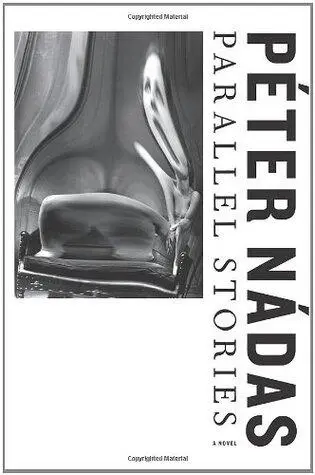
Péter Nádas - Parallel Stories
Здесь есть возможность читать онлайн «Péter Nádas - Parallel Stories» весь текст электронной книги совершенно бесплатно (целиком полную версию без сокращений). В некоторых случаях можно слушать аудио, скачать через торрент в формате fb2 и присутствует краткое содержание. Год выпуска: 2011, Издательство: Farrar, Straus and Giroux, Жанр: Современная проза, на английском языке. Описание произведения, (предисловие) а так же отзывы посетителей доступны на портале библиотеки ЛибКат.
- Название:Parallel Stories
- Автор:
- Издательство:Farrar, Straus and Giroux
- Жанр:
- Год:2011
- ISBN:нет данных
- Рейтинг книги:5 / 5. Голосов: 1
-
Избранное:Добавить в избранное
- Отзывы:
-
Ваша оценка:
Parallel Stories: краткое содержание, описание и аннотация
Предлагаем к чтению аннотацию, описание, краткое содержание или предисловие (зависит от того, что написал сам автор книги «Parallel Stories»). Если вы не нашли необходимую информацию о книге — напишите в комментариях, мы постараемся отыскать её.
Three unusual men are at the heart of
: Hans von Wolkenstein, whose German mother is linked to secrets of fascist-Nazi collaboration during the 1940s; Ágost Lippay Lehr, whose influential father has served Hungary’s different political regimes for decades; and András Rott, who has his own dark record of mysterious activities abroad. The web of extended and interconnected dramas reaches from 1989 back to the spring of 1939, when Europe trembled on the edge of war, and extends to the bestial times of 1944–45, when Budapest was besieged, the Final Solution devastated Hungary’s Jews, and the war came to an end, and on to the cataclysmic Hungarian Revolution of October 1956. We follow these men from Berlin and Moscow to Switzerland and Holland, from the Mediterranean to the North Sea, and of course, from village to city in Hungary. The social and political circumstances of their lives may vary greatly, their sexual and spiritual longings may seem to each of them entirely unique, yet Péter Nádas’s magnificent tapestry unveils uncanny reverberating parallels that link them across time and space.This is Péter Nádas’s masterpiece — eighteen years in the writing, a sensation in Hungary even before it was published, and almost four years in the translating.
is the first foreign translation of this daring, demanding, and momentous novel, and it confirms for an even larger audience what Hungary already knows: that it is the author’s greatest work.
Parallel Stories — читать онлайн бесплатно полную книгу (весь текст) целиком
Ниже представлен текст книги, разбитый по страницам. Система сохранения места последней прочитанной страницы, позволяет с удобством читать онлайн бесплатно книгу «Parallel Stories», без необходимости каждый раз заново искать на чём Вы остановились. Поставьте закладку, и сможете в любой момент перейти на страницу, на которой закончили чтение.
Интервал:
Закладка:
My mind broke everything down into tiny pieces but then left me to myself with the unconnected details. Something was happening or had already happened in the world that, without knowing the connection between the pieces and details, I could not understand.
As if feelings and emotions were not followed by value judgments and I was leaving behind periods whose duration or contents my memory could not account for.
This did not happen because my memory was faulty. Or because I remembered things randomly. My memory worked well and I remembered things not randomly but simultaneously: everything occurred to me at once. Everything was together in my mind but with no internal connections. Whatever this was, I could neither survey it nor measure its extent. It was too much and too frightening to be in the midst of a past that is all in the present. No sooner did I begin to sense or have some inkling about how things were connected in my life, and which of them were inconsequential, than paralyzing waves of emotion rushed hotly to my face. Anger and hatred for the two of them. Fear for myself. Klára Vay. Their names were right there on the nameplate. József Simon Hetés. Now I know. They lived on the third floor, in the apartment overlooking the street, above the piano teacher. And now I also know that the woman lied. They aren’t married, I know that too. It was as if I rose to the surface for a brief moment, and then timelessness quickly reclaimed me. To restrain myself, I used the fear I felt for myself and also the anger I felt for them. I had lied to her, but she’d been lying too. A half hour must surely have passed since I’d been standing here halfway between their apartment and their car, maybe only twenty minutes.
I knew perfectly well why they weren’t coming back out, and that was more important.
What a raving idiot I am. And I didn’t want to see what they were doing, as if I could possibly shoo away the image. I saw the half-open door of their bathroom, just as if I were peeking; I saw them pressed against the sink in the bathroom. Klára’s body shining in a short black slip. Ultimately, one perceives many things that never, or perhaps only later, register in one’s mind. I understood the man’s shameless and provocative winks above the glittering car roof. The dry lines on his face running together because of the deeply concealed sarcasm.
He knew why he was going upstairs.
They made each other moan and howl, just like the men on Margit Island.
While, like a dog, I was supposed to guard his car for them.
I felt as if I were being butchered; imagination made my heart pound in my throat; I was suffocating. I have to leave even if it’s just jealousy playing tricks on me, and I have to leave even if I’m making empty accusations. My breathing grew fast and heavy. Impulse carried me across the dark lobby; I ran out of the building.
But I stopped with the wind hitting me in the face.
Because I could hear noises from within.
A slamming door, a man’s voice from the depth of the courtyard, the quick tapping of a woman’s shoes. In which case it was only my jealous imagination playing tricks on me; nothing had happened in the bathroom.
Then silence, and again a door slammed.
Minutes were ticking by but they were not coming out.
And against my better judgment, this compelled me, as if I were a sneak thief, an assassin, a lousy little peeping Tom, to step back into the dark lobby. To stand next to the stinking garbage cans, listening intently. Not to go away, not to leave after all. The stench and the cold were not improbable at that moment; they were sole proof of the existing world order. But it was completely incredible that I had once again sunk so low, and the sinking wasn’t yet over, since I kept exposing myself to these things. Although nobody was forcing me, it was not a free choice. The power of the body brazenly made me do these things; I was sneaking in. The only pleasure in this was that while shamelessly obeying the compulsion, I could call myself despicable.
Perhaps for the first time in my life I realized that my physical being had nothing to do with my moral ideas or my upbringing.
While I sneaked upstairs in the dark, clinging to the peeling walls of the stairwell, all my limbs and inner organs were gently trembling with shame.
That I was capable of doing anything.
I didn’t want to fight down the sensation, yet I couldn’t imagine such a life.
In this familiar mute building, I wanted to gratify my body.
Maybe the moonlight suffused the rushing clouds, or the city lights were reflected in the sky. I really didn’t know what I was doing. In any case the well of the courtyard was shining blue. I was glad my shoes had rubber soles so that my steps were silent.
I stopped for a moment at the open gallery on the second floor. The iron railing cast an unfamiliar shadow on the patterned stone floor. As a child I’d of course never been out here at such an hour. I recalled winter afternoons when the air slowly darkened yet the yellow walls continued to glow. I wanted some certainty — about anything; or to ring their bell, to do anything that would stop the feeling of helplessness. To run up to the fourth floor, throw myself over the railing, hear the thud of my body, the shouts and screams; to end it all on the yellow ceramic paving of the courtyard.
Nothing stirred in the dark building.
I stopped on the last step and leaned my shoulder against the cold wall. No noise filtered in from the street. On the roofs, the wind continued to boom, occasionally strumming a tile or a section of the eaves.
I waited, ready to pounce.
Their apartment was the first one to the left of the stairs. If anyone crossed the foyer in the apartment, I’d hear it. The empty minutes of the waiting were measured only by my breathing. Again, I had to look in through the half-open door of the bathroom, and from what I saw there, my desire congealed in my guts. I could not help following her.
In my fear and pain I kept losing my breath, yet I was standing in front of the patterned glass of the entrance door.
The long foyer was dark, the kitchen was dark. I could see that the bathroom door was not half-open. I could hear no movement anywhere.
Their apartment did not differ from the piano teacher’s. Opposite the bathroom was the larger room’s opaque glass-paneled door on which only a weak light from the smaller room was reflected. Or who knows, maybe some light from the street, I could not decide.
Then they must be doing it in there, in that room.
By now I was not even ashamed.
On the patterned glass my breath collected as vapor.
I seemed to smell the woman’s fragrance in the air, which was the reason I had come this far and why I kept sinking ever lower. The effort not to ring their bell and a dread that I might break down the door weakened me, or my mind became hazy because in my pants fear had made my cock rear up.
Out of ideas, I staggered back down to the second-floor landing; that’s all my remaining sense could dictate to me. But my cock had stiffened to the point of real pain and hindered my walking.
The Noose Tightens
As if the question had called for him to rack his brains, the leather-capped driver did not reply for a long time.
Now and again he studied his passenger’s face in the rearview mirror, her seriousness, her self-imposed severity, the embarrassing sensuality of her features, her mildly wounded pride, and her haughtiness, which she was deploying so clumsily against him.
There was barely any light in the backseat of the Pobeda, but the oval side-window illuminated the older woman’s face. The driver scrutinized, analyzed, and seriously considered which of her features showed that she was Jewish. As a cadet in the Trieste Naval Academy he had learned from his Croatian platoon commander how to recognize Jews. Everyone had eyes, ears, a nose, and a mouth, but from that it does not necessarily follow that everyone is equal at birth. When out on individual passes or when amid much noise the big gates on Via Belpoggio were opened and the cadets marched out together in smart ranks formation, they paid close attention to passersby and to the girls hanging out the windows.
Читать дальшеИнтервал:
Закладка:
Похожие книги на «Parallel Stories»
Представляем Вашему вниманию похожие книги на «Parallel Stories» списком для выбора. Мы отобрали схожую по названию и смыслу литературу в надежде предоставить читателям больше вариантов отыскать новые, интересные, ещё непрочитанные произведения.












Обсуждение, отзывы о книге «Parallel Stories» и просто собственные мнения читателей. Оставьте ваши комментарии, напишите, что Вы думаете о произведении, его смысле или главных героях. Укажите что конкретно понравилось, а что нет, и почему Вы так считаете.