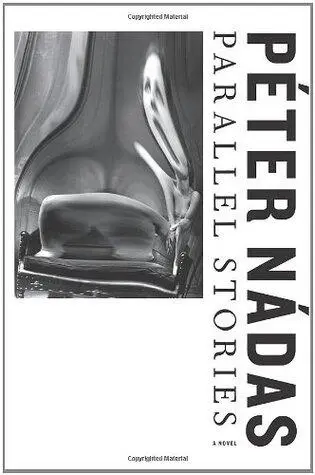
Péter Nádas - Parallel Stories
Здесь есть возможность читать онлайн «Péter Nádas - Parallel Stories» весь текст электронной книги совершенно бесплатно (целиком полную версию без сокращений). В некоторых случаях можно слушать аудио, скачать через торрент в формате fb2 и присутствует краткое содержание. Год выпуска: 2011, Издательство: Farrar, Straus and Giroux, Жанр: Современная проза, на английском языке. Описание произведения, (предисловие) а так же отзывы посетителей доступны на портале библиотеки ЛибКат.
- Название:Parallel Stories
- Автор:
- Издательство:Farrar, Straus and Giroux
- Жанр:
- Год:2011
- ISBN:нет данных
- Рейтинг книги:5 / 5. Голосов: 1
-
Избранное:Добавить в избранное
- Отзывы:
-
Ваша оценка:
Parallel Stories: краткое содержание, описание и аннотация
Предлагаем к чтению аннотацию, описание, краткое содержание или предисловие (зависит от того, что написал сам автор книги «Parallel Stories»). Если вы не нашли необходимую информацию о книге — напишите в комментариях, мы постараемся отыскать её.
Three unusual men are at the heart of
: Hans von Wolkenstein, whose German mother is linked to secrets of fascist-Nazi collaboration during the 1940s; Ágost Lippay Lehr, whose influential father has served Hungary’s different political regimes for decades; and András Rott, who has his own dark record of mysterious activities abroad. The web of extended and interconnected dramas reaches from 1989 back to the spring of 1939, when Europe trembled on the edge of war, and extends to the bestial times of 1944–45, when Budapest was besieged, the Final Solution devastated Hungary’s Jews, and the war came to an end, and on to the cataclysmic Hungarian Revolution of October 1956. We follow these men from Berlin and Moscow to Switzerland and Holland, from the Mediterranean to the North Sea, and of course, from village to city in Hungary. The social and political circumstances of their lives may vary greatly, their sexual and spiritual longings may seem to each of them entirely unique, yet Péter Nádas’s magnificent tapestry unveils uncanny reverberating parallels that link them across time and space.This is Péter Nádas’s masterpiece — eighteen years in the writing, a sensation in Hungary even before it was published, and almost four years in the translating.
is the first foreign translation of this daring, demanding, and momentous novel, and it confirms for an even larger audience what Hungary already knows: that it is the author’s greatest work.
Parallel Stories — читать онлайн бесплатно полную книгу (весь текст) целиком
Ниже представлен текст книги, разбитый по страницам. Система сохранения места последней прочитанной страницы, позволяет с удобством читать онлайн бесплатно книгу «Parallel Stories», без необходимости каждый раз заново искать на чём Вы остановились. Поставьте закладку, и сможете в любой момент перейти на страницу, на которой закончили чтение.
Интервал:
Закладка:
I was thinking of that partner of the beautiful Ingrid Bergman, Lady Erna continued, literally shouting, which drove the cabbie to further venomous and contemptuous conclusions as he handed her the hat over the front seat.
Lady Erna accepted her hat from this truly congenial and attractive man and, as was her custom, conveniently forgot that only a few minutes before she had thought the same man obnoxious. The most she noticed was that from the time they began to speak more confidentially, the driver stopped using the unpleasant if-you-please-madam phrase, with which these terrible country folk continued to embitter Lady Erna’s life.
They got on her nerves with it.
It had become a maniacal urge with her to hunt it down and eliminate it; she would not suffer it from her own servants; her ears were alerted to it. She firmly believed that it expressed secret contempt, indicated lack of openness and honesty. Whoever worked for her had to learn that no such form of address existed in the Hungarian language.
Or the person could leave; after all, his or her character was bad anyway, probably given to stealing too.
She thanked the driver for the hat, for being so kind.
As the two of them were escaping from the Nazis, from Prague if I remember correctly, she added in the same loud voice, Mister Laszlo or Victor Laszlo, come on, help me, my God, I can’t remember the name of that famous actor.
Unable to do anything else, the driver burst out laughing.
You can imagine I’d help you out, dear lady, if I could only remember it myself.
And like close acquaintances of the same generation, familiar with the same pieces of music and the same movies, which is to say whose memories propose the same information on the first try, they laughed together contentedly.
Which filled Lady Erna with a certain relief, that the man with the leather cap could not possibly be a former Hungarian Nazi or a secret policeman.
When it comes to that, Casablanca is not the worst place in the world, believe me, dear lady. I’ve traveled a lot in my life, he said cheerfully and with not a small amount of self-mockery or self-contempt. Although the second time he used the dear-lady phrase it rang sarcastically on his lips. At this time of the year, in March, everything is in bloom there.
By the way, my name is Bellardi, he added, to end the embarrassing misunderstanding between them.
And as if moved by this mention of his own historic name, he gently combined the two names.
My son is László Bellardi, and of course that’s my name too.
And as he said it he thought irritably, now she’ll know everything and be satisfied, the old Jewess.
Who was dumbstruck, alarmed, as if suddenly reprimanded. Hearing the old familiar name, she grew silent in her soul, and the gravely serious little girl instantly pierced her way through the old woman’s worn and discomposed features. As she was being taken in the familiar buggy to the station along the elm-lined street, in the noise of hoofbeats and the sight of treetops she grasped the entire strange and hostile universe.
Suddenly every possible conversational topic became too delicate to propose, let alone talk about.
If only because of Gyöngyvér, they had to be cautious. Neither of them knew whether she was an informer. Although for long minutes she had ignored what the other two were talking about, things reached her in snatches, interfering with the high, love-induced blood pressure thumping in her ear.
You would be the father of little Bellardi, she said from her corner of the backseat, surprising both her listeners, her voice hoarse and loud.
Very kind of you.
You don’t say, she exclaimed.
She felt an impulse to yield to this chitchat; she probably sensed their distrust.
What a coincidence, she exclaimed.
She ignored Lady Erna’s imploring or rebuking glance.
But then Gyöngyvér feared she had once again done something terrible, behaved improperly.
In the car reeking of stale tobacco, Gyöngyvér’s panic made the mutual caution of the other two all but palpable. The affectionate indulgence they had allowed themselves took on a material quality in the air. What could they do with such a cackling goose, such an ignorant little servant. Bellardi drove attentively, with great practice and courtesy, while Mrs. Lehr, née Erna Demén, politely holding her mill-wheel-size hat on top of her handbag, withdrew from public life, as it were. Gyöngyvér’s noisy behavior irritated her greatly. Knowledge of where they were going in this stinking dark cab with its useless springs unexpectedly came crashing down on her again.
She sat firmly upright, back glued to the seat; with her self-saving posture she resembled Gyöngyvér.
Of course she knew.
She knew a great many things that it would have been better not to know.
Of course she remembered Bellardi’s son; she did not have to strain hard for that. But she hadn’t known that the boy’s name was László. Little Bellardi, or poor little Bellardi. Gyöngyvér was right, that’s how the professor used to refer to him. When she was introduced to people who turned up in their apartment on Teréz Boulevard, she mainly acknowledged their names or their presence. So this was Bellardi. She was surprised. This was the father whom the People’s Tribunal had sentenced to life imprisonment for conspiracy against the democratic order.* What an impressive neck this Bellardi has. He did not remind her of that person, at least not by his exterior, and that’s why she hadn’t made the connection in her mind. She was amazed. So that’s why his phiz was so eerily familiar. And at that moment she seemed to remember exactly the light summer suit the father had worn in that famous newsreel when, handcuffed and between two guards, he had to step up to the microphone and respond to stern questions put to him by the presiding judge of the People’s Tribunal.
They led him up there as if he were a dog; only there did they take the handcuffs off his wrists.
He must have cut a fine figure in that suit, if I still remember it today.
Of course there are men who never lose their boyish charm.
Actually it was a dispossessed man standing there at the microphone; he held on to it, but the presiding judge quickly warned accused number 3 that it was not the microphone he should hold on to. Because of this reprimand not a peep was heard in the courtroom for a long time, of course. Foreign correspondents in the first rows were especially alarmed. His suit hung on him as on a clothes hanger.
He might get the death sentence.
The person Lady Erna must have been remembering was this robust man, crucified in many ways. But his son was short, quiet, pale, charmingly fragile or rather puny, with no cheerful strength or manly brutality; perhaps he took after his mother. Whom Mrs. Lehr had met twice in Mária Szapáry’s hunting box in Vésztő, at the time it was being liquidated. Once hunters had gone there for small game, coot, wild duck, hare, pheasant, and bustard. Both meetings were brief; on both occasions Lady Erna spoke briefly with the young woman, who seemed to her like a volatile spirit. There was no reason for Erna’s mind to bring together information originating in two different historical times. So it unfortunately never occurred to her that there might be some blood relation between poor little Bellardi, who had belonged to the professor’s circle of favorite students, and the hapless beloved of ugly Mária Szapáry. She should have known that Elisa Koháry was the little boy’s mother. So he was the boy whom she had abandoned when he was only a baby. Although she had returned for a few years because she wanted to be heroic, wanted to overcome her terrible inclination and her maternal irresponsibility. There was no reason to link the two sets of data, stored at two different places and at two different depths. Lady Erna appraised and purchased objets d’art on commission from very wealthy collectors. She managed to include a few valuable items among all sorts of cheap wares and to acquire them for a lump sum that was the usual wholesale price paid for the cheaper items. An activity for which she earned Szapáry’s eternal ire. But who cares what an insignificant costume designer had to say.
Читать дальшеИнтервал:
Закладка:
Похожие книги на «Parallel Stories»
Представляем Вашему вниманию похожие книги на «Parallel Stories» списком для выбора. Мы отобрали схожую по названию и смыслу литературу в надежде предоставить читателям больше вариантов отыскать новые, интересные, ещё непрочитанные произведения.







Обсуждение, отзывы о книге «Parallel Stories» и просто собственные мнения читателей. Оставьте ваши комментарии, напишите, что Вы думаете о произведении, его смысле или главных героях. Укажите что конкретно понравилось, а что нет, и почему Вы так считаете.