Ranko Marinkovic - Cyclops
Здесь есть возможность читать онлайн «Ranko Marinkovic - Cyclops» весь текст электронной книги совершенно бесплатно (целиком полную версию без сокращений). В некоторых случаях можно слушать аудио, скачать через торрент в формате fb2 и присутствует краткое содержание. Год выпуска: 2010, Издательство: Yale University Press, Жанр: Современная проза, на английском языке. Описание произведения, (предисловие) а так же отзывы посетителей доступны на портале библиотеки ЛибКат.
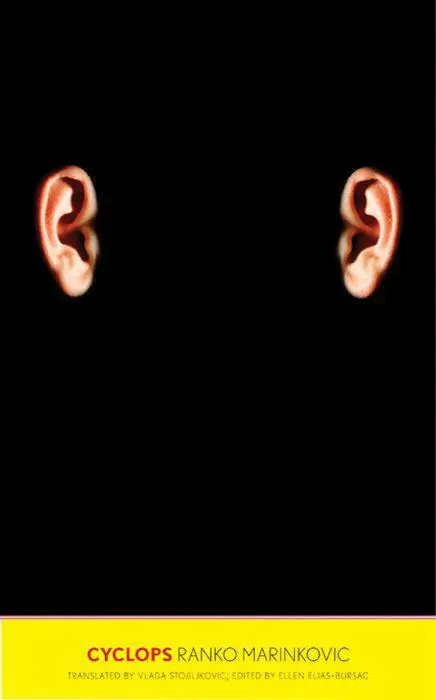
- Название:Cyclops
- Автор:
- Издательство:Yale University Press
- Жанр:
- Год:2010
- ISBN:нет данных
- Рейтинг книги:3 / 5. Голосов: 1
-
Избранное:Добавить в избранное
- Отзывы:
-
Ваша оценка:
Cyclops: краткое содержание, описание и аннотация
Предлагаем к чтению аннотацию, описание, краткое содержание или предисловие (зависит от того, что написал сам автор книги «Cyclops»). Если вы не нашли необходимую информацию о книге — напишите в комментариях, мы постараемся отыскать её.
, Croatian writer Ranko Marinkovic recounts the adventures of young theater critic Melkior Tresic, an archetypal antihero who decides to starve himself to avoid fighting in the front lines of World War II. As he wanders the streets of Zagreb in a near-hallucinatory state of paranoia and malnourishment, Melkior encounters a colorful circus of characters — fortune-tellers, shamans, actors, prostitutes, bohemians, and café intellectuals — all living in a fragile dream of a society about to be changed forever.
A seminal work of postwar Eastern European literature,
reveals a little-known perspective on World War II from within the former Yugoslavia, one that has never before been available to an English-speaking audience. Vlada Stojiljkovic's able translation, improved by Ellen Elias-Bursac's insightful editing, preserves the striking brilliance of this riotously funny and densely allusive text. Along Melkior’s journey
satirizes both the delusions of the righteous military officials who feed the national bloodlust as well as the wayward intellectuals who believe themselves to be above the unpleasant realities of international conflict. Through Stojiljkovic's clear-eyed translation, Melkior’s peregrinations reveal how history happens and how the individual consciousness is swept up in the tide of political events, and this is accomplished in a mode that will resonate with readers of Charles Simic, Aleksandr Hemon, and Kundera.
Cyclops — читать онлайн бесплатно полную книгу (весь текст) целиком
Ниже представлен текст книги, разбитый по страницам. Система сохранения места последней прочитанной страницы, позволяет с удобством читать онлайн бесплатно книгу «Cyclops», без необходимости каждый раз заново искать на чём Вы остановились. Поставьте закладку, и сможете в любой момент перейти на страницу, на которой закончили чтение.
Интервал:
Закладка:
No, I must give Enka a buzz. Poor Enka. I’m really a … He nevertheless went by the Theater Café and the Give’nTake, just in case. Perhaps Viviana had decided to parade her pretty self there. But the score was zero and … zero. Making a total of zero. Too early. A rest after last night’s gentle breath. He did not telephone Enka either. He mounted the stairs to the office, tired already. Wilted enthusiasm. See proof of review, it’s to go to print today. The day’s copy was no longer with the arts editor, it was already in the composing room.
“The Old Man crossed out a paragraph.”
“Censorship, eh?”—ready for a big showdown.
“Nonsense. Too much copy. Had to trim all around.”
“Which paragraph?”
“Do me a favor. What do you care anyway — it was only ten lines or so.”
“You could’ve asked me — I would’ve done it myself.”
“I looked for you at the Give’nTake last night. ‘He’s just gone out with Don Fernando,’ and you haven’t got a phone at your digs. How was I to ask?”
“It’s wrong all the same.”
“Don Fernando’s with the editor now. He’s brought some article or other, but it’s a no-go. They’re having a discussion … matters of principle.” The arts editor was sneering with mild derision.
That was precisely what Melkior had long wanted — coming to a “matter-of-principle” grips with the editor. But when he entered the editor’s “Black Room” (so-called because everything in it was black, himself included) the two of them were heartily laughing at something. Don Fernando was sunk in a black leather armchair, his long legs crossed so high that one of his knees touched his chin and his glass of cognac, but he couldn’t drink for laughing. The editor seemed to have just finished telling him something and was laughing himself, but his laughter had pauses and long intervals in it, during which he was making it known to his silliness that he could stop this nonsense at any moment if necessary. But he was not stopping it, which meant that this —the nonsense, the laughter — was necessary.
So this was what the “matter-of-principle” discussion was all about. The embittered realization could have been read in his face, had there been somebody to read it. They went on laughing. The editor only spared a hand to gesture toward a seat. In a little while Melkior, too, touched his chin to his knee and poured himself a cognac, only he didn’t hold it to his nose — he downed it; he did not laugh. Must be something silly to make them chortle like this. A “matter-of-principle” laugh. He was irritated by the laughter. Late for the show everyone else was enjoying, he was the only one without a clue. Damned silly business! He was hurt. For we are hurt by any laughter we can’t understand.
“I thought there were big issues being discussed here, I thought I would learn a thing or two …” and he knocked back another brandy, miffed.
“Oh, so you think … what is it that Maestro calls you — Eustachius? …” (the two of them burst out laughing again) “… that big issues can’t sometimes be handled with laughter?” Don Fernando dropped the question from on high, adding the necessary breezy tone to accentuate his condescension.
“They can,” Melkior swatted at the question as if it were a moth flying across the room, “if it’s a Molière doing it.”
“You wouldn’t settle for a lesser authority then?” The moth was losing altitude.
“It’s the nature of laughter that doesn’t settle — it’s choosy.”
Don Fernando didn’t reply. He tried to catch the editor’s eye, to assert their spiritual bond. But the editor paid no attention. He got up and sat down at his black mahogany desk. This meant, “We’ve had our fun, now back to business.”
“We’ve trimmed your review a bit,” he said to Melkior with a considerate smile. No more than ten lines or so. Had to trim everything today. A lot of small news items.”
“Sorry I was unable to mention personalities …” Melkior was trying to provoke the thing , the “matter of principle.”
The editor flashed a wry smile.
“I wouldn’t expect that from you anyway,” he said with a pleasant look at Melkior. “The fellow yesterday was a different case altogether. He himself regretted that he hadn’t remembered to look around the stalls. That’s why I gave him a piece of my mind. He was all excuses and sweet talk, where you would have stalked out and slammed the door on me.”
Melkior was overjoyed that this was said in front of Don Fernando. He actually mumbled a thank you , which mercifully went unheard.
“Here you are, then,” the editor handed a manuscript to Don Fernando. “Regretfully. All right?” They smiled at each other with an already hammered-out understanding.
Melkior caught up with Don Fernando on the stairs. They descended in silence. Don Fernando was trying to slide the manuscript into his inside pocket, but something was in the way, blocking passage, so much so that Don Fernando’s small eyes flickered a bit in irritation.
“What, it won’t fit in the pocket either?”
“Sorry?” said Don Fernando unpleasantly and rather sharply.
“I said, the article won’t fit. Why did he reject it?”
“What makes you think he did?” Don Fernando had flushed a virginal pink.
“I know he did. Do you expect to keep a secret in a newspaper office? I don’t have it from the editor — there are at least three people upstairs who are delighted.”
“I don’t know the other two,” said Don Fernando, trying to muster a smile.
“But you know one? And that’s me?” Melkior paused for a moment on the stairs. He suddenly felt a kind of painful sadness at the insinuation and asked Don Fernando, looking bemusedly down the stairs, “Why are you so evil-minded?”
“Who, me personally?” Don Fernando had regained ascendancy over Melkior.
“Both you personally and … people in general,” and Melkior gestured hopelessly.
“My dear Eustachius, whatever’s come over you? Ha, why does Maestro call you Eustachius, anyway? The editor told me a couple of first-class stories about him. That’s what we were laughing at. Maestro is a splendid variety of madman.”
“Splendid? I wouldn’t say so. He’s more of an uncorrupted cynic. A Thersites among all the shining heroes up there.”
“So he is, up to a point …” Don Fernando was clearly trying to be nice. “As a matter of fact he ought to live in a tub, ha …”
“With a mind like his, an unwashed bottle would do every bit as well. He guzzles brandy. The tub is for the Dionysian liquid … or Diogenes, if that’s what you meant.”
“Yes, well … sure … But the way he does that job of his! I mean, the way he runs his city desk! The way he pecks passionately like a sparrow among the trash brought in by his garbage collectors (that’s what he calls his reporters), as if he would use all that fecal waste matter, like a crazy alchemist, to distill at least a drop of some ‘genuine’ essence or other, be it somewhat dirty and poisonous — it would nevertheless be the genuine truth about people, a truth more authentic and real than all those majestic and authoritative political, and even so-called cultural, scribblings.”
“He enjoys his mucky alchemy!”
“Well … I wouldn’t rule out the personal experience.”
“But he simply bathes in feces! He identifies with garbage because he’s a piece of garbage himself, and there are no libations there apart from the libation of filth dripping from his …”
“Why the sudden loathing, dear Eustachius — if you’ll allow me to call you that?”
“Why the sudden love? I don’t hate him — I feel pity for him if you must know, because I have a fair idea of where his reveling in stench comes from. But you, you’ll never understand it. You’re too busy tinkering with the model of your proto-Man to be able to perceive the dirty and swinish, semisuccessful and quite unsuccessful versions of him in the phenomenological world. You cannot love Maestro, you can’t even see him. What you said about him isn’t true. Anyway, you were not speaking because of him — you had something else on your mind.”
Читать дальшеИнтервал:
Закладка:
Похожие книги на «Cyclops»
Представляем Вашему вниманию похожие книги на «Cyclops» списком для выбора. Мы отобрали схожую по названию и смыслу литературу в надежде предоставить читателям больше вариантов отыскать новые, интересные, ещё непрочитанные произведения.












Обсуждение, отзывы о книге «Cyclops» и просто собственные мнения читателей. Оставьте ваши комментарии, напишите, что Вы думаете о произведении, его смысле или главных героях. Укажите что конкретно понравилось, а что нет, и почему Вы так считаете.