Ranko Marinkovic - Cyclops
Здесь есть возможность читать онлайн «Ranko Marinkovic - Cyclops» весь текст электронной книги совершенно бесплатно (целиком полную версию без сокращений). В некоторых случаях можно слушать аудио, скачать через торрент в формате fb2 и присутствует краткое содержание. Год выпуска: 2010, Издательство: Yale University Press, Жанр: Современная проза, на английском языке. Описание произведения, (предисловие) а так же отзывы посетителей доступны на портале библиотеки ЛибКат.
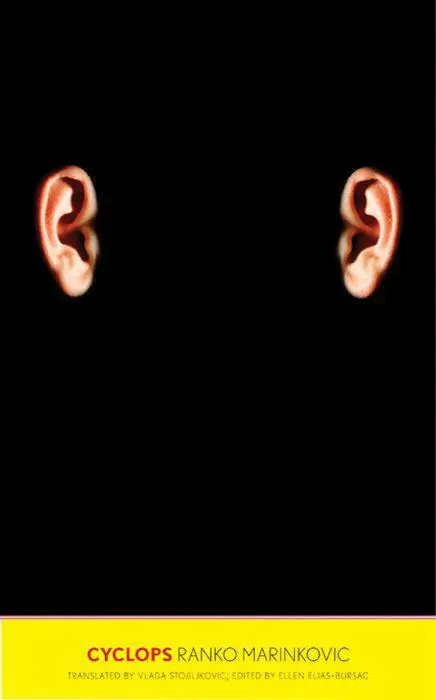
- Название:Cyclops
- Автор:
- Издательство:Yale University Press
- Жанр:
- Год:2010
- ISBN:нет данных
- Рейтинг книги:3 / 5. Голосов: 1
-
Избранное:Добавить в избранное
- Отзывы:
-
Ваша оценка:
Cyclops: краткое содержание, описание и аннотация
Предлагаем к чтению аннотацию, описание, краткое содержание или предисловие (зависит от того, что написал сам автор книги «Cyclops»). Если вы не нашли необходимую информацию о книге — напишите в комментариях, мы постараемся отыскать её.
, Croatian writer Ranko Marinkovic recounts the adventures of young theater critic Melkior Tresic, an archetypal antihero who decides to starve himself to avoid fighting in the front lines of World War II. As he wanders the streets of Zagreb in a near-hallucinatory state of paranoia and malnourishment, Melkior encounters a colorful circus of characters — fortune-tellers, shamans, actors, prostitutes, bohemians, and café intellectuals — all living in a fragile dream of a society about to be changed forever.
A seminal work of postwar Eastern European literature,
reveals a little-known perspective on World War II from within the former Yugoslavia, one that has never before been available to an English-speaking audience. Vlada Stojiljkovic's able translation, improved by Ellen Elias-Bursac's insightful editing, preserves the striking brilliance of this riotously funny and densely allusive text. Along Melkior’s journey
satirizes both the delusions of the righteous military officials who feed the national bloodlust as well as the wayward intellectuals who believe themselves to be above the unpleasant realities of international conflict. Through Stojiljkovic's clear-eyed translation, Melkior’s peregrinations reveal how history happens and how the individual consciousness is swept up in the tide of political events, and this is accomplished in a mode that will resonate with readers of Charles Simic, Aleksandr Hemon, and Kundera.
Cyclops — читать онлайн бесплатно полную книгу (весь текст) целиком
Ниже представлен текст книги, разбитый по страницам. Система сохранения места последней прочитанной страницы, позволяет с удобством читать онлайн бесплатно книгу «Cyclops», без необходимости каждый раз заново искать на чём Вы остановились. Поставьте закладку, и сможете в любой момент перейти на страницу, на которой закончили чтение.
Интервал:
Закладка:
“Do you think, then, that anything can be achieved, on a large scale, through personal terrorism and assassination?”
“Assassination, assassination, yes of course!” Don Fernando agreed with a curious kind of rage. “Give the scoundrel a taste of fear on his own hide! It’s always educational! This seems to be the only kind of pedagogy these villains understand. Fear. Your fear and mine, that’s what the scoundrel should be made to feel! If nothing else, it would give me satisfaction—‘tremble, tremble, scoundrel,’ as they sing in the opera.”
Don Fernando took a breath. He was profoundly agitated, his face flushed bright red, the corners of his lips flecked with foam. He used a handkerchief to wipe his mouth, forehead, and cheeks, as if wiping a mask from his face. His features did in fact regain the exalted expression of his serene internal glow. He was now embarrassed by his excitement, letting the breeze of a kindly smile play over his face and conceal the shame.
“You seem, however, to prefer fairy tales of one sort and another,” he said superciliously.
“What fairy tales?” said Melkior in surprise.
“Oh, Russian fairy tales about various forms of goodness … Such as the one about Alyosha Karamazov, the little monk. You even gauge that drunken cynic Maestro using the little monk as a standard. But he doesn’t fit the standard, it’s too narrow for him. Your standards are too strict, my dear Eustachius — and too regular. People are like stones: irregular in shape, heavy, scattered. It’s the devil’s own job bringing order to the lot, assembling them in one place and arranging them by this or that rule — and it’s even worse hewing each individual stone. Indeed it’s impossible to carve out what people like to call a ‘moral profile.’ Illusory is what it is.”
This is something he has going on with himself, thought Melkior. I’ve never spoken to him about “goodness” or “standards.” He must be struggling with some “little monk” of his own.
“Incidentally, you haven’t asked me how all this fits in with my actual political convictions,” asked Don Fernando suddenly, giving a dry and somehow malicious laugh.
“Now that you mention it, did you ever discuss this with Pupo?”
“With Pupo? Discuss what with him?” said Don Fernando in surprise.
“Why, this business of … of individual terror … and assassinations.”
“Why with Pupo? Is he an expert on such things? He believes the man who bashed Trotsky’s head in with an ice pick was a Mexican anarchist acting on his own initiative, that Tukhachevsky was spying for the Nazis, and so on … he believes a lot of things. He is of course against ‘individual terror.’ ‘That’s anarcho-individualism,’ and he immediately reaches for the corresponding pigeonhole. Pupo’s a sort of monk himself, but one who keeps an eye on his career — in fact, a defrocked priest who goes on believing through inertia, but in rather a Jesuit way. I’ve nothing to discuss with him.”
“So I’m honored with this discussion?” smiled Melkior.
“You are a sensitive individual capable of feeling a thought. Not merely thinking (perhaps thinking even less), but also feeling a thought, which means keeping it constantly in your mind like private torment. The Heautontimoroumenos , murderer and victim in one and the same person, knife and wound, a vampire of your own heart, as Baudelaire put it. Your thought torments you with fear, I know it and appreciate it, because few people are capable of it, particularly in the way you are — and those drunken imbeciles at the Give’nTake mock you for it. I don’t mock you, because fear is thought (and vice versa), and I should like to join you at this point, if I may. Our fear is the sensitivity of the thought with which we perceive the terrible future of our existence. (Not that the human future has ever been anything but dreadful.) Your fear is not insane, your quaking is not inane as a Quaker’s, and yet there is in you (and this is where I leave you) a maniacal need to study the fear, to explore all its tonalities and tastes, from bitter to sweet. Sweet in particular. For there is a kind of pleasure in the sensation of fear (I remember it from childhood), a possibility of some obscure inner florescence taking place, of some strange solitary ripening going on to produce the black fruit of a particularly bitter wisdom. You have made yourself a home in there and you no longer search for a way out of the mousetrap — you have found your ‘accursed’ freedom inside. ‘Accursed’ because you exercise it in the pathetic manner of a prisoner for life who has found a ‘great’ pastime: drying his straw mattress straw by straw on the single ray of sun that falls into his cell …”
“Straw is, as we know, hollow. Are you sure it’s in my mattress and not your head?” Melkior took offense and rejoindered rudely, which made Don Fernando flush pink.
“I’m sorry, I didn’t mean it so offensively. I meant to say that fear has tricked your imagination, but it came out all wrong. That bit about the prisoner was particularly bad. Fear has hidden its hideous face, which the wise man finds is beneath him to contemplate and generally beneath the accomplished man to address. That is why I meant to say that your fear was highly refined, all the richer for the beauties of your unconventional character, brought to virtuoso level, as it were, like the subtlest of vibratos on a violin string (this with reference to trembling), elevated to the point of the highest — indeed musical — sensitivity, ceasing to be a miserable human condition and becoming a work of some crazed art instead. Your alchemy has transmuted that filth into gold. That’s why I admire … Forgive me for calling it crazed — after all, any art is crazed in a certain way … that’s why I admire your heroism, for you know how to suffer. My fear is different. I don’t want to suffer. I’m afraid of what tomorrow may bring , as it may well bring it tomorrow, and there’s no rhetoric in it. I’m simply afraid for myself, for my pitiful life, like any ant that feels a storm brewing, and I have no particular ‘spiritual values’ in mind. I don’t care what happens to paintings, to books, to arty rocks. I simply fear, henlike, for my unprotected head, which in my hour of fear is my greatest cultural value, for it’s the only head that cares for me. To sum up, then: my fear is no violin vibrato , no vibrato at all, for that matter; there’s no subtlety to it, no art, no beauty — it’s intolerant, harsh, and aggressive. I don’t propose to ‘suffer for beauty,’ I don’t propose to cultivate fear like a poisonous flower garden. I’m less of a hero than you. I can’t support fear — that’s why I want to remove it from my life, like hundreds of millions of like-minded people.”
“But how are you going to remove it?” asked Melkior with grave concern. “And who are your like-minded people?”
“Common people, that’s who. Perhaps these very passersby around us. They all want to get where they’re going, to eat their lunch or kiss their wife, without the feeling of pressure in their mind, without a nightmare on their soul, with joy and certainty as if they will live forever. And that’s reason enough for me to consider them ‘my people’; they may not know it, but they belong to the large community of enemies of fear.”
“How can you be sure they’re ‘your people’? They may just as well be on the other side, they may be in favor of fear, which such ‘passersby’ usually refer to as order. They are in favor of order under the knout, and you offer them your concept of freedom, which is disorder and anarchy in their eyes.”
“What? Surely this is disorder, this general anxiety and uncertainty?”
Читать дальшеИнтервал:
Закладка:
Похожие книги на «Cyclops»
Представляем Вашему вниманию похожие книги на «Cyclops» списком для выбора. Мы отобрали схожую по названию и смыслу литературу в надежде предоставить читателям больше вариантов отыскать новые, интересные, ещё непрочитанные произведения.











Обсуждение, отзывы о книге «Cyclops» и просто собственные мнения читателей. Оставьте ваши комментарии, напишите, что Вы думаете о произведении, его смысле или главных героях. Укажите что конкретно понравилось, а что нет, и почему Вы так считаете.