Ranko Marinkovic - Cyclops
Здесь есть возможность читать онлайн «Ranko Marinkovic - Cyclops» весь текст электронной книги совершенно бесплатно (целиком полную версию без сокращений). В некоторых случаях можно слушать аудио, скачать через торрент в формате fb2 и присутствует краткое содержание. Год выпуска: 2010, Издательство: Yale University Press, Жанр: Современная проза, на английском языке. Описание произведения, (предисловие) а так же отзывы посетителей доступны на портале библиотеки ЛибКат.
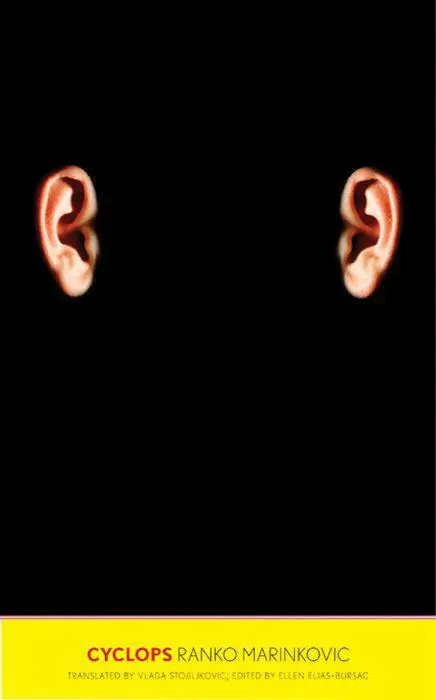
- Название:Cyclops
- Автор:
- Издательство:Yale University Press
- Жанр:
- Год:2010
- ISBN:нет данных
- Рейтинг книги:3 / 5. Голосов: 1
-
Избранное:Добавить в избранное
- Отзывы:
-
Ваша оценка:
Cyclops: краткое содержание, описание и аннотация
Предлагаем к чтению аннотацию, описание, краткое содержание или предисловие (зависит от того, что написал сам автор книги «Cyclops»). Если вы не нашли необходимую информацию о книге — напишите в комментариях, мы постараемся отыскать её.
, Croatian writer Ranko Marinkovic recounts the adventures of young theater critic Melkior Tresic, an archetypal antihero who decides to starve himself to avoid fighting in the front lines of World War II. As he wanders the streets of Zagreb in a near-hallucinatory state of paranoia and malnourishment, Melkior encounters a colorful circus of characters — fortune-tellers, shamans, actors, prostitutes, bohemians, and café intellectuals — all living in a fragile dream of a society about to be changed forever.
A seminal work of postwar Eastern European literature,
reveals a little-known perspective on World War II from within the former Yugoslavia, one that has never before been available to an English-speaking audience. Vlada Stojiljkovic's able translation, improved by Ellen Elias-Bursac's insightful editing, preserves the striking brilliance of this riotously funny and densely allusive text. Along Melkior’s journey
satirizes both the delusions of the righteous military officials who feed the national bloodlust as well as the wayward intellectuals who believe themselves to be above the unpleasant realities of international conflict. Through Stojiljkovic's clear-eyed translation, Melkior’s peregrinations reveal how history happens and how the individual consciousness is swept up in the tide of political events, and this is accomplished in a mode that will resonate with readers of Charles Simic, Aleksandr Hemon, and Kundera.
Cyclops — читать онлайн бесплатно полную книгу (весь текст) целиком
Ниже представлен текст книги, разбитый по страницам. Система сохранения места последней прочитанной страницы, позволяет с удобством читать онлайн бесплатно книгу «Cyclops», без необходимости каждый раз заново искать на чём Вы остановились. Поставьте закладку, и сможете в любой момент перейти на страницу, на которой закончили чтение.
Интервал:
Закладка:
“Yes — temporarily destroying it, until conditions arise for it to exist in a genuine sense. Being good in this world is naïve and stupid. Anyhow it is a false goodness and consequently a false tragedy. We don’t need tragedy to discover the dreadful truth. Indeed tragedy cloaks truth with the charm of art, it seduces us into enjoyment by lifting its soiled theatrical skirt coquettishly before us and showing the seamy sides of life with a fetching grin. Not even death itself is serious here. Nothing is serious, all is simply beautiful and desirable. But I want to see the truth naked, without its tragic rags. Because I know that underneath those rags lies something else tragic, a profound and genuine and terrible tragedy, one that no Racine or Shakespeare can help me with. I’m no Hamlet, I know straight from the start that my uncle means to murder my father and marry my mother, so in order to prevent it …”
“You kill him?”
“Of course, if only in theory.”
“But how can you be sure that your uncle’s going to murder?”
“How? Let’s reply with a question: why shouldn’t he murder — what’s to stop him? Why shouldn’t he, if it will get him all the pleasures he has dreamed of his whole life? You of course would not commit murder, but don’t reason in terms of yourself. Our mistake and … our irreparable oversight is precisely that — reasoning in terms of ourselves. Which the scoundrel counts on — that we’ll reason in terms of ourselves, that we won’t smell a rat. But we should reason on his terms; that is why I say we ought to watch with doubt and distrust, we ought to know beforehand. But we’re too deeply caught up with ourselves, we explore our weaknesses, believing ourselves to be some brand of terrible sinner. Meanwhile he prepares, he plots eluding notice, in perfect safety. It’s too late afterward to smack your forehead: oh if only I had known, if only I’d had an inkling! Why is it that I never saw it, never thought, never paid attention before this? Too late — the deed is done. And now we ought to take our revenge, but we’re not up to it. So we reflect: what’s the use, what is the point of revenge when our father’s gone and our mother’s sharing the murderer’s bed? We reason. ‘Thus conscience does make cowards of us all.’ We anguish. Which is exactly what the evil uncle wants — our anguish, our physical inaction; it spells safety for him. We make tragedies for people to weep, but he chortles and enjoys being used for the making of art. Art does kill him in the tragedy (or not, as the case may be), but it kills him in an artistic , symbolic way — and he doesn’t give a fig for its symbols when he knows he’s alive. And exults in being alive. He even enjoys the symbols, in which he sees someone else rather than himself, so that he will actually shed a tear over that Someone Else’s fate, for the pleasure. Oh, we pay the scoundrel a tremendous tribute in tragedies! And in real life we leave him alone to savor his criminal plunder. We also leave him his life, which is not only undeserved but actually a threat to other lives. The scoundrel ought to be gotten rid of in time. Physically and simply, not symbolically; without ceremony and catharsis and tragi-pathos mumbo jumbo à la Aristotle.”
“So we should kill preventively so as not to be killed?” concluded Melkior with a smile freezing on his lips. “But kill whom? By what criterion?”
“By a simple criterion, medical. There are symptoms. How does a surgeon know where to cut? Does he need a criterion? He simply pins down where the illness is hidden and what it is that is endangering the organism. This is largely a matter of talent, knowledge, intuition — but very often of simple cunning. The killer is lying in wait and the thing to do is provoke him. You’ve got to tease him out of the armor of his quiescence, to prod his murderous wishes awake. You will of course have observed such a character on the tram: sitting there with his legs stretched across the aisle, blocking the passage of others, everything there is his. Not that he does this purposely — he just feels like it. He doesn’t think of his legs as an obstacle, for people to step over, around, grumbling at having to adapt to him. So you trod on his foot on purpose. Step on it good and hard, with all your weight! But you apologize right away, awfully sorry, didn’t mean to, an accident, and so on … and then look at his face, look into his eyes: if you know how to look you’ll discover a murderer. What a pleasure it would be for him to kill you, given half the chance! There’s your ‘criterion’ for you!”
Don Fernando fell silent, wearing a sort of quiet sadness on his face, like someone who has had a good cry.
“Wait a minute,” said Melkior without irony, indeed with concern, “who could possibly catch them all?”
“You’re talking like a policeman!” frowned Don Fernando. “Then again, why not? That’s what the job should be of any intelligent police force which genuinely protects people’s safety — to catch murderers before they’ve committed the crime, instead of producing detective stories after the murder and inventing police geniuses and criminal heroes to tickle the fancy of small-time delinquents and romantic onanists.”
“So what you’re saying is … tread on people’s feet in trams and then peer into their eyes? But isn’t that a rather unreliable method, telling potential criminals by their eyes? There used to be this thing about low foreheads and beetle brows and skull shape … the so-called Lombrosian type …”
“There’s something in that, too. But a man with a nasty look in his eyes is undoubtedly a potential murderer,” said Don Fernando with certainty. “Just give him a chance, take a bit of a risk. Step on his foot — not literally, of course, not on a tram — I mean in a metaphorical sense … Incidentally, there’s a way that is more reliable still. You mentioned low foreheads and beetle brows … and I say: whoever’s been physically marked by Nature in any way ought to be put under surveillance. All those ill-matched arms, uneven legs, floppy ears, enormous noses (puny ones as well, mind), hunched backs, squinting eyes, and particularly — and I say particularly —anyone under five foot five. I can well understand the suffering of midgets and I believe it was one of them who invented crime. Just look at them in their platform shoes, their craning necks, their broadly inclusive sweeping gestures, settling issues in a ‘manly’ way; even their voices sound stentorian and heroic. But that’s not enough. They’re after other deeds, the real, acknowledged kind, the ones that inspire fear and awe. They aspire to greatness rather than to being normal; they would rule us, whatever the cost. They gave us Napoleon and, so it seems, Caesar the epileptic, too. Therefore beware the marked , particularly the diminutive. They are haters and will stop at nothing.”
“You’d end up with a large chunk of mankind ‘under surveillance,’” remarked Melkior acidly. “But who would be doing the job? By what right?”
“By the right of the majority …” said Don Fernando vaguely, as if he himself didn’t entirely believe this.
“But what makes you think the majority of people look ‘nice’?”
“History, that’s what!” Don Fernando sprang back to life, fortified by a fresh idea. “Every historical blackguard eventually paid his debt to mankind! But always too late, only after he’d been up to his eyes in human blood. Danton, Robespierre, Marat, and Saint-Just were too busy going after one another to notice the ambitious pint-sized general, and out he slipped between their legs to slaughter half of mankind for his greatness. Hitler should have been bumped off ten years ago (if not before) and Mussolini should have been given a resounding thrashing ten years before that until he cried and begged for mercy. He would have, too. As things stand, it will take a war and a victory at God knows what price (if we even win!) to finally strangle those two historical apes. It will be too late again, too late … because of that very same Hamlet-like inertia and naïveté.”
Читать дальшеИнтервал:
Закладка:
Похожие книги на «Cyclops»
Представляем Вашему вниманию похожие книги на «Cyclops» списком для выбора. Мы отобрали схожую по названию и смыслу литературу в надежде предоставить читателям больше вариантов отыскать новые, интересные, ещё непрочитанные произведения.







Обсуждение, отзывы о книге «Cyclops» и просто собственные мнения читателей. Оставьте ваши комментарии, напишите, что Вы думаете о произведении, его смысле или главных героях. Укажите что конкретно понравилось, а что нет, и почему Вы так считаете.