Ranko Marinkovic - Cyclops
Здесь есть возможность читать онлайн «Ranko Marinkovic - Cyclops» весь текст электронной книги совершенно бесплатно (целиком полную версию без сокращений). В некоторых случаях можно слушать аудио, скачать через торрент в формате fb2 и присутствует краткое содержание. Год выпуска: 2010, Издательство: Yale University Press, Жанр: Современная проза, на английском языке. Описание произведения, (предисловие) а так же отзывы посетителей доступны на портале библиотеки ЛибКат.
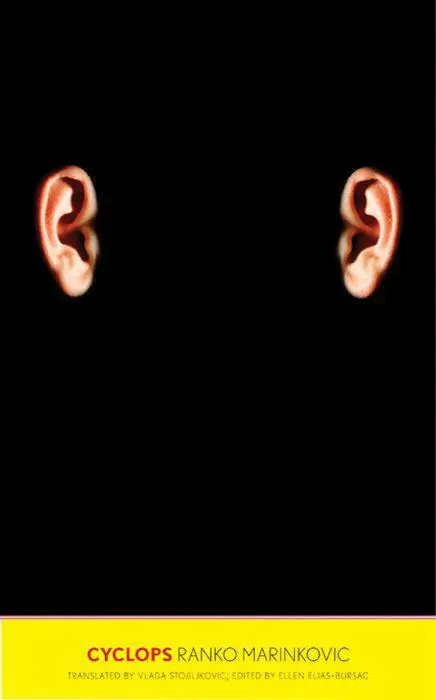
- Название:Cyclops
- Автор:
- Издательство:Yale University Press
- Жанр:
- Год:2010
- ISBN:нет данных
- Рейтинг книги:3 / 5. Голосов: 1
-
Избранное:Добавить в избранное
- Отзывы:
-
Ваша оценка:
Cyclops: краткое содержание, описание и аннотация
Предлагаем к чтению аннотацию, описание, краткое содержание или предисловие (зависит от того, что написал сам автор книги «Cyclops»). Если вы не нашли необходимую информацию о книге — напишите в комментариях, мы постараемся отыскать её.
, Croatian writer Ranko Marinkovic recounts the adventures of young theater critic Melkior Tresic, an archetypal antihero who decides to starve himself to avoid fighting in the front lines of World War II. As he wanders the streets of Zagreb in a near-hallucinatory state of paranoia and malnourishment, Melkior encounters a colorful circus of characters — fortune-tellers, shamans, actors, prostitutes, bohemians, and café intellectuals — all living in a fragile dream of a society about to be changed forever.
A seminal work of postwar Eastern European literature,
reveals a little-known perspective on World War II from within the former Yugoslavia, one that has never before been available to an English-speaking audience. Vlada Stojiljkovic's able translation, improved by Ellen Elias-Bursac's insightful editing, preserves the striking brilliance of this riotously funny and densely allusive text. Along Melkior’s journey
satirizes both the delusions of the righteous military officials who feed the national bloodlust as well as the wayward intellectuals who believe themselves to be above the unpleasant realities of international conflict. Through Stojiljkovic's clear-eyed translation, Melkior’s peregrinations reveal how history happens and how the individual consciousness is swept up in the tide of political events, and this is accomplished in a mode that will resonate with readers of Charles Simic, Aleksandr Hemon, and Kundera.
Cyclops — читать онлайн бесплатно полную книгу (весь текст) целиком
Ниже представлен текст книги, разбитый по страницам. Система сохранения места последней прочитанной страницы, позволяет с удобством читать онлайн бесплатно книгу «Cyclops», без необходимости каждый раз заново искать на чём Вы остановились. Поставьте закладку, и сможете в любой момент перейти на страницу, на которой закончили чтение.
Интервал:
Закладка:
Leaning on the window, engaged with the little drama, he had not noticed the arrival of the dawn. A gray cloud in the middle of the sky was going faintly pink: from its height it had caught sight of the sun below the horizon.
In the distance, engines whistled, early trains departed.
Melkior greeted the morning from his window. “Good morning, Morning! Welcome! Hey, I’m alive!” But this was only a moment of welcome. “Aah, I’m alive … so what?” and he was again gripped by a dull and despairing dread, feeling a strange and repulsive anxiety all over his body.
The landlady was up. He could hear her tottering and tramping in the dawn’s half-light, still woozy from sleep. She purposely banged an elbow on his door and muttered, “Up and moving all night …”
Melkior felt the cold metal of the knife in his hand and gave a shiver of strange revulsion. He stepped quickly out onto the landing and went into the landlady’s flat. He found her in front of the bathroom door, tousled, limp, sodden with sleep.
“Up all night again, were you?” she gathered her housecoat at her chest, concealing her un-maternal and still ambitious breasts.
“Would you please take this knife, Madam?”
Fully dressed, pale, thick blue rings around eyes. She watches him with what is almost fear.
“What’s the matter, Mr. Melkior? Why do you want me to take the knife?”
“I have bad dreams when it is near me.”
“Ah, I dream of those damned knives myself. Snakes, too.” But she took the knife with a kind of passion. Melkior noticed it.
“Why don’t you remarry, Madam? It’s not too late for you at all.”
“What about you? Why don’t you get married?” she retorted with fresh matutinal coquetry.
On his way back to his room Melkior thought of Viviana. Of Enka, too, in passing. Her knife. She does not have knives stuck into her belly in her sleep like the poor landlady. Her dreams are like a cat’s — nocturnal mouse-hunting.
A bird piped up in a park near by: chee-chee-caw … chee-chee-caw …
“Chi-chi-kov … Chi-chi-kov …” replied Melkior with literary sarcasm. “Dead Souls. And so to bed, with our own soul dead”—this he was barely able to say as he toppled on the bed, dead with exhaustion and lack of sleep.
“They have these binges night after night. He’s clearly drunk. He didn’t even take off his clothes.”
“Never mind, don’t wake him. We’ll just leave my things and go.”
He heard the voices above, but couldn’t open his eyes. A tremendous fatigue sat heavy on his eyelids and kept his consciousness in a state of listless floating on the surface of a very shallow sleep. From time to time he felt contact with wakefulness underneath, as if his sleep were bobbing in a shallow and scraping the bottom. He made out “he’s drunk”—that was Pupo speaking; “never mind” was someone else, a stranger. But he thought he was dreaming, so he let himself sink into his stupor like a drunkard, using the voices to put together a small sketch:
“Binges for flowers, thank you, thank you,” says the old lady pianist over his bed. Pupo tries to drag her away, “He didn’t even take his clothes off”; she struggles with him, “Never mind, don’t wake him.” But there is a third person here, someone invisible, important, “We’ll just leave my things and go.” And everyone leaves.
Melkior was suddenly frightened at the prospect of being left; he jumped to his feet: “Wait! No, wait! Right away … I’ll get undressed right away.” … But his eyes were still closed. “He’s dreaming,” said a strange voice. But Melkior was awake already, it was just that his eyes were still glued shut by thick, greasy sleep.
Nevertheless he padded with extraordinary certainty over to the glass carafe with water in it, poured some into his cupped palm, and splashed his eyes. Yes, there were Pupo and a stranger, standing next to his bed, beaming at him.
“I’m so sorry, I’ve … I didn’t sleep all night.” He was making excuses to the stranger. “His kind are early risers,” he thought.
“Was it at least a good binge?” Pupo was smiling contemptuously.
“Binge? No. Insomnia. Can’t sleep.” He smoothed out his rumpled suit, embarrassed. He straightened his tie, too. It was only eight o’clock. “I must have dropped off just a little while ago. Funny, I don’t remember.” But he was still standing in the same spot, face wet, confused.
“Why don’t you put it down on the floor?” said Pupo to the stranger. Indeed, the man was still holding a valise in his hand, undecidedly. A raincoat was draped over his other arm. Tall, fair-haired, lean, fortyish, with a grave, care-ridden face. Melkior finally came out of his trance. He put away the carafe, approached the man, and reached to take his valise. The man put forward his hand. Melkior returned the handshake, cordially. He said his name. The man muttered something unintelligible, looking at Melkior with an apologetic smile. “Right you are, brother,” thinks Melkior, the name remains the Stranger.
Accommodatingly, he opened the wardrobe door.
“This is for your things.” This time he succeeded in taking the valise away from the Stranger. He put it in the wardrobe. “It’s down here. Do sit down. And you, what are you wondering about?” he said to Pupo with erstwhile intimacy. “I haven’t been drinking — here, see for yourself,” and he puffed into Pupo’s face.
The Stranger laughed. “What, does he forbid it?” gesturing at Pupo.
“I educate them. The others are worse,” said Pupo asserting his authority.
“You can imagine the educator: carried by us because he’s been walking on all fours. He chews drinking glasses, not to mention shouting, ‘Down with the monarchy.’ ”
Melkior instantly realized he had gone too far. Pupo gave him a look of contemptuous rage. He had clearly been playing the saint “here,” being in a subordinate position in “those” circles.
The Stranger laughed. But on seeing Pupo’s face he abruptly cut his laughter short and erased it completely from his face. The face was now calm and care-ridden again.
“If you’d like to wash up,” said Melkior to the Stranger, “the bathroom is across there, in the flat proper.” He wished to be alone with Pupo for a moment. He wanted to apologize.
“No, thank you.”
Melkior offered him a cigarette. “Thank you, no. I don’t smoke.”
He offered one to Pupo and smiled in a friendly way. Pupo took it and accepted the smile.
“I always have black coffee in the morning. I’ll fetch some right away.” Melkior was in high spirits.
“Don’t bother on my account,” said the Stranger. “I would like only to sit down here for a minute. I’m tired.” He sat down on the sofa. But he promptly dropped down on an elbow, and then leaned his head back against the cushion. “I’m very tired,” he said apologetically.
“Lie down by all means. I’ve got to go to the office anyway. You can sleep if you like. I’ll tell the landlady not to send the maid in.”
Melkior went across to the flat proper to fetch the coffee. He explained to the landlady that a relative had unexpectedly arrived. He would be staying for a few days. She offered to do the room herself, to make the sofa for the guest, out of curiosity, of course. Melkior put that all off for later. He brought the coffee back. The two of them cut their conversation short. He felt extraneous there between them. He slurped his coffee hastily, explained to the Stranger the technique of living in the room, handed over all the necessary keys, and, with a most courteous Bye for now to both of them, fled.
He may be a future Marat for all I know, he thought, hurrying down the stairs, even though he had no reason to hurry at all. But why Marat, of all men? The man was killed in his bath — the whore Charlotte cut his throat. Danton, Saint-Just, Robespierre? … snick-snick-snick … all three heads — snick! — rolling into a basket. None of the examples is good enough. Not Zinoviev, not Kamenev, not Bukharin, not even Leo Bronstein, it was again snick-snick-snick and crash! The ice pick striking Leo’s head, whereas I wish my guest the Stranger to live. Long live my guest the Stranger! — Hip, hip, hoorayyy! He was rallying in the street, semiaudible even, making people turn around after him. He would have dearly loved to rush into the Give’nTake and tell everyone, like Bobchinsky-Dobchinsky, what kind of a guest had arrived. Mysterious, secretive, yet quite straightforward and likable, tall and fair-haired and lean and decidedly on the shy side, “No, thank you, don’t bother on my account.”
Читать дальшеИнтервал:
Закладка:
Похожие книги на «Cyclops»
Представляем Вашему вниманию похожие книги на «Cyclops» списком для выбора. Мы отобрали схожую по названию и смыслу литературу в надежде предоставить читателям больше вариантов отыскать новые, интересные, ещё непрочитанные произведения.









Обсуждение, отзывы о книге «Cyclops» и просто собственные мнения читателей. Оставьте ваши комментарии, напишите, что Вы думаете о произведении, его смысле или главных героях. Укажите что конкретно понравилось, а что нет, и почему Вы так считаете.