Ranko Marinkovic - Cyclops
Здесь есть возможность читать онлайн «Ranko Marinkovic - Cyclops» весь текст электронной книги совершенно бесплатно (целиком полную версию без сокращений). В некоторых случаях можно слушать аудио, скачать через торрент в формате fb2 и присутствует краткое содержание. Год выпуска: 2010, Издательство: Yale University Press, Жанр: Современная проза, на английском языке. Описание произведения, (предисловие) а так же отзывы посетителей доступны на портале библиотеки ЛибКат.
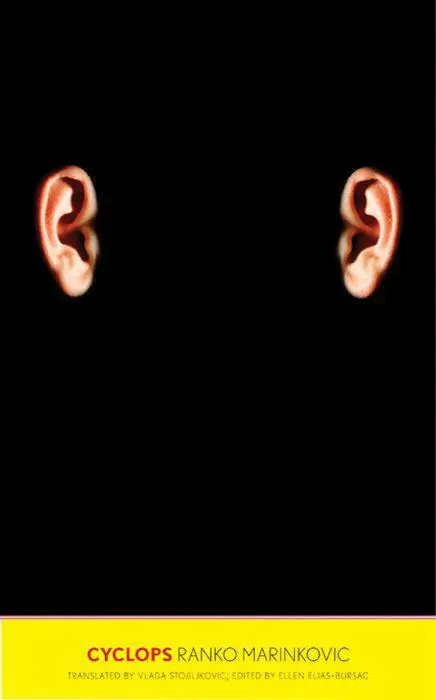
- Название:Cyclops
- Автор:
- Издательство:Yale University Press
- Жанр:
- Год:2010
- ISBN:нет данных
- Рейтинг книги:3 / 5. Голосов: 1
-
Избранное:Добавить в избранное
- Отзывы:
-
Ваша оценка:
Cyclops: краткое содержание, описание и аннотация
Предлагаем к чтению аннотацию, описание, краткое содержание или предисловие (зависит от того, что написал сам автор книги «Cyclops»). Если вы не нашли необходимую информацию о книге — напишите в комментариях, мы постараемся отыскать её.
, Croatian writer Ranko Marinkovic recounts the adventures of young theater critic Melkior Tresic, an archetypal antihero who decides to starve himself to avoid fighting in the front lines of World War II. As he wanders the streets of Zagreb in a near-hallucinatory state of paranoia and malnourishment, Melkior encounters a colorful circus of characters — fortune-tellers, shamans, actors, prostitutes, bohemians, and café intellectuals — all living in a fragile dream of a society about to be changed forever.
A seminal work of postwar Eastern European literature,
reveals a little-known perspective on World War II from within the former Yugoslavia, one that has never before been available to an English-speaking audience. Vlada Stojiljkovic's able translation, improved by Ellen Elias-Bursac's insightful editing, preserves the striking brilliance of this riotously funny and densely allusive text. Along Melkior’s journey
satirizes both the delusions of the righteous military officials who feed the national bloodlust as well as the wayward intellectuals who believe themselves to be above the unpleasant realities of international conflict. Through Stojiljkovic's clear-eyed translation, Melkior’s peregrinations reveal how history happens and how the individual consciousness is swept up in the tide of political events, and this is accomplished in a mode that will resonate with readers of Charles Simic, Aleksandr Hemon, and Kundera.
Cyclops — читать онлайн бесплатно полную книгу (весь текст) целиком
Ниже представлен текст книги, разбитый по страницам. Система сохранения места последней прочитанной страницы, позволяет с удобством читать онлайн бесплатно книгу «Cyclops», без необходимости каждый раз заново искать на чём Вы остановились. Поставьте закладку, и сможете в любой момент перейти на страницу, на которой закончили чтение.
Интервал:
Закладка:
You flee. You walk over dead things and dead men. Helmets, pots, broken lavatory porcelain. You expect a stab in the back at any moment. Merhum Melkior.
Merhaba! Somebody has caught up with you and prodded you in the back with his finger and your first thought is merhum. … But the skinny, toothless, and generally comical-looking man who has caught up with you immediately asks: “We’re retreating, n’est-ce pas? ” Obviously an intellectual.
“Yes, Professor, a tactical move. García said so. But our side is putting up a damned fine show.”
“Histrionics?”—and the toothless man smiles with calm contentment.
In the next sequence the two of you find yourselves in a cramped school lavatory (the teachers’) papered over with old newspapers with pictures of many living kings. There ensues a horrible bellowing, horse hooves, broken glass, a great hullabaloo. Then victorious drums, brass bands, shouts of Mamma! Cara mamma! and Sieg Heil! Finally the song Vento, vento, porta mi via con te …
The old professor, for all that he appears to be a military person, is unable to control his knees, which knock as though they are carrying an unimaginably heavy load. In the end he sits down on the toilet seat and, having made a stink, sighs, “Oh, my career, my career!”
“So, Professor, have you any pesetas on you?”
“Seven hundred … and forty centimos, here. You’re not going to confiscate them, are you?”
“Yes. To throw them out the window to people downstairs.”
“Then what?”
“Then you wipe that career of yours and we run for it!”
And while the victors downstairs are squabbling over the handful of change, you make your way through a tangle of dark corridors with changing luck and you would certainly have gotten away were you able to run. … But the cannibals are already there, converging on all sides. Surrounded! Trapped! Maestro (for it is he) (as they say in the kind of novel where a character’s identity is held back for a time) is immediately rejected as unfit for human consumption (they cut into him a little, the knife tarnishes— morbus lues , poisonous, says the red-haired Asclepian), and you are thrown into the cauldron for their breakfast. Making a fire under the cauldron (as a slave, of course, with a certain right to be resentful) is Foma Fomich Opiskin, who mutters: “I’m being persecuted. I work for a living!”
The red-haired Asclepian is there, too, disguised as Sartorius the Critic, smirking smugly: “Look who’s claiming to be free of the influence of Dostoyevsky! Rotten lies, lies, lies …”
Cut to:
The wharf of a small seaside town. Barges and fishing boats alongside. On the shore, wine barrels and drying fishing nets. And no one in sight. An indefinite time of day, morning or noon, there is no way of telling which, the hands are missing from the church spire clock. Its face is rusty.
You are alone (… alone, alone, all, all alone, comes the echo of the ancient Mariner’s voice). You have an empty ink bottle in hand and it suddenly occurs to you to rinse it in the sea. You descend two steps, nearer to the water, you kneel … but the ink bottle no longer matters. You take out a knife, a big pocket knife, you open it and, grabbing your hair with your left hand, you slice your head off with a natural and easy stroke. A simple business, like killing a chicken. Next you rinse your head instead of the ink bottle: up-down, splash-splash. A clear picture of decapitation: a body minus a head, the head in your hands, its eyes open and indifferent. Suddenly your head slips out of your hands and floats away in the water. You cannot reach it. You call out to it, entreating it to come back, but it only looks at you — a long, hurt look — then smiles sadly and closes its eyes as if in sudden pain. You try to draw it near using a stick; it only spins like a pumpkin and will not come nearer to you. It then gives you a desperately painful, farewell look and says sorrowfully (but seeming to blame you for its sorrow): “Goodbye, I’m off,” and you hear it sob. Then it takes a deep dive and disappears.
A feeble-minded man is standing behind you on the shore, grinning idiotically as he watches you. When the head dives he said, “You could’ve given it to me. My old lady’s sister, the deaf one, is dead.”
“The deaf one” was what Melkior heard when he opened his eyes. What’s this? he said aloud.
The light is on in the room. “Who’s there?” he asks the room.
The room is silent. It diverts his gaze from itself, directing it downward, at the bed, at himself, his legs, his belly, his chest, and closer and closer still … it would show him his head, too.
The Gaze is frightened. It has discovered you on the bed, fully dressed and with your shoes on, and is now watching you in amazement, as it would watch a stranger, a discovery.
You show it your arms, by turns. The Gaze watches them, unmoved, “The arms” being its sole, indifferent comment. It has no interest in arms. It shortens its range, searching for a target closer to. It closes and crosses, peering at the nose from both sides at once, like Picasso. That is the closest object it can see — the nose. It defines the nose in passing: a bilateral something jutting out into space and dividing the visible world in two, into the left and the right. But the Gaze wants the head, the solution to the conundrum, the answer to this night, to his dream of decapitation.
The Gaze wants itself, its very self, it wants to see its own self. And to admire itself, a narcissist, stupid, shortsighted, blind to anything that is not It, a Sharp Gaze, a pure, eighteen-carat Gaze.
The Gaze would look at itself, full face and profile, to examine its breadth of field, its acuity, to discover its face from a novel, as yet unfamiliar vantage point. It would penetrate its self, dive into its past, into its ancient, Proterozoic origin, into times when it still touched the world warily, with pseudopods and tendrils.
The Gaze has an intrepid desire to see itself.
But you are put off by the audacity. Who knows what may lurk inside? Perhaps an entrance to an entirely new, undiscovered hell from which there is no return? The disappearance into one’s own eyes and entry into an endless ordeal?
You are afraid of your own self lying on the bed. Fully dressed, with your shoes on. (They say sleeping with your shoes on gives you bad dreams.) But who turned the light on? He could have sworn that, this morning, when he’d gone up to his room, he’d taken off the sodden clothes and muddy shoes, put on his pajamas, slid under the blanket, and turned off the light! And proceeded to reflect in bed: Love? how unexplained it all still is! Is it the Song of Songs, Cleopatra, Beatrice, Laura, Phaedra, Don Juan, Werther, Stendhal, or Casanova? What is love?
He remembers quite clearly: first he threw himself on the sofa, rain-soaked and tired as he was, and browsed through Stendhal’s On Love and then, eyes closed, pondered many inexplicable points about beauty and suffering in love. “How fair and how pleasant art thou, Oh love, for delights! This thy stature is like to the palm tree, and thy breasts to clusters of grapes. Thou art beautiful, Oh my love, as Tirzah, comely as Jerusalem, terrible as an army with banners. Solomon had the vineyard at Baalhamon …” “Minus dormit et edit quem amoris cogitatio vexat,” says De amore , by André le Chapelain of Avignon. All those sad, empty days, all those sleepless nights, all the fear, anxiety, pining, misery, folly! All the suffering. All the blood for the sake of love’s “delights”! All the hearts aflutter! All the heads cut off!
La douce pensée
Qu’amour souvent me donne!
Читать дальшеИнтервал:
Закладка:
Похожие книги на «Cyclops»
Представляем Вашему вниманию похожие книги на «Cyclops» списком для выбора. Мы отобрали схожую по названию и смыслу литературу в надежде предоставить читателям больше вариантов отыскать новые, интересные, ещё непрочитанные произведения.








Обсуждение, отзывы о книге «Cyclops» и просто собственные мнения читателей. Оставьте ваши комментарии, напишите, что Вы думаете о произведении, его смысле или главных героях. Укажите что конкретно понравилось, а что нет, и почему Вы так считаете.