Ranko Marinkovic - Cyclops
Здесь есть возможность читать онлайн «Ranko Marinkovic - Cyclops» весь текст электронной книги совершенно бесплатно (целиком полную версию без сокращений). В некоторых случаях можно слушать аудио, скачать через торрент в формате fb2 и присутствует краткое содержание. Год выпуска: 2010, Издательство: Yale University Press, Жанр: Современная проза, на английском языке. Описание произведения, (предисловие) а так же отзывы посетителей доступны на портале библиотеки ЛибКат.
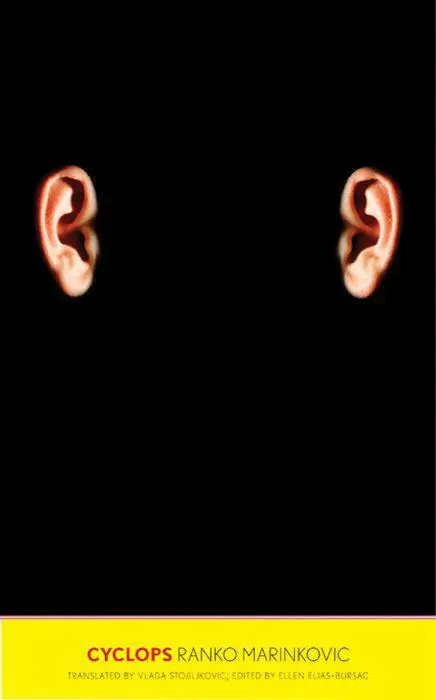
- Название:Cyclops
- Автор:
- Издательство:Yale University Press
- Жанр:
- Год:2010
- ISBN:нет данных
- Рейтинг книги:3 / 5. Голосов: 1
-
Избранное:Добавить в избранное
- Отзывы:
-
Ваша оценка:
Cyclops: краткое содержание, описание и аннотация
Предлагаем к чтению аннотацию, описание, краткое содержание или предисловие (зависит от того, что написал сам автор книги «Cyclops»). Если вы не нашли необходимую информацию о книге — напишите в комментариях, мы постараемся отыскать её.
, Croatian writer Ranko Marinkovic recounts the adventures of young theater critic Melkior Tresic, an archetypal antihero who decides to starve himself to avoid fighting in the front lines of World War II. As he wanders the streets of Zagreb in a near-hallucinatory state of paranoia and malnourishment, Melkior encounters a colorful circus of characters — fortune-tellers, shamans, actors, prostitutes, bohemians, and café intellectuals — all living in a fragile dream of a society about to be changed forever.
A seminal work of postwar Eastern European literature,
reveals a little-known perspective on World War II from within the former Yugoslavia, one that has never before been available to an English-speaking audience. Vlada Stojiljkovic's able translation, improved by Ellen Elias-Bursac's insightful editing, preserves the striking brilliance of this riotously funny and densely allusive text. Along Melkior’s journey
satirizes both the delusions of the righteous military officials who feed the national bloodlust as well as the wayward intellectuals who believe themselves to be above the unpleasant realities of international conflict. Through Stojiljkovic's clear-eyed translation, Melkior’s peregrinations reveal how history happens and how the individual consciousness is swept up in the tide of political events, and this is accomplished in a mode that will resonate with readers of Charles Simic, Aleksandr Hemon, and Kundera.
Cyclops — читать онлайн бесплатно полную книгу (весь текст) целиком
Ниже представлен текст книги, разбитый по страницам. Система сохранения места последней прочитанной страницы, позволяет с удобством читать онлайн бесплатно книгу «Cyclops», без необходимости каждый раз заново искать на чём Вы остановились. Поставьте закладку, и сможете в любой момент перейти на страницу, на которой закончили чтение.
Интервал:
Закладка:
The man ardently delivered his entire, long-in-the-making, carefully prepared argument and fell silent. He was tired. This was perhaps the first time he had shared it with someone, with a stranger in a dark doorway, under bizarre circumstances, and was now embarrassed. Perhaps this was the first time he had doubted it, its validity, its viability in the cold world of other people’s indifference?
“You’re laughing, aren’t you?” the man spoke up from the nether darkness. “You think I worked it all out down here like a sapient reptile slithering on the ground? Or evolved a new organ for my miserable existence? Or that this is a whole new, my very own, indeed original brand of generosity? No, I’m as selfish as you, as any normal male. (He put a very heavy stress on normal ). It’s out of selfishness that I’m telling you all this.”
“No, you’re not being selfish,” said Melkior without conviction, just to say something.
“Because I’m not snarling at that business up there? Why, I pine for that business up there with all my supracanine faith in absolute love. I want love, do you understand what I’m saying, love, not gnaw a bone on the ground in this dark doorway!”
An outcry de profundis. Melkior shuddered. Inside him vibrated muffled affinities with this pathetic ground-bound being who had raised high a huge sky above his head and planted in it a single star in which he had inscribed his destiny. The sky above … and Viviana shining in it. Matter of fact, my dear groundling, our love’s sky is a common or garden skirt at whose zenith twinkles a stubbornly chosen … all right, call it a star … That’s our destiny.
“You’ll help me upstairs then?” the legless man asked uncertainly.
Well, what do you know, the man won’t give it up. He wants his cantilena. All right, have it your own way.
“Of course I will. Come on.”
“Get hold of me from the back, under the armpits,” the man instructed him briskly, with a kind of joy. He even raised his arms, as if about to take off. Melkior took hold of him like someone teaching a small child to walk and brought him to the staircase. They had just begun to climb, barely clearing the first step or two, when a door upstairs opened and there was the sound of voices. Serious, grave voices.
“It’s her! Something’s wrong,” the man whispered, terrified. “Run for it, run! As far as you can!” He was hurrying Melkior as if some dreadful anger were threatening.
“I can’t just leave you on the stairs.”
“Then dump me behind the door and run!” the man cried in frightful panic. “All’s lost! God, I’m so unhappy!”
Melkior grabbed him hurriedly and carried him back to the doorway. He set him down piously behind the door like a broken saint, whispered “goodbye” and fled outside.
But did not go far. Let’s see the violin after all. He positioned himself well, facing a shop window that had a mirror set diagonally in it. He did not have long to wait. Out of the door came an indeed well-built young woman with a very pretty face. But when she stepped onto the pavement Melkior noticed the floating motion of her somehow fetching lameness. With one leg she barely touched the ground in a weightless, fairylike hover; with the other she trod firmly, with all her well-endowed corporeality. As a counterpoint.
Oh, what an instrument! sighed Melkior. Hence the ardent wish for a virtuoso upstairs. He thought of the luckless torso behind the door. Oh poor church-portal saint, not even Johann Sebastian himself could have played your life in a more charming counterpoint.
And now, where to? All the roads are blocked by heavy drifts of uncertainty. The thing to do would be to proceed from some starting point under this nocturnal star-riddled dome. Following what star? Every star is the beginning of some motion … Every thought is a star from an undiscovered constellation drowned in the infinity of time. The infinities. The conceptual confidence tricks. The metaphors. The fearful astronomy above the life of a small carnivore rolled up in a ball of yearning under his little sky of a crinoline atop which shines … Viviana. This was his destiny. Stella Viviana. And he set off, following his lost star, to wander vainly in the night.
Far off in town the cathedral clock tolls the hours. Five o’clock. But night is still strangling the city with damp and cold darkness. The long autumn night. He was freezing in the deserted arbored walk under the tall vaults of withered leaves rustling fearfully on weary trunks. He winced at the roaring of lions. The sound of the zoological tyrant’s voice drew responses from other animals, jerked awake from fearful sleep. The emperor was hungering for their flesh.
Melkior smelled the stench of the zoo. The warm furs were unrolling, the beasts were stretching, opening their jaws wide, yawning, roaring into the new day. Zoopolis was waking. And broadcasting the stench of its slavery.
This would be what prisons and barracks stink like. The katorgas. The hordes, legions, cohorts, regiments. The glorious armies that gave epochs their peculiar smells. The large-scale collective fumes, the stenches of history. Stenches Persian, stenches Alexandrine, stenches Hannibalic, stenches Caesarean, stenches Avaran, Hunnish, Tartar, Mongolian, Germanic, stenches Turkish, stenches Napoleonic, stenches Samuraic, stenches Prussian, Franz-Josephinian, Benito-Mussolinian, and stenches Adolf-Hitleran … Stenches and more stenches, as far as history reaches. Mankind has well and truly made a stink of it in troop and bowel movements. Ptui! Melkior spat on the animal stench with which history had invaded his nostrils from the zoo.
He came out on the long straight road leading back to town. In the distance appeared the lights of an early tram. Here comes Technology, as Maestro would put it. Here comes Power. All right then, let’s see what happens. He was suddenly overcome by a strange thought, a spiteful and terrible thought in fact, it gave him goose bumps all over but he was unable and unwilling to resist it. Let it be. … He stepped down from the pavement onto the track and set off between the rails to meet the tram. Provocatively, irascibly even, with the comic courage of a cartoon hero — a pint-sized intrepid hunter — thumbing its nose at an approaching rhinoceros. The rhinoceros was clanging his way toward him with an angry grumble. Melkior already felt the ground shake under his feet with the approach of the iron beast. Horror gave him a cold lick down his back. Well, let’s see how long we can take it. His imagination began to frighten him with tableaux: limbs torn apart, bowels spilled … Flies. He shooed his imagination away from his dead body and calmly fell to gazing straight ahead. And what’s that? — it’s no longer moving, it’s merely getting larger, more visible. Not approaching at all. The trick is to let the eyes take over. Like in the cinema. That’s the entire secret to this courage. The trick is to regard everything as an image on a screen, to reflect the light from the object to the world-image in my field of vision. And the objects become weak and powerless, under my full control. Symbolic of a world I have created and can banish immediately by closing my eyes. A silent film. He closed his eyes. Fiction. There, the celluloid has snapped, interrupting the projection. But the tram grunted on the uneven rails and the projector came back on in an instant. The addition of sound to the picture alarmed his entire body, exposed in space. This may be the critical moment when the body must be mastered, its fear dispelled by an idea. Well, why shouldn’t my idea, Hold on , be strong enough to bear a courage that is equal to any other great courage? The courage of a captain going down with his ship? A totally useless death. The idée fixe of honor. Which essentially means overcoming one’s fear. Bearing the idea of death — to the death. Spitefully. Stubbornly. But this is where you face a spate of individual variations, mixtures, confusions, with flashes of madness. My idea is mad, too. Hold on. Quite near now. Two hundred meters. If that.
Читать дальшеИнтервал:
Закладка:
Похожие книги на «Cyclops»
Представляем Вашему вниманию похожие книги на «Cyclops» списком для выбора. Мы отобрали схожую по названию и смыслу литературу в надежде предоставить читателям больше вариантов отыскать новые, интересные, ещё непрочитанные произведения.








Обсуждение, отзывы о книге «Cyclops» и просто собственные мнения читателей. Оставьте ваши комментарии, напишите, что Вы думаете о произведении, его смысле или главных героях. Укажите что конкретно понравилось, а что нет, и почему Вы так считаете.