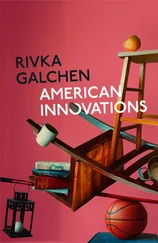
Rivka Galchen - American Innovations - Stories
Здесь есть возможность читать онлайн «Rivka Galchen - American Innovations - Stories» — ознакомительный отрывок электронной книги совершенно бесплатно, а после прочтения отрывка купить полную версию. В некоторых случаях можно слушать аудио, скачать через торрент в формате fb2 и присутствует краткое содержание. Год выпуска: 2014, Издательство: Farrar, Straus and Giroux, Жанр: Современная проза, на английском языке. Описание произведения, (предисловие) а так же отзывы посетителей доступны на портале библиотеки ЛибКат.
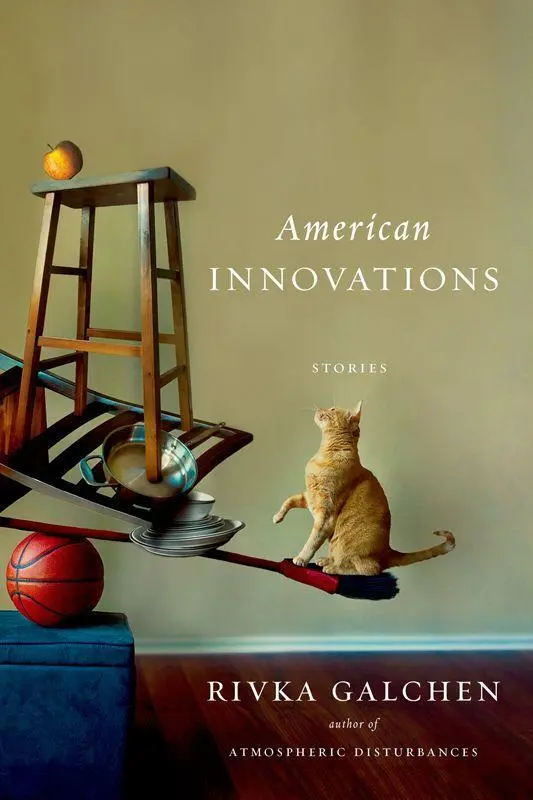
- Название:American Innovations: Stories
- Автор:
- Издательство:Farrar, Straus and Giroux
- Жанр:
- Год:2014
- ISBN:нет данных
- Рейтинг книги:4 / 5. Голосов: 1
-
Избранное:Добавить в избранное
- Отзывы:
-
Ваша оценка:
American Innovations: Stories: краткое содержание, описание и аннотация
Предлагаем к чтению аннотацию, описание, краткое содержание или предисловие (зависит от того, что написал сам автор книги «American Innovations: Stories»). Если вы не нашли необходимую информацию о книге — напишите в комментариях, мы постараемся отыскать её.
, a young woman’s furniture walks out on her. In another, the narrator feels compelled to promise to deliver a takeout order that has incorrectly been phoned in to her. In a third, the petty details of a property transaction illuminate the complicated pains and loves of a family.
The tales in this groundbreaking collection are secretly in conversation with canonical stories, reimagined from the perspective of female characters. Just as Wallace Stevens’s “Anecdote of the Jar” responds to John Keats’s “Ode on a Grecian Urn,” Galchen’s “The Lost Order” covertly recapitulates James Thurber’s “The Secret Life of Walter Mitty,” while “The Region of Unlikeness” is a smoky and playful mirror to Jorge Luis Borges’s “The Aleph.” The title story, “American Innovations,” revisits Nikolai Gogol’s “The Nose.”
By turns realistic, fantastical, witty, and lyrical, these marvelously uneasy stories are deeply emotional and written in exuberant, pitch-perfect prose. Whether exploring the tensions in a mother-daughter relationship or the finer points of time travel, Galchen is a writer like none other today.
American Innovations: Stories — читать онлайн ознакомительный отрывок
Ниже представлен текст книги, разбитый по страницам. Система сохранения места последней прочитанной страницы, позволяет с удобством читать онлайн бесплатно книгу «American Innovations: Stories», без необходимости каждый раз заново искать на чём Вы остановились. Поставьте закладку, и сможете в любой момент перейти на страницу, на которой закончили чтение.
Интервал:
Закладка:
I pulled my shirt back down. It was fitted but, thankfully, long.
Was this an inheritance?
I made myself sunny-side-up eggs. The newspaper informed me that a young volunteer worker at a large-cat reserve had been killed by a lion. Her parents said their daughter had been doing what she loved, there at the reserve; she had never been happier; protocol had been followed; it was a rare and tragic accident and not the result of carelessness; the parents did not blame the reserve; they listed the large-cat sanctuary as one of the charities to which mourners might elect to donate in lieu of flowers. I’m not saying I didn’t feel disfigured and humiliated. But I know such things are mainly a matter of mind.
* * *
Like the girl pounced on and accidentally killed by the large cat, I also was attempting to do something I loved. I was studying Library Sciences. I had always loved libraries. No one looks at you there, and you can look at everyone, so people probably are looking at you, just like you’re looking at them, but it’s all nice and quiet, and everyone can stay inside his or her headspace. But I hadn’t really known what library sciences was, and it turned out to be highly nonoverlapping with what I had deduced from the blurred, squinting assessment I had made of it from a distance with as little information—“information” being a word and concept I both dislike and distrust — as possible. Then it turned out I wasn’t even really in a Library Sciences program, I was in a Library and Information Sciences program, the core of which focused on “Humans becoming informed via intermediation between inquirers and instrumented records.” I was learning computer skills, basically. I was becoming trained as a searcher of databases. I was taking a metadata course on Indexing and Cataloging and another course on Knowledge Management.
That first day of my supernumeraryness I went to the school library for a timed assignment, done from my pale blue laminated tin carrel. It was a set of twenty query transformations. Query transformations are just what they sound like. A human has a curiosity — something simple, like, What are the seasons like in Mongolia? or less simple, like, How was gender represented in the literature of Heian Japan? — and ideally, the library information scientist will translate that curiosity into intelligently delimited searches in well-chosen databases that then return navigable information.
Whatever. Number twenty-one on the assignment was to generate one’s own query and query results. I chose not to query my body’s recent developments; even more than mirrors, Internet reflections combine the qualia of unflinching and unfaithful. I had once, via the Internet, tried to learn about the anthropologist Margaret Mead. After an hour I was left only with a strong impression that Mead’s primary intellectual contribution had been the adding of an s to the term “semiotic.” That, and having taken a female lover for much of her later life. I assumed, and continue to assume, that there are more important things to know about Mead, although how would I know?
At noon I attended a lecture given by Professor Sidwell. The lecture was about the problem of acidification — what to do about the hydrolysis of paper in books, the “slow fires” caused by the low pH levels of the paper commonly used for printing during certain key decades. Professor Sidwell had the same sloping posture my dad had had, and so I felt closer to him than in reality I was. Early on in the term, I’d had a conversation with him in the cafeteria in which he said that American cuisine had gone downhill since the 1940s. His grandmother had been a great cook, but she was the last of the Mohicans. I said, Wasn’t it at least an improvement to know about Chinese food? About soy sauce? No, he said. It wasn’t. Widely available refrigeration? I asked. No, Sidwell answered, refrigeration has been awful. Refrigeration has been absolutely catastrophic.
In the lecture that day Sidwell was saying, among other things, that the new de-acidification processes — there were several of them, and they were all bad — were leaving the treated paper with an unpleasant texture (the wrong texture), depositing powders, sometimes causing colored inks to run, and leaving clamp marks on books’ bodies. De-acidification was hastening destruction, not delaying it.
After the lecture I went up to Professor Sidwell, to see if he’d notice my altered self. Also just to say hello. “Ah, the refrigeration advocate,” he said. He barely looked at me. “Are things well in the land of the young and innovative?”
“I really liked the lecture,” I said. “I guess you’re damned if you do and damned if you don’t.”
“No, no, that’s not quite accurate,” he said. He looked me over. His tone softened notably as he said, “I don’t want you to take this in a negative way, I don’t mean it like that, but you remind me of my grandmother.”
“Interesting,” I said.
“I’m going to go ahead and ask you something. Have you become one of those macrobiotic people? Or vegans? I strongly recommend against it.”
I couldn’t tell if this was an acknowledgment of my alteration or just something else he was saying. No one else I saw that day had yet noticed anything. Though I had a five months pregnant classmate who had recently made a similar report: that no one had noticed.
And that was the day. I suppose I might have been more detained or disturbed by the change in my romantic prospects — either I had suffered a bad blow or, it was slimly possible, I’d received a tremendous boon — but I kind of knew where I was in my relationship cycle.
* * *
On Tuesdays, Wednesdays, and Fridays, when I had no afternoon classes, I worked at an after-school program for teenage girls, called GRLZ. Fridays were for Bardo exercises, which are “perceptual distortion” exercises. The week before, our Bardo exercise involved going to the grocery store with the goal of walking each aisle without touching anything, without buying anything, without even setting off the sensors for the automatic doors at the entrance, but, instead, following in and out other people who had set off the sensors. We spent an hour and a half like that. It was like practicing being a ghost.
The mechanism of Bardo activities is that they require total focus, but they also blank you out. I know these exercises sound stupid, I say to the girls, but they seem to work. Or at least to do something. The van ride home after the grocery store, for example, was very peaceful. Although one girl started crying. But in a very unobtrusive way. The girls in the program are — I wouldn’t say they are “difficult.” It is more that they have difficulties. Most of them are referred to GRLZ from the nearby pediatric clinic and have lupus, or eating disorders, or severe asthma, or early run-ins with alcohol and drugs.
That day we were staying close to home for Bardo. The local Mormon church provides GRLZ with a free space: a large, open-layout basement with pantry shelves holding gallon jars of peanut butter, vats of pickles, costumes from past Christmas pageants, cartons of colored pipe cleaners, hanks of yarn, reams of colored stationery, boxes whose labels cannot be trusted but that purport to contain Life cereal. I opened the Bardo notebook to a random page and began to read aloud from Activity #14: “‘Walk quietly around the space, touching nothing except the floor with your feet—’”
“We’re all touching air all the time,” interrupted Alina, the most frizzy-haired and isolated of the girls. “Air is a thing.”
“That’s true,” I said. “Very good. OK, ‘As you quietly walk around the space, pause to take note, almost like you’re a camera taking pictures, of perspectives or places or things that remind you of being dead.’”
Читать дальшеИнтервал:
Закладка:
Похожие книги на «American Innovations: Stories»
Представляем Вашему вниманию похожие книги на «American Innovations: Stories» списком для выбора. Мы отобрали схожую по названию и смыслу литературу в надежде предоставить читателям больше вариантов отыскать новые, интересные, ещё непрочитанные произведения.




Обсуждение, отзывы о книге «American Innovations: Stories» и просто собственные мнения читателей. Оставьте ваши комментарии, напишите, что Вы думаете о произведении, его смысле или главных героях. Укажите что конкретно понравилось, а что нет, и почему Вы так считаете.