Rivka Galchen - American Innovations - Stories
Здесь есть возможность читать онлайн «Rivka Galchen - American Innovations - Stories» — ознакомительный отрывок электронной книги совершенно бесплатно, а после прочтения отрывка купить полную версию. В некоторых случаях можно слушать аудио, скачать через торрент в формате fb2 и присутствует краткое содержание. Год выпуска: 2014, Издательство: Farrar, Straus and Giroux, Жанр: Современная проза, на английском языке. Описание произведения, (предисловие) а так же отзывы посетителей доступны на портале библиотеки ЛибКат.
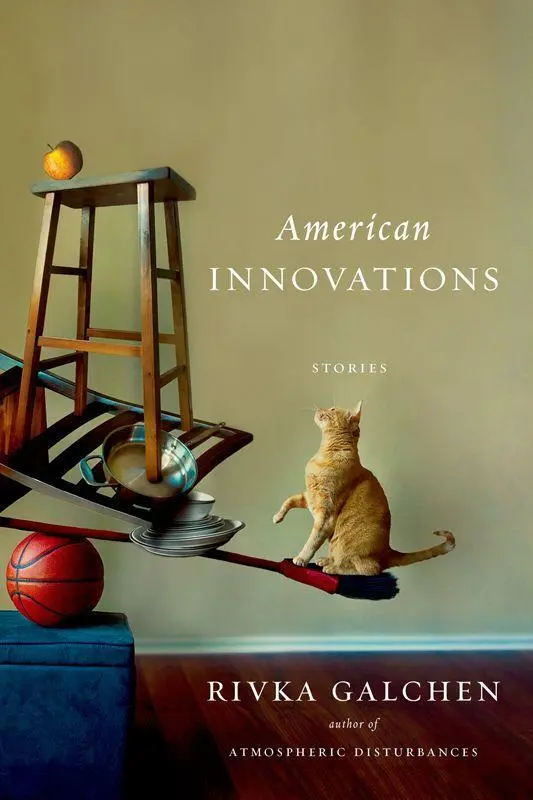
- Название:American Innovations: Stories
- Автор:
- Издательство:Farrar, Straus and Giroux
- Жанр:
- Год:2014
- ISBN:нет данных
- Рейтинг книги:4 / 5. Голосов: 1
-
Избранное:Добавить в избранное
- Отзывы:
-
Ваша оценка:
American Innovations: Stories: краткое содержание, описание и аннотация
Предлагаем к чтению аннотацию, описание, краткое содержание или предисловие (зависит от того, что написал сам автор книги «American Innovations: Stories»). Если вы не нашли необходимую информацию о книге — напишите в комментариях, мы постараемся отыскать её.
, a young woman’s furniture walks out on her. In another, the narrator feels compelled to promise to deliver a takeout order that has incorrectly been phoned in to her. In a third, the petty details of a property transaction illuminate the complicated pains and loves of a family.
The tales in this groundbreaking collection are secretly in conversation with canonical stories, reimagined from the perspective of female characters. Just as Wallace Stevens’s “Anecdote of the Jar” responds to John Keats’s “Ode on a Grecian Urn,” Galchen’s “The Lost Order” covertly recapitulates James Thurber’s “The Secret Life of Walter Mitty,” while “The Region of Unlikeness” is a smoky and playful mirror to Jorge Luis Borges’s “The Aleph.” The title story, “American Innovations,” revisits Nikolai Gogol’s “The Nose.”
By turns realistic, fantastical, witty, and lyrical, these marvelously uneasy stories are deeply emotional and written in exuberant, pitch-perfect prose. Whether exploring the tensions in a mother-daughter relationship or the finer points of time travel, Galchen is a writer like none other today.
American Innovations: Stories — читать онлайн ознакомительный отрывок
Ниже представлен текст книги, разбитый по страницам. Система сохранения места последней прочитанной страницы, позволяет с удобством читать онлайн бесплатно книгу «American Innovations: Stories», без необходимости каждый раз заново искать на чём Вы остановились. Поставьте закладку, и сможете в любой момент перейти на страницу, на которой закончили чтение.
Интервал:
Закладка:
In the spring of 2010, the daughter and the man broke up. The reasons for the marriage’s end are not clear, though there are theories. The main cause of the rapid appreciation in the value of real estate in that time has also not been satisfactorily determined, though there are, again, theories; one, again, tries to account for things. Regardless, the daughter wanted to use the money from the sale of the asset/apartment to buy herself an apartment/asset — an apartment/asset to live in as a home. The mother did not agree with or to this. The mother would not specify the location of what had previously been described as the daughter’s money, because the daughter was “not the daughter that I know because the daughter that I know is not a cruel person,” the mother said. She further said that the current daughter, the unknown one, could not be trusted, not with her own money, not with her own reproductive potential, not with anything, really. The daughter needed to go back home. To her husband’s apartment. To where she belonged. Whatever unhappiness and fears were keeping the couple apart were pure childishness. The mother said that the daughter had always done exactly as she (the daughter) wanted, that the daughter was lazy, and that women who don’t have babies become alcoholics, which ruins their figures. The daughter was thirty-three.
In 2010, the mother was in some ways financially stable and in some ways not. (It depends, of course, on the comparison group.) The mother often reported that she did not feel financially stable. The mother also was often trying to lose weight. Sometimes the two anxieties, weight and money, joined together. For example, in the fall of 2010, the mother signed up with the Jenny Craig Weight Loss program. The program entailed paying in advance for prepared meals. On Wednesdays, when she went to the Jenny Craig Centre [ sic ] for her appointment with her Jenny Consultant — the consultant being another service that she paid for in advance — the mother picked up the prepaid meals. In addition to the meal and the consultant expenses, the mother also, at the Jenny Craig Centre, purchased, for $190, a specialized armband, enabled with Bluetooth wireless technology, that kept track of walking speed, heart rate, calories burned, calories in and out, metabolic something-or-other … it was all confusing. The armband was supposed to be able to monitor and communicate. Sometimes the armband seemed to know she was moving and sometimes it didn’t. It beeped unpredictably. Also it flashed. For a few days the armband would not light up at all. Then it unexpectedly revived. Then it alarmed hourly. The armband was a failure; the mother wanted a refund. But, as the mother explained to her daughter, the Jenny Consultant said that, while it was true that Jenny Craig did sell the armband on-site at the Centre, and that the consultant and the program did both believe that the armband could be a positive friend in any weight loss or weight maintenance regimen, still, the armband was not a Jenny Craig armband per se, and the Jenny Craig Centre did not represent the armband, or the armband makers, nor did the armband or its makers represent the Jenny Craig Centre, and the Jenny Craig Centre did not even formally endorse the armband’s makers, or vice versa — there was no real relation — and so the mother needed to address her inquiries or complaints not to the Jenny Craig Centre but to the armband company directly. Whose number the Jenny Consultant would be happy to look up for her. The mother called the company directly. Her calls were not returned. The daughter also rarely returned the mother’s calls. The mother e-mailed the company. The mother and the daughter arranged via e-mail to meet up for coffee, and it was during that coffee that the mother explained that three days after e-mailing the armband company, she received an e-mail response: a FAQ sheet with the phone number she had already called listed at the bottom, for any further questions. Eventually, the mother said, she got through on the phone to someone who represented the company that represented the armband that was failing her. This representative suggested that the mother return the armband, in its original packaging. The representative further specified that the armband would, if it showed no signs of wear and tear beyond that incurred in normal use, be serviced and returned to the mother within four to six weeks. Are you just trying to stall until you can get rid of me? the mother said she said to the representative. The mother said she said to the representative that he was representing a company of cheaters. The mother hung up the phone, she said. Later that day, the mother explained to the daughter, she told the Jenny Consultant that the armband company had not helped, of course, that she had been encouraged to buy an armband from a charlatan company, that she had been encouraged by these people right here, in this office, these Jenny Craig people, who, the mother said that she said to the Jenny Consultant, obviously didn’t care about their customers, who didn’t have an ethic of customer service, who were just squeezing people for money. The mother said she said, You took my hundred and ninety dollars for what you knew was junk and now you’re just sending me to hell. You know that’s where you’re sending me when you send me to contact the company directly. I work in service. I like working in service. I like to help people. I know what an ethic of customer service is, the mother said, and it isn’t this. (The mother, at the time, post-corporate-job, was working as a real estate broker in the city; the real estate market was considerably weaker than it had been during the years of the aforementioned rise in value of the asset/apartment.) The mother said to the daughter that she really shouted at them, the Jenny Craig people, that she felt a little bit bad about that, but that what they did was wrong and they should know that what they did was wrong. But, she explained to the daughter, she did not need the Jenny Craig program anymore. She did not need them. Though she had lost ten pounds since she started with the program. Could the daughter tell? It’s not the first ten pounds, the mother explained, that anyone notices. It would probably be the next ten pounds that people would be able to notice, the next ten, which would of course be more difficult to lose, but she now knew what Jenny Craig did and so she could do it without Jenny Craig. She had cracked it. You eat twelve hundred calories a day. You make sure to get twenty grams of protein. Your meals are around three hundred and fifty calories, and then there’s room for two fruits. She said, I’m doing it like this: I’m making lentil dishes that are high in protein and low in calories. For example, I made a vegetarian chopped liver dip. One cup dry lentils, two cups water, one tablespoon onion soup powder, two large stir-fried onions, two hard-boiled eggs — all blended together. It’s delicious. You should try it, the mother said. That’s what I wanted to tell you about.
The daughter said she thought that sounded good.
Then they were quiet for a bit. Then the mother began to talk about how a friend of hers had cervical cancer; she’d never had children, the mother explained of her friend; it’s a risk to one’s health to never have children. I pray to God that you will have a child. You are a difficult person, but you can get pregnant, you can even just go to a clinic these days and get pregnant. There’s nothing wrong with that. The daughter put some sugar in her coffee, even though she almost never put sugar in her coffee. The mother reminded the daughter of the story of the cousin who had gotten pregnant, most likely from a clinic, the cousin who people said was a lesbian but, the mother said, was probably just never lucky with men, but it didn’t matter, because the cousin was so happy now, even though she had always been a very ill-tempered person before, and the mother said that she (the mother) would pay any medical expenses there might be, that she would help the daughter.
Читать дальшеИнтервал:
Закладка:
Похожие книги на «American Innovations: Stories»
Представляем Вашему вниманию похожие книги на «American Innovations: Stories» списком для выбора. Мы отобрали схожую по названию и смыслу литературу в надежде предоставить читателям больше вариантов отыскать новые, интересные, ещё непрочитанные произведения.










Обсуждение, отзывы о книге «American Innovations: Stories» и просто собственные мнения читателей. Оставьте ваши комментарии, напишите, что Вы думаете о произведении, его смысле или главных героях. Укажите что конкретно понравилось, а что нет, и почему Вы так считаете.