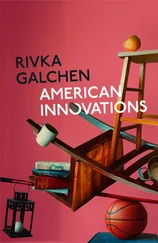
Rivka Galchen - American Innovations - Stories
Здесь есть возможность читать онлайн «Rivka Galchen - American Innovations - Stories» — ознакомительный отрывок электронной книги совершенно бесплатно, а после прочтения отрывка купить полную версию. В некоторых случаях можно слушать аудио, скачать через торрент в формате fb2 и присутствует краткое содержание. Год выпуска: 2014, Издательство: Farrar, Straus and Giroux, Жанр: Современная проза, на английском языке. Описание произведения, (предисловие) а так же отзывы посетителей доступны на портале библиотеки ЛибКат.
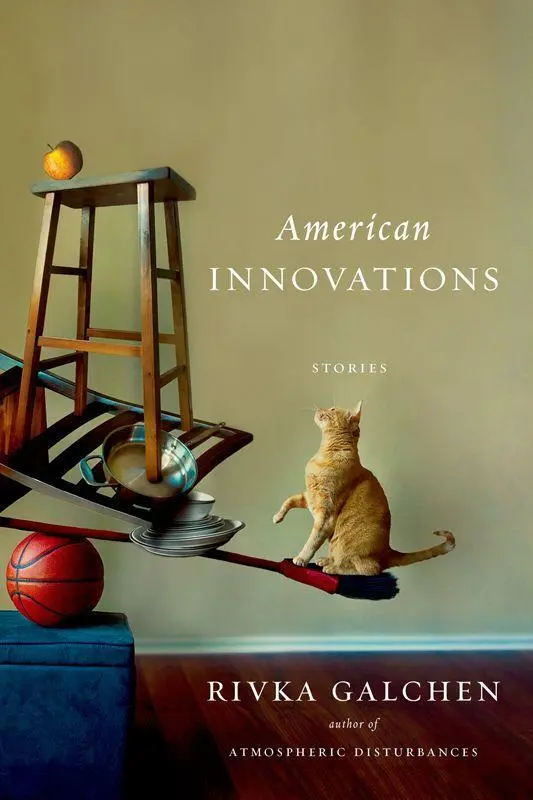
- Название:American Innovations: Stories
- Автор:
- Издательство:Farrar, Straus and Giroux
- Жанр:
- Год:2014
- ISBN:нет данных
- Рейтинг книги:4 / 5. Голосов: 1
-
Избранное:Добавить в избранное
- Отзывы:
-
Ваша оценка:
American Innovations: Stories: краткое содержание, описание и аннотация
Предлагаем к чтению аннотацию, описание, краткое содержание или предисловие (зависит от того, что написал сам автор книги «American Innovations: Stories»). Если вы не нашли необходимую информацию о книге — напишите в комментариях, мы постараемся отыскать её.
, a young woman’s furniture walks out on her. In another, the narrator feels compelled to promise to deliver a takeout order that has incorrectly been phoned in to her. In a third, the petty details of a property transaction illuminate the complicated pains and loves of a family.
The tales in this groundbreaking collection are secretly in conversation with canonical stories, reimagined from the perspective of female characters. Just as Wallace Stevens’s “Anecdote of the Jar” responds to John Keats’s “Ode on a Grecian Urn,” Galchen’s “The Lost Order” covertly recapitulates James Thurber’s “The Secret Life of Walter Mitty,” while “The Region of Unlikeness” is a smoky and playful mirror to Jorge Luis Borges’s “The Aleph.” The title story, “American Innovations,” revisits Nikolai Gogol’s “The Nose.”
By turns realistic, fantastical, witty, and lyrical, these marvelously uneasy stories are deeply emotional and written in exuberant, pitch-perfect prose. Whether exploring the tensions in a mother-daughter relationship or the finer points of time travel, Galchen is a writer like none other today.
American Innovations: Stories — читать онлайн ознакомительный отрывок
Ниже представлен текст книги, разбитый по страницам. Система сохранения места последней прочитанной страницы, позволяет с удобством читать онлайн бесплатно книгу «American Innovations: Stories», без необходимости каждый раз заново искать на чём Вы остановились. Поставьте закладку, и сможете в любой момент перейти на страницу, на которой закончили чтение.
Интервал:
Закладка:
I’d tip the carton back slowly in order to see what I dreaded seeing, just to feel that queasiness, and also the pre-queasiness of knowing the main queasiness was coming, the anticipatory ill. Beautiful, Horrible: I had a running mental list. Cleaning lint from the screen of the dryer — beautiful. Bright glare on glass — horrible. Mealworms — also horrible. The stubbles of shaved hair in a woman’s armpit — beautiful.
The Saturday I was to meet Roy, after dropping a cookie in the milk, I looked over, up at my dad. “Cookie,” I squeaked, turning a sour face at the carton.
He pulled out his worn leather wallet, with its inexplicable rust stain ring on the front. He gave me a dollar. My mom never gave me money, and my dad always gave me more than I needed. (He also called me the Queen of Sheba sometimes, like when I’d stand up on a dining room chair to see how things looked from there.) The torn corner of the bill he gave me was held on with yellowed Scotch tape. Someone had written on the dollar in blue pen, over the Treasury seal, “I love Becky!!!”
I go up to the counter with the Becky dollar to buy my replacement milk, and what I see is a tattoo, most of which I can’t see. A starched white long-sleeve shirt covers most of it. But a little blue-black lattice of it I can see — a fragment like ancient elaborate metalwork, that creeps down all the way, past the wrist, to the back of the hand, kinking up and over a very plump vein. The vein is so distended I imagine laying my cheek on it in order to feel the blood pulse and flow, to maybe even hear it. Beautiful. So beautiful. I don’t know why but I’m certain this tattoo reaches all the way up to his shoulder. His skin is deeply tanned but the webbing between his fingers sooty pale.
This beautiful feeling. I haven’t had it about a person before. Not in this way.
In a trembling moment I shift my gaze up to the engraved nametag. There’s a yellow M emblem, then “Roy.”
* * *
I place my dollar down on the counter. I put it down like it’s a password I’m unsure of, one told to me by an unreliable source. “Milk,” I say, quietly.
Roy, whose face I finally look at, is staring off, up, over past my head, like a bored lifeguard. He hasn’t heard or noticed me, little me, the only person on line. Roy is biting his lower lip and one of his teeth, one of the canines, is much whiter than the others. Along his cheekbones his skin looks dry and chalky. His eyes are blue, with bruisy, beautiful eyelids.
I try again, a little bit louder. “Milk.”
Still he doesn’t hear me; I begin to feel as if maybe I am going to cry because of these accumulated moments of being nothing. That’s what it feels like standing so close to this type of beauty — like being nothing.
Resolving to give up if I’m not noticed soon I make one last effort and, leaning over on my tiptoes, I push the dollar farther along the counter, far enough that it tickles Roy’s thigh, which is leaned up against the counter’s edge.
He looks down at me, startled, then laughs abruptly. “Hi little sexy,” he says. Then he laughs again, too loud, and the other cashier, who has one arm shrunken and paralyzed, turns and looks and then looks away again.
These few seconds seem like everything that has ever happened to me.
My milk somehow purchased, I go back to the table wondering if I am green, or emitting a high-pitched whistling sound, or dead.
* * *
It’s not actually the first time I’ve seen Roy I realize back at the table as, with great concentration, I dip my Hamburglar cookie into the cool milk. I think that maybe I’ve seen Roy— that coarse blond hair — every Saturday, for all my Saturdays. I take a bite from my cookie. I have definitely seen him before. Just somehow not in this way.
My dad appears to be safely immersed in whatever is on the other side of the crossword puzzle and bridge commentary page. I feel — a whole birch tree pressing against my inner walls, its leaves reaching to the top of my throat — the awful sense of wanting some other life. I have thought certain boys in my classes have pretty faces, but I have never before felt like laying my head down on the vein of a man’s wrist. (I still think about that vein sometimes.) Almost frantically I wonder if Roy can see me there at my table, there with my dad, where I’ve been seemingly all my Saturdays.
Attempting to rein in my anxiety I try to think: What makes me feel this way? Possessed like this? Is it a smell in the air? It just smells like beefy grease. Which is pleasant enough but nothing new. A little mustard. A small vapor of disinfectant. I wonder obscurely if actually Roy is Jewish, as if that might make normal this spiraling fated feeling. As if really what’s struck me is just an unobvious family resemblance. But I know that we’re almost the only Jews in town.
Esther married the gentile king, I think in a desperate absurd flash.
Since a part of me wants to stay forever I finish my cookies quickly.
“Let’s go,” I say.
“Already?”
“Can’t we just leave? Let’s leave.”
* * *
There’s the Medieval Fair, I think to myself in consolation all Sunday. It’s two weekends away. You’re always happy at the Medieval Fair, I say to myself, as I fail to enjoy sorting my stamps, fail to stand expectantly, joyfully, on the dining room chair. Instead I fantasize about running the french fry fryer in the back of McDonald’s. I imagine myself learning to construct Happy Meal boxes in a breath, to fold the papers around the hamburgers just so. I envision a stool set out for me to climb atop so that I can reach the apple fritter dispenser; Roy spots me, making sure I don’t fall. And I get a tattoo. Of a bird, or a fish, or a ring of birds and fish, around my ankle.
There is no happiness in these daydreams. Just an overcrowded and feverish empty.
At school on Monday I sit dejectedly in the third row of Mrs. Brown’s class because that is where we are on the weekly seating chart rotation. I suffer through exercises in long division, through bits about Magellan. Since I’m not in the front, I’m able to mark most of my time drawing a tremendous maze, one that stretches to the outer edges of the notebook paper. This while the teacher reads to us from something about a girl and her horse. Something. A horse. Who cares! Who cares about a horse! I think, filled, suddenly, with unexpected rage. That extra-white tooth. The creeping chain of the tattoo. I try so hard to be dedicated to my maze, pressing my pencil sharply into the paper as if to hold down my focus better.
All superfluous, even my sprawling maze, superfluous. A flurry of pencil shavings — they come out as if in a breath— from the sharpener distracts me. A sudden phantom pain near my elbow consumes my attention.
I crumple up my maze dramatically, do a basketball throw to the wastebasket like the boys do. I miss, of course, but no one seems to notice, which is the nature of my life at school, where I am only noticed in bland, embarrassing ways, like when a substitute teacher can’t pronounce my name. The joylessness of my basketball toss, it makes me look over at my once-crush Josh Deere and feel sad for him, for the smallness of his life.
One day, I think, it will be Saturday again.
But time seemed to move so slowly. I’d lost my appetite for certain details of life.
* * *
“Do you know about that guy at McDonald’s with the one really white tooth?” I brave this question to my dad. This during a commercial break from Kojak .
“Roy’s a recovering heroin addict,” my dad says, turning to stare at me. He’s always said things to me other people wouldn’t have said to kids. He’d already told me about the Oedipus complex, and I had stared dully back at him. He would defend General Rommel to me, though I had no idea who General Rommel was. He’d make complex points about the strait of Bosporus.
Читать дальшеИнтервал:
Закладка:
Похожие книги на «American Innovations: Stories»
Представляем Вашему вниманию похожие книги на «American Innovations: Stories» списком для выбора. Мы отобрали схожую по названию и смыслу литературу в надежде предоставить читателям больше вариантов отыскать новые, интересные, ещё непрочитанные произведения.


Обсуждение, отзывы о книге «American Innovations: Stories» и просто собственные мнения читателей. Оставьте ваши комментарии, напишите, что Вы думаете о произведении, его смысле или главных героях. Укажите что конкретно понравилось, а что нет, и почему Вы так считаете.