Rivka Galchen - American Innovations - Stories
Здесь есть возможность читать онлайн «Rivka Galchen - American Innovations - Stories» — ознакомительный отрывок электронной книги совершенно бесплатно, а после прочтения отрывка купить полную версию. В некоторых случаях можно слушать аудио, скачать через торрент в формате fb2 и присутствует краткое содержание. Год выпуска: 2014, Издательство: Farrar, Straus and Giroux, Жанр: Современная проза, на английском языке. Описание произведения, (предисловие) а так же отзывы посетителей доступны на портале библиотеки ЛибКат.
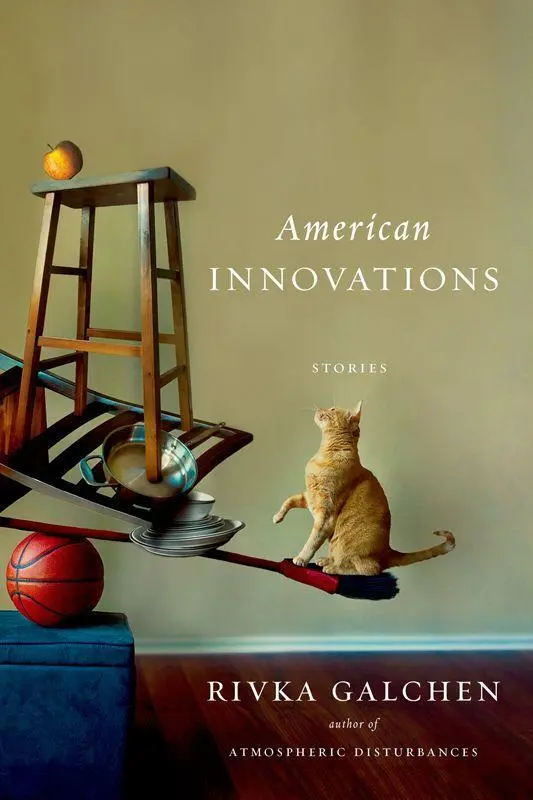
- Название:American Innovations: Stories
- Автор:
- Издательство:Farrar, Straus and Giroux
- Жанр:
- Год:2014
- ISBN:нет данных
- Рейтинг книги:4 / 5. Голосов: 1
-
Избранное:Добавить в избранное
- Отзывы:
-
Ваша оценка:
American Innovations: Stories: краткое содержание, описание и аннотация
Предлагаем к чтению аннотацию, описание, краткое содержание или предисловие (зависит от того, что написал сам автор книги «American Innovations: Stories»). Если вы не нашли необходимую информацию о книге — напишите в комментариях, мы постараемся отыскать её.
, a young woman’s furniture walks out on her. In another, the narrator feels compelled to promise to deliver a takeout order that has incorrectly been phoned in to her. In a third, the petty details of a property transaction illuminate the complicated pains and loves of a family.
The tales in this groundbreaking collection are secretly in conversation with canonical stories, reimagined from the perspective of female characters. Just as Wallace Stevens’s “Anecdote of the Jar” responds to John Keats’s “Ode on a Grecian Urn,” Galchen’s “The Lost Order” covertly recapitulates James Thurber’s “The Secret Life of Walter Mitty,” while “The Region of Unlikeness” is a smoky and playful mirror to Jorge Luis Borges’s “The Aleph.” The title story, “American Innovations,” revisits Nikolai Gogol’s “The Nose.”
By turns realistic, fantastical, witty, and lyrical, these marvelously uneasy stories are deeply emotional and written in exuberant, pitch-perfect prose. Whether exploring the tensions in a mother-daughter relationship or the finer points of time travel, Galchen is a writer like none other today.
American Innovations: Stories — читать онлайн ознакомительный отрывок
Ниже представлен текст книги, разбитый по страницам. Система сохранения места последней прочитанной страницы, позволяет с удобством читать онлайн бесплатно книгу «American Innovations: Stories», без необходимости каждый раз заново искать на чём Вы остановились. Поставьте закладку, и сможете в любой момент перейти на страницу, на которой закончили чтение.
Интервал:
Закладка:
“But do you think I can get it safely removed?” I asked. “Do you think my insurance will cover the surgery? It’s not considered just cosmetic, is it? I mean, it’s a pretty extreme case if it is. Would I need full anesthesia?”
“I can answer all those questions for you,” she said, deploying full eye contact. “And I will answer all those questions for you. But first I want to say”—and here her status as a pretty person seemed to flush her face with ordained assuredness—“you might want to think about this new part of yourself. Just take some time and think about it. Do you really want to change yourself just to suit fashion when you don’t even know what fashion will bring next? That may not be the person you want to be.”
The visit cost me $215. I appreciated that she had taken the time to really talk to me.
* * *
Spring came around. Flowers, I suspect they were daffodils, made their pronouncements. What were maybe dogwood blossoms decorated neighborhood trees. I started craving fruit popsicles. One evening, on the street, I by chance met a woman I had known back when I was in high school. She had distinctively large and wide-set eyes and had never seemed to have reached puberty; it might have been a medical thing; anyhow, it made her easy to recognize. She was in town to help design a duck pond for the campus, or really it was a sort of goose pond, she explained, a place to encourage Canadian geese to rest during their annual migrations. What a treat to see you, she said. You know, I wanted to write to you, she went on. To make sure you were OK. But I didn’t want you to feel singled out in that way. I hadn’t talked to you for so many years.
Don’t worry about it, I said. I’m just happy to have run into you.
I had no idea what she might be talking about. That evening I went ahead and investigated myself on the Internet.
Someone, probably one of the GRLZ, or one of the GRLZ’s friends, had pinned one of the more casually striking photos of my “condition” onto her Pinterest, which had gone to a number of other Pinterests, and Tumblrs, and other places I didn’t know about, and those images had synapsed and traveled and collided with other images, and commentary, and eventually become a Buzzfeed, yoked alongside what must have really driven the traffic, a photo of an actress from a remake of the movie Total Recall ; the woman — she played an alien or something — was three breasts across and wore an outfit that offered coverage of those breasts only via a strap across the nipples. She was fairly inarguably hot. Although somewhat arguably, as manifested in the comments sections. However, the majority of the censoriousness, ridicule, and loving support was directed not at the altered beauty from a fictional dystopic 2084 in a red dress and thigh-high black leather boots but, rather, at me. I was an ugly who needed to get over herself, or someone bravely making my own choices, or a fourth-wave feminist, or a symptom of fakesterdom, or a rebel against the tyranny of the “natural,” or a person who really, really needed help … It was unclear what I would learn if I read more, and I wasn’t sure I wanted to learn it. Though I did like one comment, in which someone wondered whether this was “a difference that made a difference.” He/she posited that that was what knowledge was: a difference that made a difference. The next comment compared me with eugenicists. I stopped reading. I wrote to administrators of the first few sites I had come across, in the cases where I was able to find a contact address; I asked, politely, if my photo could be taken down. It was, after all, a photo of me, an ordinary citizen who had not put herself forward. Only one person wrote back to me. He expressed understanding. He said he admired my courage in making a physical “statement,” and he invited me to participate in an interview series he curated, American Innovations, on his YouTube channel. There were freedoms from and freedoms to , he said. That was what made this country great, he said. Past participants had included the celebrity underwear designer Lorna Drew and the winner of Survivor Panama Aras Baskaukas.
I had once seen a hog at a farm. That hog must have weighed near on two thousand pounds, and she was in a little pen — not the worst conditions, merely depressing ones — and there were sores near her tail, which seemed to have been clipped off; the sores had attracted flies; she had many nipples, and they also looked like sores, and might have been cohabiting space with sores; her babies were not with her; she was quiet in her pen. I describe this because that was how I felt. I came across stories connecting soy consumption to extra-mammary development; another story of a plastic surgeon in Los Angeles who combined belly button removal with breast addition in a package deal. In Germany, some male soldiers were developing enlarged breasts from the repetitive recoil of shooting rifles. I’m not one of these people who are disheartened that the universe is expanding. But as news and data breed and the crowded channels grow ever noisier, I do feel that the space is ever increasing between me and it, whatever it might be. I didn’t call up my mom, or my aunt, or my previous boyfriend, or any of the boyfriends before that, either. I didn’t make a Facebook posting on which others might comment with generous sympathy. But I did feel very feminine. I went out and bought a mod kind of dress, sort of like a shift.
WILD BERRY BLUE
This is a story about my love for Roy, though first I have to say a few words about my dad, who was there with me at the McDonald’s every Saturday, letting his little girl, I was maybe nine, swig his extra half-and-halfs, stack the shells into messy towers. My dad drank from his bottomless cup of coffee and read the paper while I dipped my McDonaldland cookies in milk and pretended to read the paper. He wore gauzy striped button-ups with pearline snaps. He had girlish wrists, a broad forehead like a Roman, a terrifying sneeze.
“How’s the coffee?” I’d ask.
“Not good, not bad. How’s the milk?”
“Terrific,” I’d say. Or maybe “Exquisite.”
My mom was at home cleaning the house; our job there at the McDonald’s was to be out of her way.
And that’s how it always was on Saturdays. We were Jews, we had our rituals. That’s how I think about it. Despite being secular Israelis living in the wilds of Oklahoma, an ineluctable part in us still indulged certain repetitions.
* * *
Many of the people who worked at the McDonald’s were former patients of my dad’s: mostly drug addicts and alcoholics in rehab programs. A few plain old depressions. An occasional paranoid. The McDonald’s hired people no one else would hire; I think it was a policy. My dad, in effect, was the McDonald’s — Psychiatric Institute liaison. The McDonald’s manager, a deeply Christian man, would regularly come over and say hello to us and thank my dad for many things. Once he thanked him for, as a Jew, having kept safe the word of God during all the dark years.
“I’m not sure I’ve done so much,” my dad had answered.
“But it’s been living there in you,” the manager said. He was a nice man, admirably tolerant of the accompanying dramas of his workforce, dramas I picked up on peripherally. Absenteeism, petty theft, once a worker ODing in the bathroom. I had no idea what that meant, to OD, but it sounded spooky. “They slip out from under their own control,” I heard the manager say, and the phrase stuck with me. I pictured the right side of a person lifting up a velvet rope and leaving the left side behind.
* * *
Sometimes, dipping my McDonaldland cookies — FryGuy, Grimace — I’d hold a cookie in the milk too long and it would saturate and crumble to the bottom of the carton. There it was something mealy, vulgar. Horrible. I’d lose my appetite. Though the surface of the milk often remained pristine, I could feel the cookie’s presence down below, lurking. Like some ancient bottom-dwelling fish with both eyes on one side of its head.
Читать дальшеИнтервал:
Закладка:
Похожие книги на «American Innovations: Stories»
Представляем Вашему вниманию похожие книги на «American Innovations: Stories» списком для выбора. Мы отобрали схожую по названию и смыслу литературу в надежде предоставить читателям больше вариантов отыскать новые, интересные, ещё непрочитанные произведения.





Обсуждение, отзывы о книге «American Innovations: Stories» и просто собственные мнения читателей. Оставьте ваши комментарии, напишите, что Вы думаете о произведении, его смысле или главных героях. Укажите что конкретно понравилось, а что нет, и почему Вы так считаете.