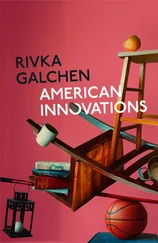
Rivka Galchen - American Innovations - Stories
Здесь есть возможность читать онлайн «Rivka Galchen - American Innovations - Stories» — ознакомительный отрывок электронной книги совершенно бесплатно, а после прочтения отрывка купить полную версию. В некоторых случаях можно слушать аудио, скачать через торрент в формате fb2 и присутствует краткое содержание. Год выпуска: 2014, Издательство: Farrar, Straus and Giroux, Жанр: Современная проза, на английском языке. Описание произведения, (предисловие) а так же отзывы посетителей доступны на портале библиотеки ЛибКат.
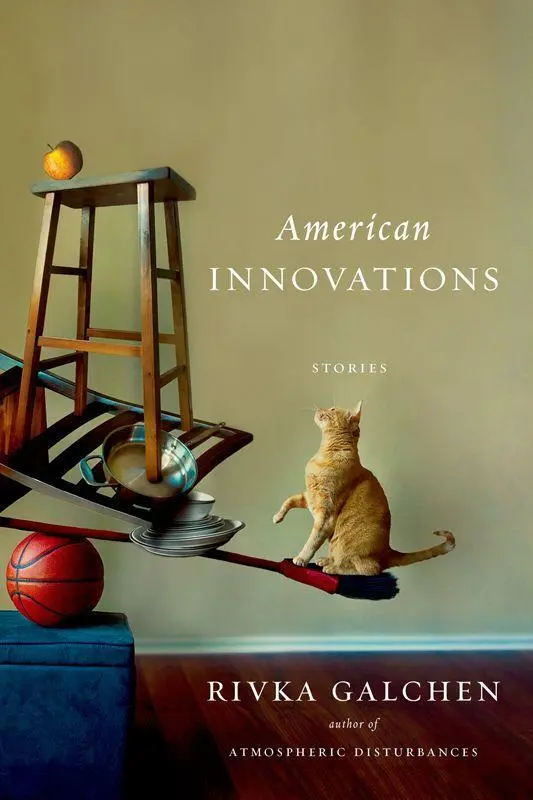
- Название:American Innovations: Stories
- Автор:
- Издательство:Farrar, Straus and Giroux
- Жанр:
- Год:2014
- ISBN:нет данных
- Рейтинг книги:4 / 5. Голосов: 1
-
Избранное:Добавить в избранное
- Отзывы:
-
Ваша оценка:
American Innovations: Stories: краткое содержание, описание и аннотация
Предлагаем к чтению аннотацию, описание, краткое содержание или предисловие (зависит от того, что написал сам автор книги «American Innovations: Stories»). Если вы не нашли необходимую информацию о книге — напишите в комментариях, мы постараемся отыскать её.
, a young woman’s furniture walks out on her. In another, the narrator feels compelled to promise to deliver a takeout order that has incorrectly been phoned in to her. In a third, the petty details of a property transaction illuminate the complicated pains and loves of a family.
The tales in this groundbreaking collection are secretly in conversation with canonical stories, reimagined from the perspective of female characters. Just as Wallace Stevens’s “Anecdote of the Jar” responds to John Keats’s “Ode on a Grecian Urn,” Galchen’s “The Lost Order” covertly recapitulates James Thurber’s “The Secret Life of Walter Mitty,” while “The Region of Unlikeness” is a smoky and playful mirror to Jorge Luis Borges’s “The Aleph.” The title story, “American Innovations,” revisits Nikolai Gogol’s “The Nose.”
By turns realistic, fantastical, witty, and lyrical, these marvelously uneasy stories are deeply emotional and written in exuberant, pitch-perfect prose. Whether exploring the tensions in a mother-daughter relationship or the finer points of time travel, Galchen is a writer like none other today.
American Innovations: Stories — читать онлайн ознакомительный отрывок
Ниже представлен текст книги, разбитый по страницам. Система сохранения места последней прочитанной страницы, позволяет с удобством читать онлайн бесплатно книгу «American Innovations: Stories», без необходимости каждый раз заново искать на чём Вы остановились. Поставьте закладку, и сможете в любой момент перейти на страницу, на которой закончили чтение.
Интервал:
Закладка:
I did feel a slight jet stream of having stumbled into an “advanced” exercise. “Take special note of the particular words, OK?” I went on, following the script. “It’s not about what reminds you of death . Or of dying . It says specifically: things that remind you of being dead . We can think about what that might mean.”
That’s when Brandee, who has lupus and nice manners, said to me, “You look sideways pregnant.”
“I’m not pregnant, but thank you for asking.”
“I didn’t say pregnant, I said sideways pregnant.”
“Do you guys have any questions about the exercise?” I asked. “Listen to your instincts. I’ll set the egg timer for forty-five minutes. Then we’ll regroup and discuss. Just try to relax into it.” The setting was ideal for the exercise, really. The fluorescent lighting glanced off the steel refrigerator in a way that was like not being in Kansas anymore.
“That’s what happens when you’re a bulimia,” another of the girls said. “The sideways thing.”
“No,” a third said. “When you’re a bulimia, your teeth are black and you cough blood. That’s where the idea of werewolves comes from, these hungry creatures with bloody mouths—”
“That’s not true. In bulimia you explode out your ribs—”
“That bleeding mouth stuff is about being inbred, it’s not bulimia—”
“I didn’t mean to start a thing,” quiet Brandee said.
I acknowledged to the girls that their curiosity and speculation were normal, even admirable. I made a simple announcement that it was a breast, what they were talking about. My hope was that we could then quickly move on.
“I think it looks hot,” said Lucille, the one GRL who herself was especially “hot” and who, when she arrived two weeks earlier, had unsettled the group dynamics just by looking the way she did. She was of the physical type, already full and curvy, of whom I’d heard men say that she was so ripe that one had to take her now, before she was rotten. Lucille snapped a photo of me with her phone. I asked her nicely to please not do that. She took several more photos. At least I liked the navy color of the fitted long tee I was wearing. My face looks best against dark colors. I would need more of these longer shirts, I noted to myself. Lucille went on: “You know those models, they’re all so, so flat, they have no breasts at all. They choose them as models because they look like young boys, you so totally know that’s what all those gays running the industry are dreaming of, of a world where even women are boys, they’re trying to convince us to wish we were boys, they’re trying to make us think like them , and that is so, so wrong. It’s like so wrong, and that’s why it’s so cool; it’s like you’re like saying, No, I am so definitely not a boy, not a man, very much not, like there’s no denying it.”
I repeated, to Lucille and to everyone, that I was setting the timer. I also reread the exercise prompt aloud, start to finish, one more time. I reemphasized that we were entering quiet Bardo time. And that was that. I sat on a costume trunk and waited for the minutes to pass. I like being near kids. It takes me out of myself; or, it does something. There had been a woman, Helen Magramm, whose children, two boys, I babysat when I was a teenager. I had no authority with those kids, and nearly every time one or both of them ended up crying before their parents returned home. I’m surprised neither was ever seriously hurt. One night years later, the boys were in high school, the husband woke up to his wife having a seizure in her sleep. It turned out she had a brain tumor. The tumor was resected and she recovered. Three years later the younger son was killed in a car accident. Eventually the mom, in her forties, was put in a nursing home, after a return of the tumor. I’d probably lived in seven different towns after I had last seen Helen Magramm; that was why, I think, I very rarely thought of her; I was away from almost all the triggers that might bring me back to being a teenager. Not too long ago, Helen appeared briefly in one of my dreams; and a couple of days later my mother told me Helen had died. That spooked me, naturally.
* * *
I decided to go see a professional about the breast.
The doctor had thick, long blond hair and a mild Russian accent; when she palpated my neck, a scent of eucalyptus that must have been her hand lotion or soap came to me. I trusted this doctor because a few months earlier I’d come to her about an intermittent ear pain I’d had for years — it was always in the same ear, and the pain was worse in the mornings, but I couldn’t predict which mornings it would be there — and with no fuss or imaging she had determined that my ear pain was heartburn manifesting as ear pain. A diagnostic trial of Prilosec had disappeared the problem. She told me an apparently-so story about how long ago, in an early pre-embryonic state, the ear’s nerve and the esophagus’s nerve had been intimates, and that it was a memory of this closeness that made the two areas confuse their pains, and that this intimacy persisted even as they were now distant. It was a fanciful, pastel-hued story, yes, but I mean, she cured me. After that solve, Dr. Jane Shliakhtsitsava seemed to me like a dragon slayer.
Also, I couldn’t help trusting her because she was very pretty.
I mentally absented myself as she examined the dorsal breast.
She asked me about heart palpitations, about night sweats, rapid weight gains, rapid weight losses. “Any major regrets?” she asked.
“I don’t think so,” I said.
“Losses you haven’t accepted?”
“Not really. I mean, I’m far from home. But I guess we’re all far, right?”
“Have you been trying to have children or adopt children? Or thinking about it?”
“No.”
“Have you lost a child?”
“Never.”
“Have you lost a loved one? Or love? Are you longing for your childhood?”
“I don’t get your line of questions,” I said.
“I ask these things,” she began, and her accent suddenly sounded false to me, “because it’s very common to manifest these things in our body. It’s nothing to be ashamed about. Your body speaks a language. It’s like a foreign language we all speak but have forgotten how to understand. Maybe you’ve heard of pseudocyesis, of women who develop all the signs and symptoms of pregnancy, even though they aren’t pregnant. There’s no shame in speaking in signs. You shouldn’t worry about the word ‘hysteria.’ It’s not just women who speak these languages. I think men are even more fluent in them—”
“Did you do your training in Oregon?”
“In Vladivostok,” she said. “But I’m always training. Even now I’m training.”
“I just want you to say whether I’m dying or not dying. Really, that’s it.”
She took out a green marker pen from her lab coat and wrote down two words in all caps on the white butcher paper of the exam table. “I understand you’re more interested in prognosis than diagnosis ,” she said, indicating the two words she had written. She paused. “That’s natural. I understand that. But I’m not so detained by either diagnosis or prognosis; what really interests me is simply gnosis .” She had underlined and was pointing to the stacked “gnosis” ends of the two words. “Gnosis itself.”
There had once been a TV show in which a gnu named Gary Gnu reported the gnews. “It seems like you don’t believe in illness,” I said.
“I believe in wellness,” Dr. Shliakhtsitsava said.
Her framed diplomas suggested she was normally certified; also, she had helped me before; you can’t be blinded to past goodness by the klieg lights of a little bit of odd.
Читать дальшеИнтервал:
Закладка:
Похожие книги на «American Innovations: Stories»
Представляем Вашему вниманию похожие книги на «American Innovations: Stories» списком для выбора. Мы отобрали схожую по названию и смыслу литературу в надежде предоставить читателям больше вариантов отыскать новые, интересные, ещё непрочитанные произведения.





Обсуждение, отзывы о книге «American Innovations: Stories» и просто собственные мнения читателей. Оставьте ваши комментарии, напишите, что Вы думаете о произведении, его смысле или главных героях. Укажите что конкретно понравилось, а что нет, и почему Вы так считаете.