Joseph O'Neill - Blood-Dark Track
Здесь есть возможность читать онлайн «Joseph O'Neill - Blood-Dark Track» — ознакомительный отрывок электронной книги совершенно бесплатно, а после прочтения отрывка купить полную версию. В некоторых случаях можно слушать аудио, скачать через торрент в формате fb2 и присутствует краткое содержание. Год выпуска: 2010, ISBN: 2010, Издательство: Knopf Doubleday Publishing Group, Жанр: Современная проза, на английском языке. Описание произведения, (предисловие) а так же отзывы посетителей доступны на портале библиотеки ЛибКат.
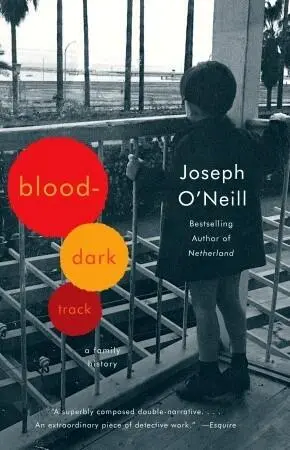
- Название:Blood-Dark Track
- Автор:
- Издательство:Knopf Doubleday Publishing Group
- Жанр:
- Год:2010
- ISBN:978-0-307-74265-0
- Рейтинг книги:4 / 5. Голосов: 1
-
Избранное:Добавить в избранное
- Отзывы:
-
Ваша оценка:
Blood-Dark Track: краткое содержание, описание и аннотация
Предлагаем к чтению аннотацию, описание, краткое содержание или предисловие (зависит от того, что написал сам автор книги «Blood-Dark Track»). Если вы не нашли необходимую информацию о книге — напишите в комментариях, мы постараемся отыскать её.
, a fascinating, personal, and beautifully crafted family history.
Joseph O'Neill's grandfathers-one Turkish, one Irish-were both imprisoned for suspected subversion during the Second World War. The Irish grandfather, a handsome rogue from a family of small farmers, was an active member of the IRA. O'Neill's other grandfather, a debonair hotelier from the tiny and threatened Turkish Christian minority, was interned by the British in Palestine on suspicion of being an Axis spy.
With intellect, compassion, and grace, O'Neill sets the stories of these individuals against the history of the last century's most inhuman events.
Blood-Dark Track — читать онлайн ознакомительный отрывок
Ниже представлен текст книги, разбитый по страницам. Система сохранения места последней прочитанной страницы, позволяет с удобством читать онлайн бесплатно книгу «Blood-Dark Track», без необходимости каждый раз заново искать на чём Вы остановились. Поставьте закладку, и сможете в любой момент перейти на страницу, на которой закончили чтение.
Интервал:
Закладка:
We spent the night at the Morris house, and the following morning drove towards the border. We were waved through the British army checkpoint, and very shortly afterwards approached — for the first time, in my case — the city of Derry.
The slogans, spray-painted on walls and hoardings in huge, brutal letters, hit us as soon as we entered the city. INLA. ALL PARTY TALKS NOW. RELEASE ALL P.O.W.S NOW. REPATRIATE NOW . We were in the Catholic part of Derry. The Protestant district lay on the other side of the Foyle, a beautiful and immense waterway that seemed altogether too magnificent for the small, gloomy city that rose in clusters of spires above the river’s foggy banks. Brendan drove carefully; one false turn and we could have been swept away on a current of one-way traffic across the river. We drove up to the Creggan, as the heights of south Derry are known, and then descended the hill to the Bogside, where the gable end of a destroyed terrace of houses was preserved and painted with the famous words, first daubed during the disturbances in the late ’sixties, You Are Now Entering Free Derry.
Brendan, who has his mother’s extraordinary memory for detail, was temporarily disoriented when we came to the Bogside. Changes had taken place since 1969 — blocks of flats had disappeared, new roads had been built — and it took him a few moments to reconcile the quiet new landscape with the urban battleground he had known. But we were in the right place, there was no doubt about that. Bunting strung out from garden rails to rooftops fluttered in celebration of St Columba, a 1400-year-old saint; kerbs and lamp-posts were painted green, white and gold; Irish tricolours fluttered from flagpoles; and huge, impressively detailed murals protested against the Orange parades through Catholic areas and exhorted remembrance of Bloody Sunday, 30 January 1972, when thirteen civilians were shot dead in the Bogside by British paratroopers.
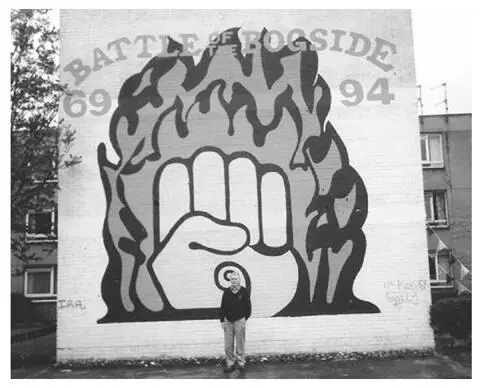
We dropped in on the Bogside Sinn Féin Advice Centre. It occupied a small terraced house and was staffed by four striking dark-haired young women. Brendan chatted to the woman in charge, explaining that this was his first visit to Derry since 1969 and that I was writing a book about the internment days. The young woman smiled and said a few words of welcome, and then mentioned an old-timer, Barney McFadden, who had been in the movement for over sixty years. Barney (born 1921) arrived a few minutes later, and we sat down to talk in the privacy of a back room of the Sinn Féin office. Barney and Brendan found common ground almost immediately, and for an hour or so the two exchanged information and names of old volunteers, almost all deceased. Barney spoke about the historical project that now occupied his time, which was to produce a list of all those volunteers in 1910–30 period — who included a Protestant, he was especially proud to say — who’d never been properly acknowledged by the republican movement.
When we left, Brendan was thrilled. ‘It feels great,’ he said, as we walked back to the car, ‘it’s like a warm hug you’re getting from the community.’ He looked at me with a grin. ‘It’s a real buzz, isn’t it? Don’t you feel at home here, really at home?’
I smiled at Brendan. It was intoxicating to have been taken into the very core of the republican struggle and to feel solidarity with my oppressed kinfolk, but of course I did not feel at home on the Bogside. How could I, when simply to open my English mouth exposed me to prejudice and mistrust? When my experiences and my outlook, informed by a middle-class European upbringing, were so different from those of the people here? The Sinn Féin woman at the Advice Centre had remarked to me, ‘We’re not sectarian here; Derry’s not like Belfast,’ and I couldn’t help marvelling, as we drove anxiously through suburbs daubed in red, white and blue, at the difference between her perspective and mine. As I saw it, a city divided into Catholic and Protestant halves was sectarian in character, and horribly so; and the assertion to the contrary, founded on a comparison with Belfast, was stunning. Was this woman unaware of the norms prevalent in the world outside the North of Ireland?
Brendan drove through Strabane and took a detour to Clady, Co. Tyrone, a small, untidy village that sits right on the border with the Republic. Near Clady, the river Finn is scruffy with weedy isles and broad enough to be spanned by a handsome stone bridge with seven arches. The quirk of the bridge is that its waist-high stone walls are serpentine; they wriggle along the flanks of the road in a series of bulges and nooks into which two or three men might crouch without being visible from a distance. In January 1957, Brendan’s IRA unit passed the night in these recesses, vainly waiting for British forces to respond to an explosion the unit had detonated. ‘We blew a crater around here,’ Brendan said, pointing to a spot on the bridge. ‘The object was to lure the enemy into an ambush. We waited all night in the cold but British troops never came. In the end, we narrowly avoided capture ourselves by the Free State Army.’
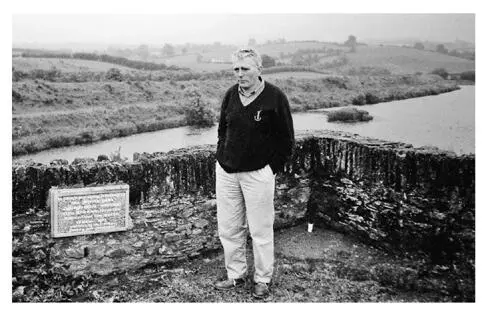
It was another foggy day, and the views up and down the river were of blurred green farmland. On one bank, just by the bridge, cows and horses grazed on thick scrub grass. I took a photograph of my uncle beside a plaque attached to the bridge commemorating an IRA man called Jim McGinn, ‘who was killed on active service’ on 15 December 1973. Brendan stood with his hands in the pockets of his khaki trousers. He was wearing a navy-blue V-necked golfing sweater and a button-down shirt with fine blue checks. His hair — a full head, grey and cut short and spiky — was like my father’s, and his eyebrows, silver and thick like my grandfather’s, lent further solemnity to the dour and heavy-hearted expression with which he gazed into the distance. It was an old-fashioned pose for the camera that spoke of the gravity of the republican enterprise and of the respect in which those who have given their lives for it are held, irrespective of how long ago they died; it also spoke of the extraordinary lengths to which the republican movement went to ensure that a volunteer’s sacrifices were the tinder of his tragic remembrance. This exclusive emphasis on suffering and self-denial was, of course, a little deceptive, because political activists, even those who may be secretive extremists, generally derive sustenance and gratification from their activities, which are, after all, voluntary, and which inevitably attract a certain kudos. To outsiders, IRA men personified menace; but to those inside the movement, they were good-hearted and lovable figures invested with a certain high-minded nobility — cavaliers, even.
We left Clady and headed south-east, via Omagh, through Tyrone, which genealogical tradition holds to be the ancestral territory of the O’Neill family. Tyrone is a fluvial county, and we crossed or drove by the Mourne, Derg, Strule, Fairy Water and Owenreagh rivers. As we approached the Blackwater river, whose course marks the border for a few miles, I asked Brendan what he thought ought to be the objective of settlement negotiations by Sinn Féin in the apparently imminent event of the IRA announcing a second ceasefire. Brendan said carefully, ‘There should be a declaration of British withdrawal from Ireland in twenty-five years’ time. Such a declaration, coupled with a ceasefire, would perhaps be a way forward. It would give unionists time to adjust to the reality of it,’ Brendan said.
Читать дальшеИнтервал:
Закладка:
Похожие книги на «Blood-Dark Track»
Представляем Вашему вниманию похожие книги на «Blood-Dark Track» списком для выбора. Мы отобрали схожую по названию и смыслу литературу в надежде предоставить читателям больше вариантов отыскать новые, интересные, ещё непрочитанные произведения.



Обсуждение, отзывы о книге «Blood-Dark Track» и просто собственные мнения читателей. Оставьте ваши комментарии, напишите, что Вы думаете о произведении, его смысле или главных героях. Укажите что конкретно понравилось, а что нет, и почему Вы так считаете.