Joseph O'Neill - Blood-Dark Track
Здесь есть возможность читать онлайн «Joseph O'Neill - Blood-Dark Track» — ознакомительный отрывок электронной книги совершенно бесплатно, а после прочтения отрывка купить полную версию. В некоторых случаях можно слушать аудио, скачать через торрент в формате fb2 и присутствует краткое содержание. Год выпуска: 2010, ISBN: 2010, Издательство: Knopf Doubleday Publishing Group, Жанр: Современная проза, на английском языке. Описание произведения, (предисловие) а так же отзывы посетителей доступны на портале библиотеки ЛибКат.
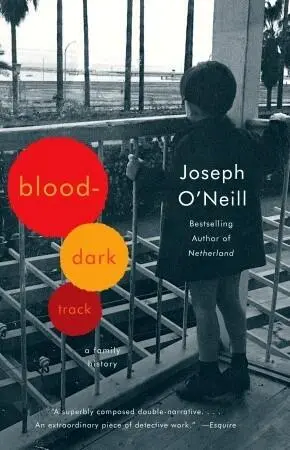
- Название:Blood-Dark Track
- Автор:
- Издательство:Knopf Doubleday Publishing Group
- Жанр:
- Год:2010
- ISBN:978-0-307-74265-0
- Рейтинг книги:4 / 5. Голосов: 1
-
Избранное:Добавить в избранное
- Отзывы:
-
Ваша оценка:
Blood-Dark Track: краткое содержание, описание и аннотация
Предлагаем к чтению аннотацию, описание, краткое содержание или предисловие (зависит от того, что написал сам автор книги «Blood-Dark Track»). Если вы не нашли необходимую информацию о книге — напишите в комментариях, мы постараемся отыскать её.
, a fascinating, personal, and beautifully crafted family history.
Joseph O'Neill's grandfathers-one Turkish, one Irish-were both imprisoned for suspected subversion during the Second World War. The Irish grandfather, a handsome rogue from a family of small farmers, was an active member of the IRA. O'Neill's other grandfather, a debonair hotelier from the tiny and threatened Turkish Christian minority, was interned by the British in Palestine on suspicion of being an Axis spy.
With intellect, compassion, and grace, O'Neill sets the stories of these individuals against the history of the last century's most inhuman events.
Blood-Dark Track — читать онлайн ознакомительный отрывок
Ниже представлен текст книги, разбитый по страницам. Система сохранения места последней прочитанной страницы, позволяет с удобством читать онлайн бесплатно книгу «Blood-Dark Track», без необходимости каждый раз заново искать на чём Вы остановились. Поставьте закладку, и сможете в любой момент перейти на страницу, на которой закончили чтение.
Интервал:
Закладка:
At that moment we arrived at the border village of Aughnacloy, where two armed and camouflaged British soldiers were stopping cars going south. We wound down our windows. ‘What is the purpose of your trip?’ asked one young soldier, inspecting the driver’s licence that Brendan had handed up at his request. ‘We’re going to Dublin,’ Brendan said. ‘We’ve come from Derry.’ ‘Brilliant, thank you,’ the soldier said as he handed back the licence. ‘Thank you,’ Brendan said politely, taking his time to replace the document in the proper compartment in his wallet. It was, in its way, a small gesture of political resistance: he was not going to be rushed in his own country by any British soldier.
We resumed our conversation. Brendan, elaborating on his earlier statement, said that in twenty-five years’ time the likes of Ian Paisley would be dead and a whole new generation would have grown up in the knowledge that the change would take place.
This proposition — that objections to a united Ireland would dissolve in the face of sufficient notice of unification — was obviously problematic, but I didn’t argue. Instead, I asked Brendan: ‘In what way does the use of violence promote the objective of British withdrawal?’
He began by saying that if it wasn’t for the civil rights movement in 1969, nothing would have been achieved.
‘No,’ I interrupted, ‘I don’t mean street violence — I mean the taking of life.’ I was referring to the three thousand and more people who had been killed by the various armed groups, republican and loyalist and British, since 1969.
‘Well,’ Brendan said, ‘there hasn’t in fact been much physical force of that kind used, apart from on the soldiers and RUC men.’
Too surprised to say much else, I said, ‘What has the killing achieved, though?’
‘Well,’ Brendan said, ‘it got rid of Stormont, for one thing; and it put Northern Ireland on the map.’
I sensed we were heading for a historical debate, so I said, ‘What I can’t see is how renewing the campaign of violence, after we’ve had the ceasefire, promotes the objective of British withdrawal.’
Brendan, who was driving, did not respond. A few moments later, seething slightly, he said, ‘Do you know, I know it’s hatred, but I’d probably want to shoot those two soldiers anyway, even if there was a settlement. I’d just want to do it.’
The atmosphere in the car had suddenly chilled. I decided to press on anyway. It was uncivil of me, but as Brendan well knew, anyone who — rightly or wrongly — expects thousands of others to submit to the experience of death and ruinous injury ought to be prepared to submit to the experience of argument. Besides, Brendan was an unorthodox, independent thinker whom I admired. I wanted to tap into his insights. ‘I’m just uncertain,’ I said, upping the stakes, ‘that the violence has achieved any more than thirty years of civil disobedience would have achieved. That’s why I can’t say that the killing has been necessary.’
Brendan drove on along the bending, tree-darkened road that took us through the Monaghan countryside. After a long silence, he said slowly, ‘Joseph, did you have to do military service in the English army?’
‘How do you mean?’ I said.
‘Oh, that’s right,’ Brendan said, still looking ahead, dawning comprehension in his tone, ‘you wouldn’t.’
Another silence descended. Now I was fuming, too, furious at the questioning of my patriotism — of my Irish nationality, even — and of my right to speak on the national question. Wasn’t my opinion as valid as anybody’s? Wasn’t it my country, too?
Then, looking at it from Brendan’s point of view, I could see why he might have reacted in the way he had. There are few things more provocative to Irish ears — even ears attached to a person of very mild views — than the sound of a voice in an English accent pronouncing on Ireland, a voice that packs into its drawling vowels centuries of racial condescension and seemingly ineradicable and wilful misconceptions about the rights and aspirations of the Irish people. For an Irishman, it can sometimes seem that there is no arguing with a voice of that kind, because it is precisely the voice of prejudice against arguments made by an Irishman. Did it lie in my English-sounding mouth to question Brendan? Why should he be confident that I was capable of understanding his viewpoint, that I was not regarding him through the eyes of a blinkered, indoctrinated member of the English establishment?
The fact was, I had spent no more that a year of my adult life in Ireland. As soon after my birth as they were able to, my parents removed me from Cork and set off on a global journey that took the family to Africa and Asia and finally, when I was six years old, continental Europe. When my father’s project in Rotterdam came to an end in 1975, the family stayed put while he worked in the fjords of Norway, the Borneo jungles and the Arabian deserts, flying back as often as he was able. Aside from a couple of years at the French Lycée in The Hague, I was educated at the British School in The Netherlands, an expensive yet unpretentious day school, where uniforms were worn and the English educational curriculum was followed. The students were mainly the children of diplomats and of scientists and technocrats working for large enterprises like the European Space and Technology Centre, Shell Oil, and Unilever. It was a multinational set-up: I had British, Italian, Gambian, Australian, Portuguese friends. We were all in the same boat, pleasantly adrift from our native land. Necessarily, our relationship with that place was, to a greater or lesser degree, fantastical. For the non-British, the matter was doubly complicated, since in addition to cultivating an expatriate conception of our place of origin we had to construct a relationship with England, whose culture and educational qualifications we were acquiring at school and whose universities and jobs beckoned. For those of us from two different non-British countries, things were triply unstraightforward; quadruply so if, like me and my siblings, you spoke Dutch and hung out for many years with Dutch friends; and, finally, quintuply tricky if, on top of the aforementioned complexities, you spoke French at home.
But it never occurred to me, faced with Turkish, English, Dutch and French possibilities, to relinquish or even question my identity as an Irishman — not even when, walking as a teenager in The Hague, a couple of Dutch girls I’d never seen in my life shouted ‘ Vuile Turk! ’ (Filthy Turk!) at me. I stoutly refused, as a cub scout of 1st The Hague, to utter the pack’s ritual oath of loyalty to the Queen of England. I supported Irish national sports teams, fantasized about an all-Ireland soccer team — imagine McIlroy, McGrath, Whiteside and Brady in the same XI — listened to the Irish records I found at home and, of course, pored over books by Irish writers. Then, in 1980, my father’s work took him to Aughinish Island, Co. Limerick, as project manager in the construction of a huge alumina processing plant. In January 1982, he got me a job there, too, as an unskilled ‘general operative’. It was a political education of a kind. On my first morning at work I joined the Irish Transport and General Workers’ Union, and on my first afternoon I went on strike: some welders had been dismissed by my father for refusing to work in the cold, bright weather, and the shop stewards had called on the men to ‘hit the gate’ in sympathy. So we did. When I got home that evening, I asked my father what I should do. ‘You’ll stay on strike until further notice,’ he said. ‘I’ll not have any scabs in this house. One more thing,’ he said, opening his newspaper as he sat down on the sofa. ‘You’re fired.’ A day or two later, everybody was reinstated and went back to work.
Читать дальшеИнтервал:
Закладка:
Похожие книги на «Blood-Dark Track»
Представляем Вашему вниманию похожие книги на «Blood-Dark Track» списком для выбора. Мы отобрали схожую по названию и смыслу литературу в надежде предоставить читателям больше вариантов отыскать новые, интересные, ещё непрочитанные произведения.



Обсуждение, отзывы о книге «Blood-Dark Track» и просто собственные мнения читателей. Оставьте ваши комментарии, напишите, что Вы думаете о произведении, его смысле или главных героях. Укажите что конкретно понравилось, а что нет, и почему Вы так считаете.