Joseph O'Neill - Blood-Dark Track
Здесь есть возможность читать онлайн «Joseph O'Neill - Blood-Dark Track» — ознакомительный отрывок электронной книги совершенно бесплатно, а после прочтения отрывка купить полную версию. В некоторых случаях можно слушать аудио, скачать через торрент в формате fb2 и присутствует краткое содержание. Год выпуска: 2010, ISBN: 2010, Издательство: Knopf Doubleday Publishing Group, Жанр: Современная проза, на английском языке. Описание произведения, (предисловие) а так же отзывы посетителей доступны на портале библиотеки ЛибКат.

- Название:Blood-Dark Track
- Автор:
- Издательство:Knopf Doubleday Publishing Group
- Жанр:
- Год:2010
- ISBN:978-0-307-74265-0
- Рейтинг книги:4 / 5. Голосов: 1
-
Избранное:Добавить в избранное
- Отзывы:
-
Ваша оценка:
Blood-Dark Track: краткое содержание, описание и аннотация
Предлагаем к чтению аннотацию, описание, краткое содержание или предисловие (зависит от того, что написал сам автор книги «Blood-Dark Track»). Если вы не нашли необходимую информацию о книге — напишите в комментариях, мы постараемся отыскать её.
, a fascinating, personal, and beautifully crafted family history.
Joseph O'Neill's grandfathers-one Turkish, one Irish-were both imprisoned for suspected subversion during the Second World War. The Irish grandfather, a handsome rogue from a family of small farmers, was an active member of the IRA. O'Neill's other grandfather, a debonair hotelier from the tiny and threatened Turkish Christian minority, was interned by the British in Palestine on suspicion of being an Axis spy.
With intellect, compassion, and grace, O'Neill sets the stories of these individuals against the history of the last century's most inhuman events.
Blood-Dark Track — читать онлайн ознакомительный отрывок
Ниже представлен текст книги, разбитый по страницам. Система сохранения места последней прочитанной страницы, позволяет с удобством читать онлайн бесплатно книгу «Blood-Dark Track», без необходимости каждый раз заново искать на чём Вы остановились. Поставьте закладку, и сможете в любой момент перейти на страницу, на которой закончили чтение.
Интервал:
Закладка:
The letter was dated 8 November 1942. It was written at the Hôpital du Liban, Beirut, while my grandfather was convalescing after his final attempt at suicide.
It was thanks to the Turkish consul in Beirut that my grandmother received the letter. In September 1942, Georgette Dakad temporarily entrusted the children to her sisters and boarded the Taurus Express in an attempt to see her husband in Lebanon. On the outward journey, she met un monsieur très raffiné who, no doubt intrigued by the well-dressed young woman travelling in mysterious solitude, propositioned her. My grandmother rejected the advance; but once the distinguished gentleman became aware of the purpose of her trip, he introduced himself formally as the Turkish consul to Beirut and put himself at her service. The consul, Rifki Bey, was not able to secure for my grandmother access to her husband, but he did pay a personal visit to the prisoner and passed him a letter and various items sent by Mamie Dakad. He also conveyed Joseph’s letter to Mamie Dakad. It was the first time she’d heard from him since his arrest more than five months earlier.
My grandmother had been facing an ordeal of her own. Georgette Dakad was a strong woman — as a strong as a man, her friends used to say — but she was devastated by her husband’s disappearance; and things got no easier after 28 April 1942, when she gave birth to a third child, Amy. (Whom, in fact, she named Claude. When the little girl finally met her father at three and half years of age, she was renamed after a nurse who had been good to him. ‘Your name shall no longer be Claude,’ her father informed her. ‘You are Amy now.’) In their father’s absence, the three children grew up surrounded by women. Their grandmother, Teta, lived in the house, and their mother’s spinster sisters Isabelle and Alexandra were a constant presence. My mother said that she was a happy young child. When she grew old enough to ask about her father, she was told that Papa was away on a business trip. Then one day a spiteful girl said to her in the course of a kindergarten tiff about hopscotch, ‘At least my father isn’t in jail.’
Prices in Mersin were very high and Georgette was forced to make savings. The racehorse, Tayara, was sold, as was the shop in which the valuable hoard of tin had been secretly deposited by my grandfather; and so (the story went) a fortune was mislaid. Georgette also had to take over the business of the Toros Hotel. This was not without its complications. The British, Mamie Dakad would later tell my mother, posted a spy in the hotel. Masquerading as a customer, he occupied the room near the office and stayed for some time, peeping and prowling around. One day, Georgette entered her office to discover that there had been a break-in. The safe was open, papers were scattered everywhere, but strangely the thousands of lira kept in the safe (a sum large enough to buy a property) were untouched. On another occasion, she was greeted on the stairs of the hotel by an eminent Axis guest — the German or Italian ambassador, my mother thought — and she immediately went to the British consulate to report the encounter before they heard it from anyone else. Otherwise, Mamie Dakad effectively withdrew from society. She saw to the hotel in the mornings and stayed at home in the afternoons, when she would do housework and play cards with trusted girlfriends like Kiki and Dora and Lolo. According to Lolo, my grandmother was right to be cautious. The war split Mersin into factions, and a partisan or ambiguous gesture or flippant remark could lead to trouble with the Turkish authorities.
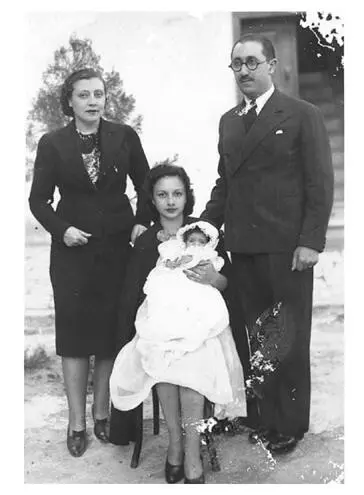
Georgette and Joseph, 1940. A family friend holds my infant mother.
In May 1943, the same month that Joseph Dakak was moved from the military hospital in Beirut to the monastery at Emuas, Denis Wright took over from Norman Mayers in Mersin. This was a significant development: according to my grandmother, Monsieur Wright helped her with sending and receiving letters, and he advised her not to invest hope and money in trying to secure her husband’s release but, rather, to await the end of the war. ‘I don’t remember giving her that advice,’ Wright said to me when I raised the subject, ‘but if I had advised her, that is the advice I would have given.’ ‘What do you remember?’ I asked. ‘I recall seeing her from time to time about her husband,’ Wright said. ‘I don’t recall much else.’ He added with a smile, ‘I take it you’ve read my letter about that party in Gözne.’
I had read it, in Wright’s volume of his letters home from Mersin. On the first weekend of September 1944, Wright went up to Gözne for ‘an end-of-season party arranged by the Vali but paid for by the Syrians’:
The Saturday evening dance took place in the garden of the coffee house: the Club orchestra was there and the refreshments were all prepared by the Syrians who complained that the Turkish women had done nothing to help with the fête.…
It was a rollicking party with a full moon shining down on us and all Gözne was there. The Syrians were as noisy as ever but seemed happier and less restrained in their own Gözne. I had a dance with Mme Dakad, the Toros Hotel woman whose husband is in one of our concentration camps in Syria or Palestine: it was the first time she had really amused herself in public since his arrest and the excitement of it all and the odd drinks she had had (and I gave her one which perhaps I shouldn’t have done) went to her head. She had a fit of crying and a sort of hysterics (by this time she had been removed from the dance floor to a room in the pub) shouting ‘ J’ai dansé avec M. Wright! Vive M. Wright! Vive le Consul d’Angleterre! ’ and repeating all this until she was forcibly taken home by Mme Carodi. She had recovered yesterday morning when I saw her playing poker — these Gözne Syrians play morning, afternoon and night daily and lose or win anything up to 300 liras a session, probably more. Mme Dakad has won about 3000 liras [about £410, which was more or less Wright’s annual salary] in the last few weeks, they say.
Denis Wright’s letters of the autumn of 1944 portrayed a more relaxed Mersin. The blackout was lifted, cricket matches were played at the ‘Braithwaites’ construction camp, and the consul represented Mersin in a tennis match. A jazz band played on the ‘millionairish’ seafront boulevard that was being built under the direction of the new Vali, Tewfik Gür. Jewish refugees bound for Cyprus passed through Mersin, and another excitement was the defection of an Austrian couple and a German who were working for German intelligence in Turkey — Herr and Frau von Kleckowski and Wilhelm Hamburgher. (The Americans had asked the British to smuggle them out of the country, and the trio stayed at the consulate before heading off to Syria on the Taurus Express.) Otherwise, life at the consulate passed quietly. On 11 November 1944, Mr Busk at the Ankara embassy noted, ‘The importance of Mersin has in the past lain in the fact that it was one of two accessible ports. We may hope that the Aegean will be shortly opened up and when this happens the importance of Mersin will sink to almost nothing.’
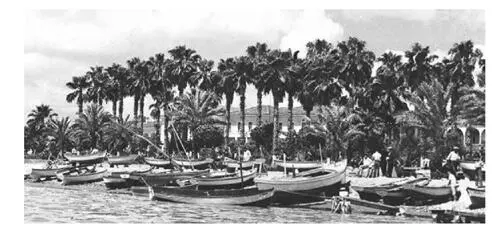
The old seafront at Mersin
And so, in January 1945, Denis Wright left Mersin for London. Before he left, he received a letter from my grandmother dated 9 January 1945 which he kept and later pasted in his album of memoirs. Mamie Dakad wrote (in French):
Mr Wright,
I have just learned of your departure and unfortunately there is not enough time to see you and thank you for all that you have been good enough to do for me. I hope that you will not forget me in Syria, because I must receive news from my husband.
Читать дальшеИнтервал:
Закладка:
Похожие книги на «Blood-Dark Track»
Представляем Вашему вниманию похожие книги на «Blood-Dark Track» списком для выбора. Мы отобрали схожую по названию и смыслу литературу в надежде предоставить читателям больше вариантов отыскать новые, интересные, ещё непрочитанные произведения.











Обсуждение, отзывы о книге «Blood-Dark Track» и просто собственные мнения читателей. Оставьте ваши комментарии, напишите, что Вы думаете о произведении, его смысле или главных героях. Укажите что конкретно понравилось, а что нет, и почему Вы так считаете.