Carole Maso - Ghost Dance
Здесь есть возможность читать онлайн «Carole Maso - Ghost Dance» весь текст электронной книги совершенно бесплатно (целиком полную версию без сокращений). В некоторых случаях можно слушать аудио, скачать через торрент в формате fb2 и присутствует краткое содержание. Год выпуска: 2013, ISBN: 2013, Издательство: Dzanc Books, Жанр: Современная проза, на английском языке. Описание произведения, (предисловие) а так же отзывы посетителей доступны на портале библиотеки ЛибКат.
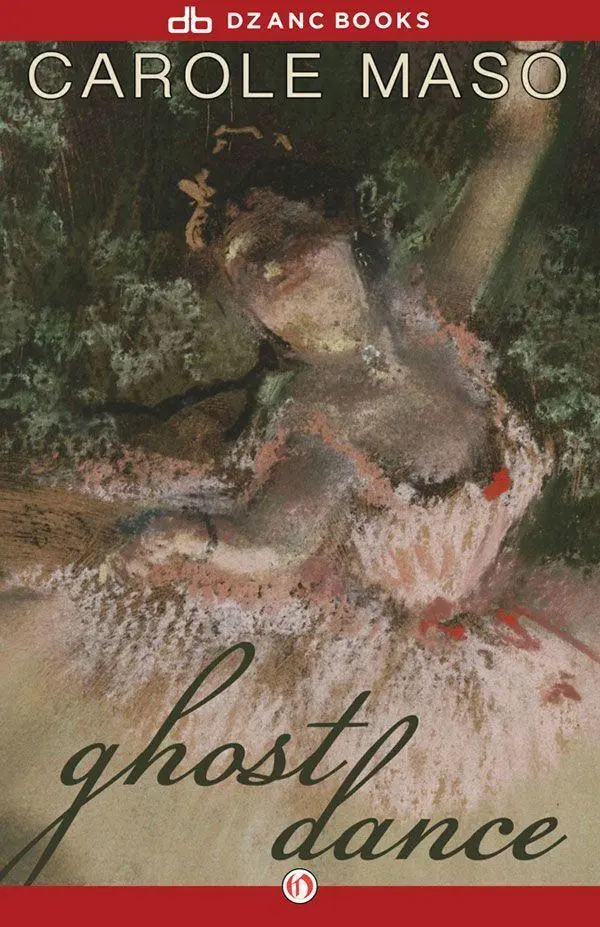
- Название:Ghost Dance
- Автор:
- Издательство:Dzanc Books
- Жанр:
- Год:2013
- ISBN:9781480441897
- Рейтинг книги:5 / 5. Голосов: 1
-
Избранное:Добавить в избранное
- Отзывы:
-
Ваша оценка:
Ghost Dance: краткое содержание, описание и аннотация
Предлагаем к чтению аннотацию, описание, краткое содержание или предисловие (зависит от того, что написал сам автор книги «Ghost Dance»). Если вы не нашли необходимую информацию о книге — напишите в комментариях, мы постараемся отыскать её.
has to offer. Like her artist-protagonists, Maso's subject as well as medium is language, and she is brave and dangerous in her command of it. She abandons traditional narrative forms in favor of a shaped communication resembling Beckett and rivalling his evocative skill. Immersed in dilated and intense prose, the readers view is a privilege one, riding the crest of clear expression as it navigates the tangled terrain of loss and desperate sorrow.
Ghost Dance — читать онлайн бесплатно полную книгу (весь текст) целиком
Ниже представлен текст книги, разбитый по страницам. Система сохранения места последней прочитанной страницы, позволяет с удобством читать онлайн бесплатно книгу «Ghost Dance», без необходимости каждый раз заново искать на чём Вы остановились. Поставьте закладку, и сможете в любой момент перейти на страницу, на которой закончили чтение.
Интервал:
Закладка:
“I love you, Mom,” I said, and the “m” sound hung in the air. It reminded her, I think, that she was a mother, that next to her was her daughter, in front of her son, and she smiled slightly, if only for my sake; and as I watched her smiling for my sake I knew for no particular reason that somehow this was the beginning of the end. How ridiculous, I said to myself as soon as the thought formed; I did not know what it meant, it was senseless, melodramatic, and still I believed it.
“We are each of us alone,” I thought.
My grandmother, dead two years, would think that on such a bright day such thoughts were inappropriate: my brother giving a public speech, the sky an impossible blue. But my grandmother could not see beyond primary colors, and this sky had too much white in it to be a true blue. I watched Fletcher against this backdrop.
He is a little boy fishing in the lake, catching trout, then throwing them back.
He is a little boy waking early to find his turtles, which he left outside overnight in a pail of water, eaten by birds, a tiny leg there, a piece of shell, a head bitten off and left.
He is a little older, up late, caught already in the excitement of primary politics, watching the young senator win California, then moments later fall mortally wounded.
He is older, sitting in the woods collecting moss and putting it in a basket.
He is older, looking at mushrooms under a microscope.
And there is my brother, sometime in the future, slumped over the edge of a stage, dejected, but I don’t know why.
He felt himself to be falling. He seemed to be struggling as he spoke to maintain his momentum, to keep up his energy. He was floundering in shallow water. He was doing all he could to stay afloat. Those who did not know him could not have realized that he was having trouble, but he was my brother and an intricate system of attachments bound us in a way not even we completely understood. He was having difficulty. My magnetic brother, the person who could convince anyone to follow him anywhere, my brother, whom hordes of people had followed wherever he asked them to go, now panicked. As he began I saw him take a deep breath and shake his head. Like an athlete he had prepared for this speech, done jumping jacks, run in place, but he was not feeling it. Something was wrong. It might all slip away as he spoke. He might wander off or his voice might falter. People would pull back. People would think him insincere or weak. This is what I detected in him. He worried through the speech that he was somehow not connecting, not getting through, holding back. Only the audience reaction, the donations of money, the number of volunteers proved otherwise. He had moved his listeners, illuminated the problems. In some new way they would see the situation. He had succeeded. He sighed. He felt such relief that tears fell from his eyes, and his arms and legs went limp.
As we neared him I could see that tiny lines had already begun forming in his face. The shadows cast in the bright sunlight were long and dramatic. Now that his speech was over, his thoughts turned inward, growing darker, and they kept him separate from his earthly vision, and his own pleasure at what he had accomplished that day was diminished. For a split second he knew it. What he had sensed somewhere in the beginning of his speech now was clear: what he hoped for with every cell of his body would not come true. He sat alone perched on the edge of the stage, a dark hawk (dark as the sky was light), inconsolable.
It is late afternoon. He is an old man. He stares at the bright orange wall of the house. His eyes burn. He looks down at his hands. His palm twitches. He knows this means he will soon strike someone or become angry.
Nothing moves — not the high grass, not the prairie dog, not the shriveled pods of yucca. All is the color of sand and dust. Rusted cans are strewn on the landscape.
Wood ages quickly here, worn by wind and rain. He looks out over the reservation and then further off at all he has lost. He sees a row of wooden boxes bleached gray. These tiny houses are like the coffins of white men: there’s no air. He sends a petition to the Great Spirit. “We can’t breathe in here. We lie down in here and die.”
It is the end. He walks into the kitchen, turns on the faucet: sound of metal, sound of dark water. He opens the refrigerator, closes it. “The young ones tell me I’ve got to forget the way it was,” and a smirk comes to his face. “When we forget, then surely we die. Once there were buffalo and elk and clear water. Once we roamed freely on the land.
“Give me back,” he rasps, “what you have taken.”
He walks into the other room. He turns on the television.
Fred Flintstone and Barney Rubble flip brontosaurus burgers on the grill in Bedrock in brilliant technicolor and plot how to sneak away to the Water Buffalo meeting without the girls finding out.
Lucy and Ethel have just begun work at a chocolate factory. They stand in front of the conveyor belt. The foreman tells them if one candy passes them and gets down to the packing room unwrapped, they’re finished.
A game-show host in heavy makeup smiles madly. “What is behind that curtain?” he asks a squealing audience.
“Come on down,” he calls out. “Mrs. Betty Loomis from Nashville, Tennessee, come on down! Let’s make a deal.”
Switch to a commercial: a woman in a nurse’s uniform breathes her mouthwash breath on a young doctor.
A man offers a woman a cup of coffee by a fire. Demurely she refuses. “It’s the caffeine,” she says, wrinkling her brow with puppy-dog sincerity. “But it’s decaf,” he says. “No, it can’t be. This rich?” she says in amazement, in adoration.
His voice quivers. “Give me back,” he says into the false smiles, “give me back,” he says into the antiseptic grins, into all the lies, “give me back what you have taken.”
Now as the orange and yellow and lime-green walls start to close in on him and he is beginning to have difficulty breathing, he closes his eyes and calls up the sacred land of the grandfathers. Slowly the walls recede and disappear.
Tears fall; tears have fallen for hundreds of years. The sun drops; the clouds turn pink and purple. Once he could call rain from the sky. “You must never forget,” he says.
He looks out the tiny window and sees his grandchildren reaching for the red medicine ball.
Lucy and Ricky, roses in their mouths, do the tango for the PTA at Little Ricky’s school.
In this fragile light which seems to change even as he observes it, the figures of the children dissolving, as he holds them, into a dusty background — in this light he calls up Butte Mountain where he can still go whenever he has to, in his mind. He reaches for it now.
“I dream of you,” he smiles,
“I dream of you jumping.
Rabbit,
Jackrabbit,
Quail.”
“We are killing people. There is no other way to see this,” Fletcher said in sorrow, standing paralyzed in his realization. “We fill the earth with the bones of those who beg simply to live out an average life: seventy years and the chance to work, but for many even that is not possible. This must change,” Fletcher burned, looking at Bill whose lungs had filled with asbestos.
Timmy Skofield was filled with questions.
Clifford kept saying, “I quit. I quit for good.” The deal he and Fletcher had made now seemed stupid. He had made the promise earlier that week that he would not quit at all for ten days and Fletcher in turn would take him out alone to any movie he wanted and afterwards for ice cream. It was the fifth day but now he kept saying, “I quit, I quit,” over and over. Fletcher was leaving. What Clifford had always known was still true: there was no one who would take him seriously, no one who could be trusted, relied upon, though life in the house with the other residents and Fletcher had seemed different somehow.
Читать дальшеИнтервал:
Закладка:
Похожие книги на «Ghost Dance»
Представляем Вашему вниманию похожие книги на «Ghost Dance» списком для выбора. Мы отобрали схожую по названию и смыслу литературу в надежде предоставить читателям больше вариантов отыскать новые, интересные, ещё непрочитанные произведения.






Обсуждение, отзывы о книге «Ghost Dance» и просто собственные мнения читателей. Оставьте ваши комментарии, напишите, что Вы думаете о произведении, его смысле или главных героях. Укажите что конкретно понравилось, а что нет, и почему Вы так считаете.